
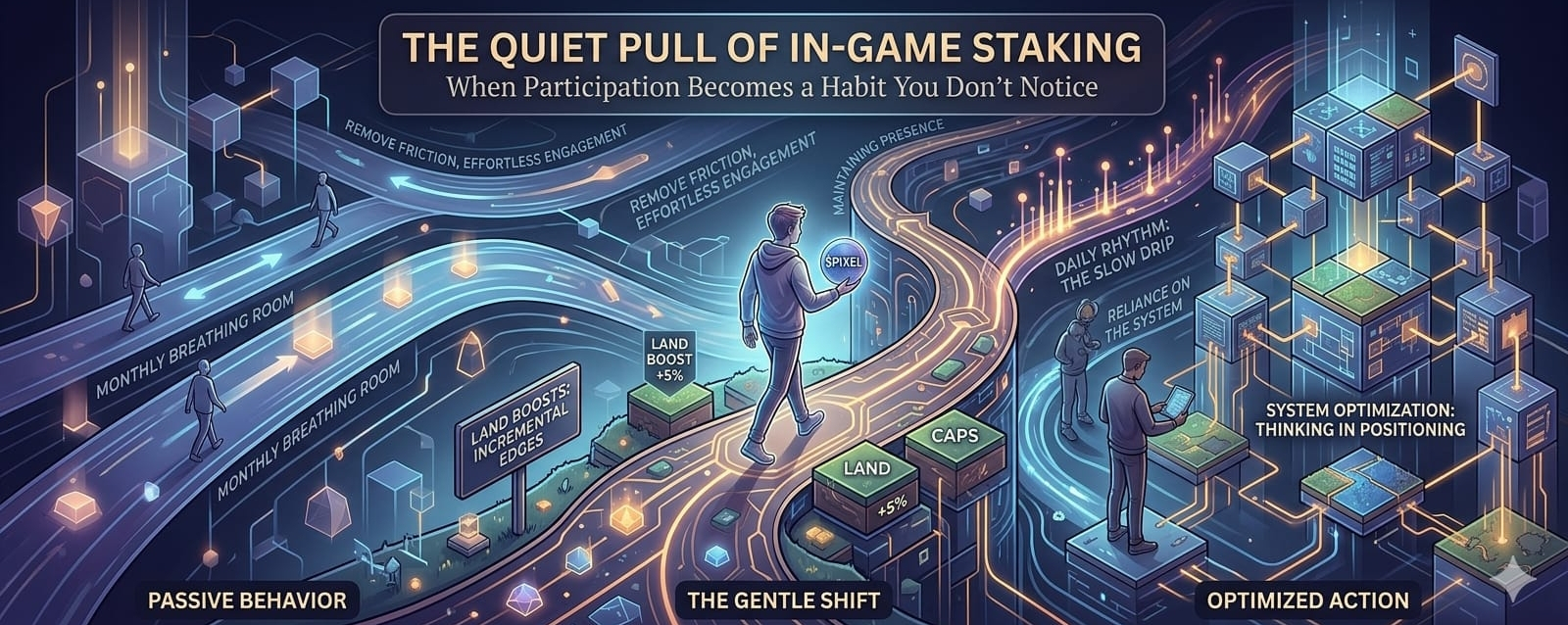
I keep finding myself circling back to this feeling—subtle, almost easy to ignore—that in-game staking isn’t just a feature sitting there waiting to be used, but something that quietly shapes the way we behave without asking for attention. It doesn’t interrupt you, doesn’t demand effort, doesn’t even try to impress. Instead, it just runs in the background, steady and patient, like it knows you’ll eventually adapt to its rhythm without realizing when that shift actually happened.
At first glance, it feels almost comforting in its simplicity. You hold your $PIXEL, you check in every so often, and everything else unfolds on its own. There’s no pressure, no constant decisions to make. The system handles the mechanics, calculates rewards, keeps things moving. It creates this soft sense of participation where you’re involved, but not burdened. And maybe that’s exactly why it feels so natural—because it removes friction to the point where engagement doesn’t feel like effort anymore.
But the more time I spend thinking about it, the more I start to question what happens when effort fades away like that. When something stops requiring intention, it slowly stops feeling like a choice. It turns into something quieter, more automatic. Not something you actively decide to do, but something you just… continue. Like checking your phone without thinking, or opening an app out of habit rather than purpose. And staking, in this form, begins to feel a little like that.
There’s this low, almost invisible threshold to remain part of it. A minimum balance, a simple login within a set period—nothing demanding, nothing that asks for real commitment. It doesn’t feel like participation in the traditional sense. It feels more like maintaining presence. Like the system is gently asking, “Are you still here?” and as long as the answer is yes, it keeps everything flowing without interruption.
What stays with me is how quiet that interaction is. There’s no push, no urgency. Just a soft continuity that doesn’t break unless you step away entirely. It’s almost like a space that remains open as long as you pass through it occasionally. No pressure to stay, but no noise when it closes either. Just a natural fading out if you stop showing up. And I keep wondering whether that kind of design keeps people connected, or slowly turns their involvement into something they don’t actively think about anymore.
Then there’s the layer introduced by land boosts, and that’s where things begin to feel a bit more intentional. The logic is straightforward—owning land strengthens your staking position, giving you a percentage boost that builds with each piece. It seems fair, even balanced on the surface, especially with caps in place to prevent things from stretching too far.
But small advantages have a way of evolving over time. They don’t stay small. They accumulate, quietly, consistently. One piece of land doesn’t change much on its own, but over time, those incremental edges start to create distance. Not dramatic gaps, not anything immediately obvious—but enough to shift positioning slowly. And that’s where behavior starts to change.
Land stops being something passive. It becomes a tool, something you use to enhance what you already have. And once that shift happens, the system begins to feel less like a neutral space and more like something that invites optimization. People start paying closer attention, adjusting their approach, thinking in terms of positioning rather than just participation.
It reminds me of how water behaves when it starts moving through uneven ground. At first, everything looks level. But as the flow increases, even the smallest differences begin to matter. Some paths carry more, not because they were designed that way, but because they had a slight advantage from the beginning. And over time, those paths deepen.
I don’t get the sense that anything here is broken. If anything, it feels carefully designed. But it also feels like it quietly creates layers, where progress isn’t defined by sudden leaps, but by steady, almost unnoticeable accumulation. And maybe that’s enough to reshape how people interact with it.
The shift in reward timing adds another dimension to this. Moving from monthly distributions to daily ones sounds like a clear improvement—more frequent feedback, a tighter connection between holding and earning. And in many ways, it probably is.
But it also changes the rhythm entirely.
Monthly rewards create space. You stake, and then there’s distance. Time passes. You don’t feel tied to the system in a constant way. You can forget about it for a while without feeling like you’re missing something immediate. There’s a kind of breathing room in that gap.
Daily rewards feel closer, more immediate. They create a pattern, a subtle pulse that repeats every day. It’s not overwhelming, but it’s consistent enough to draw your attention back again and again. Not in a demanding way, but in a way that’s hard to ignore completely. It’s like a slow drip—small, regular signals that keep reminding you the system is still there, still active.
And I keep wondering what that does to people over time. Does it deepen engagement, or does it create a quiet dependency on checking, observing, staying in sync with that daily rhythm? Shorter cycles tend to shift how we think. They reduce the distance between action and outcome, and when that distance shrinks, reactions become quicker, more frequent. Sometimes without giving space to step back.
There’s also this underlying layer of trust that sits beneath everything. When staking happens automatically, you’re not directly involved in each step. You’re relying on the system to function as expected, without needing constant verification. Most of the time, that trust feels natural, almost invisible.
But trust tends to reveal itself when something small goes wrong. A delay, a slight inconsistency, a moment where things don’t line up perfectly—these aren’t major disruptions, but they linger. They shift perception, even if only slightly. Like a minor slowdown in traffic that gradually builds tension, even when the cause isn’t clear.
And I keep thinking about how the system responds to that kind of everyday pressure. Not extreme situations, just the gradual build-up that comes from more users, more optimization, more expectations layered over time. Because no matter how stable a system is, behavior around it never stays still.
That might be the most complex part of all. This isn’t just mechanics or rules—it’s something that interacts with people, subtly guiding decisions, shaping habits, influencing how attention flows. It creates patterns that aren’t obvious at first, but grow stronger through repetition, through consistency, through design choices that feel almost too simple to question.
I don’t see it as a problem. But I do feel like it’s something worth noticing, especially while everything still feels calm and balanced on the surface.
Because sometimes, the most meaningful changes don’t arrive loudly. They don’t announce themselves. They build quietly, layer by layer, until one day you realize things feel different—and you’re not entirely sure when that shift began.
And I keep coming back to one thought that never quite settles.
If a system keeps running this smoothly, guiding behavior so gently in the background, at what point do we stop observing it—and start moving with it, without even realizing we already are?