
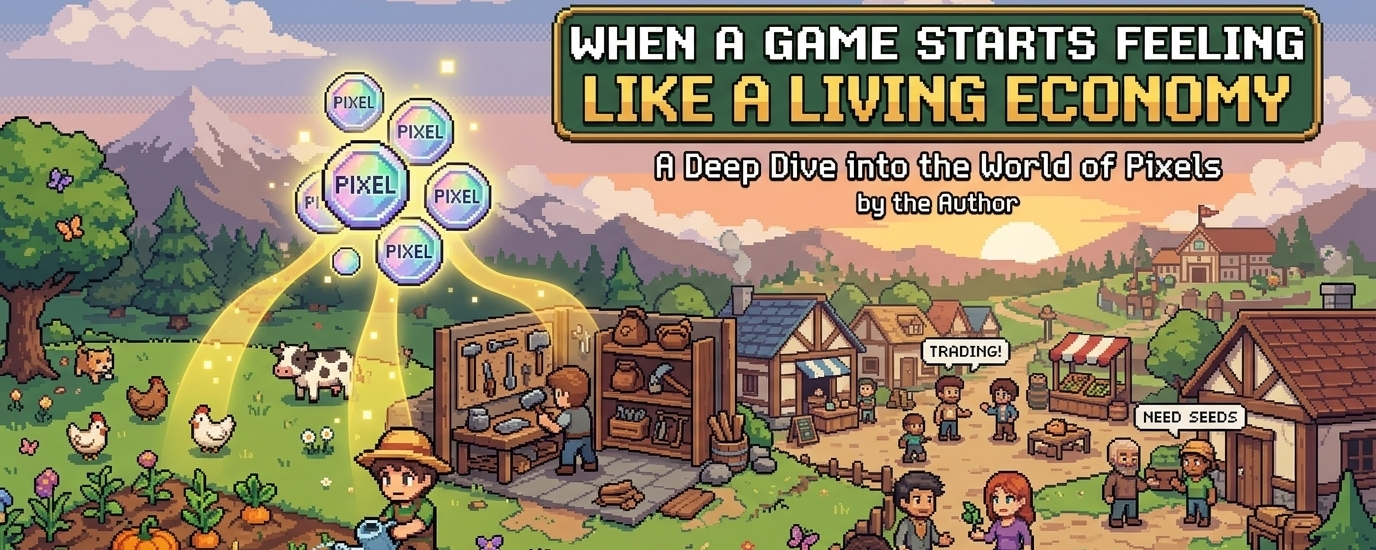
I've logged more hours in @Pixels than I ever expected to when I first clicked into its browser window a couple of years back. What drew me in wasn't any grand promise of riches or revolution just the quiet satisfaction of planting a row of crops under a low-resolution sky, watching them grow in real time while the chat window flickered with strangers trading seeds and stories. The game has always felt like a deliberate step back from the polished, hyper-detailed worlds that dominate most screens today. Its pixel art isn't a stylistic choice for nostalgia alone; it feels like a quiet insistence that complexity doesn't need high fidelity to matter. In a medium where every new release chases photorealism, Pixels reminds you that meaning can emerge from the smallest, most atomic units each square a potential foundation for something larger.
What lingers with me is how the blockchain layer sits beneath all that without ever shouting for attention. You own your land plots, your crafted tools, the pets that now trot alongside you in Chapter 2. None of it demands you treat the game like a second job. Instead, ownership arrives as a subtle shift in perspective: the harvest you sell today isn't just pixels vanishing into the ether; it's a piece of a persistent world that others can see and interact with long after you've logged off. I've watched friends pour weeks into perfecting a single farm layout, not because it yields the best returns, but because that patch of digital soil carries their signature. The economy anchored by the $PIXEL token handles the premium side of things: staking for small boosts, minting rarer items, unlocking conveniences that smooth the edges of daily play. It never pretended to be pure play-to-earn in the old sense. The real loop has always been the one between tending the land and tending the community that gathers around it.
Chapter 2 sharpened this feeling without rewriting the game's gentle core. Skills consolidated into broader categories, industries gained tiers, and new recipes layered in just enough depth to reward steady hands rather than frantic grinding. Pets arrived as companions rather than mere assets, and the bi-weekly updates have kept the world feeling alive rather than static. What stands out isn't the mechanical polish; it's the way these changes seem to respect the player's time. The game doesn't punish casual returns. You can step away for weeks, come back, and still find your plot waiting changed perhaps by seasonal shifts or neighborly collaborations, but fundamentally yours. In an age when most online spaces reset the moment you leave, there's something quietly radical about that continuity.
Even more intriguing is the direction the team has hinted at beyond a single game. Pixels positions itself as a platform now, a place where others might build their own experiences atop the same collectible infrastructure. Guilds, shared resources, and the slow expansion into multi-game territory suggest a future where ownership isn't confined to one farm or one map. Your progress, your creations, could travel. It evokes an older idea of the internet modular, extensible, built by many hands updated for an era when digital objects can actually be carried from one corner of the metaverse to another. Not every player cares about that horizon, of course. Most of us are still just here for the simple rhythm of planting and harvesting, the occasional late-night trade run with whoever happens to be online.
Yet the longer I play, the more I notice how these small decisions accumulate into larger questions about what we value in digital spaces. #pixel doesn't lecture or theorize; it simply lets you live inside the experiment. You watch your little pixelated avatar walk the same paths day after day, building something that outlasts any single session, and you start to wonder whether the boundaries between play and possession have always been thinner than we admitted. The world keeps updating, the token keeps circulating, and the farms keep growing each one a modest claim on a corner of the infinite grid. What we do with that claim, and what it does to us in return, remains an open question.