
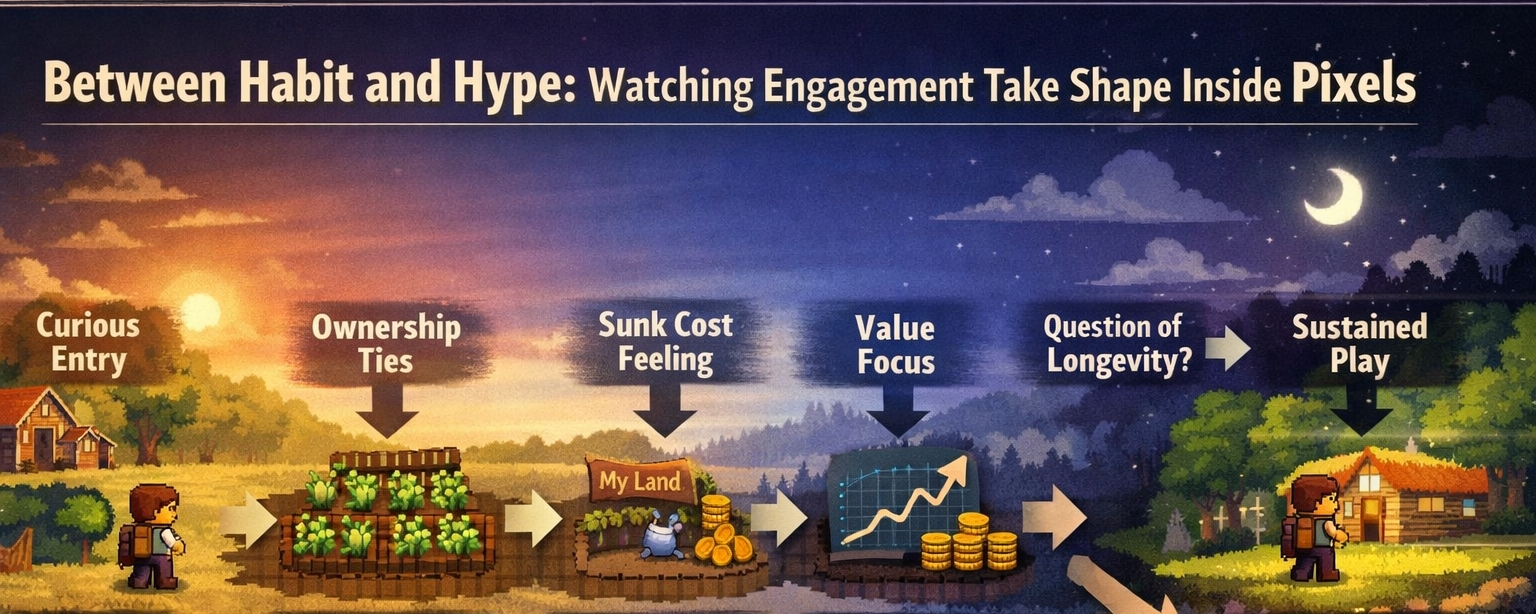
I’m watching how people actually move through it, not what they say about it, I’ve been noticing the small habits forming before any big opinions do, I focus on the quiet returns—the logins that don’t get posted anywhere, I keep seeing players drift back in almost automatically, I’m tracking how time slips into the system in short, repeatable bursts, I’m trying to understand whether Pixels is something people genuinely enjoy or something they slowly get used to, and the more I sit with it, the more it feels like the real story isn’t about farming or Web3 at all—it’s about how easily routine can start to feel like intention.
At first, it feels light. Almost harmless. You plant, you collect, you wander a bit. Nothing demanding, nothing overwhelming. That’s probably why it works. There’s no pressure to “commit,” so people don’t feel like they’re making a decision to stay—they just… don’t leave. And over time, that matters more than excitement. Excitement fades fast. Comfort doesn’t.
What I keep noticing is how ownership changes the tone without making a big announcement. The moment something becomes yours—land, items, progress—it quietly shifts your mindset. You don’t think, “this is fun,” you start thinking, “I should probably check on this.” It’s not heavy, not stressful, just a soft nudge in the back of your mind. And those nudges add up. They turn optional engagement into something that feels slightly expected.
The tech side, especially the Ronin Network, sits in the background, but it still shapes behavior. Even if players aren’t thinking about it directly, they feel it indirectly. There’s this underlying awareness that what they’re doing might have some kind of value outside the game. And that changes how people act. Slowly, without realizing it, they start making decisions not just for fun, but for outcome.
You can see it in how play evolves. Early on, people explore. Later, they optimize. Paths get shorter. Actions get faster. The world doesn’t shrink, but the way people move through it does. It becomes less about discovering what’s possible and more about repeating what works. That’s not necessarily bad—it just means the experience shifts from open-ended to patterned.
Still, there’s something quietly effective about how it all holds together. It doesn’t demand too much. It doesn’t punish absence. You can step away and come back without feeling behind. That kind of flexibility makes it easy to stay connected without feeling trapped. It’s not addictive in an obvious way—it’s just consistently there, waiting.
But the question that keeps sitting in the background for me is simple: what happens when the extra incentives start to matter less? When the rewards aren’t as interesting, when the novelty wears off, when people stop paying attention for reasons outside the game—what’s left?
Because right now, it feels like a mix of things keeping people here. A bit of curiosity, a bit of habit, a bit of potential value. And that mix works… for now. But if one of those pieces fades, the system has to rely more on the others. Eventually, it comes down to whether the core experience is enough on its own.
I don’t think Pixels has fully answered that yet. It’s good at pulling people in and giving them a reason to return. But long-term? That depends on whether those returns come from genuine interest or just quiet conditioning.
If I’m being honest, it feels like I’m watching something in the middle of becoming—not fully stable, not fragile either, just… in motion. And the real test isn’t happening right now while everything is active and engaging. It’ll happen later, when things slow down.
If people are still logging in then—not because they feel like they should, but because they actually want to—that’s when I’ll believe it’s real.