
Something about $PIXEL (@Pixels ) land feels too alive for what it’s supposed to be.
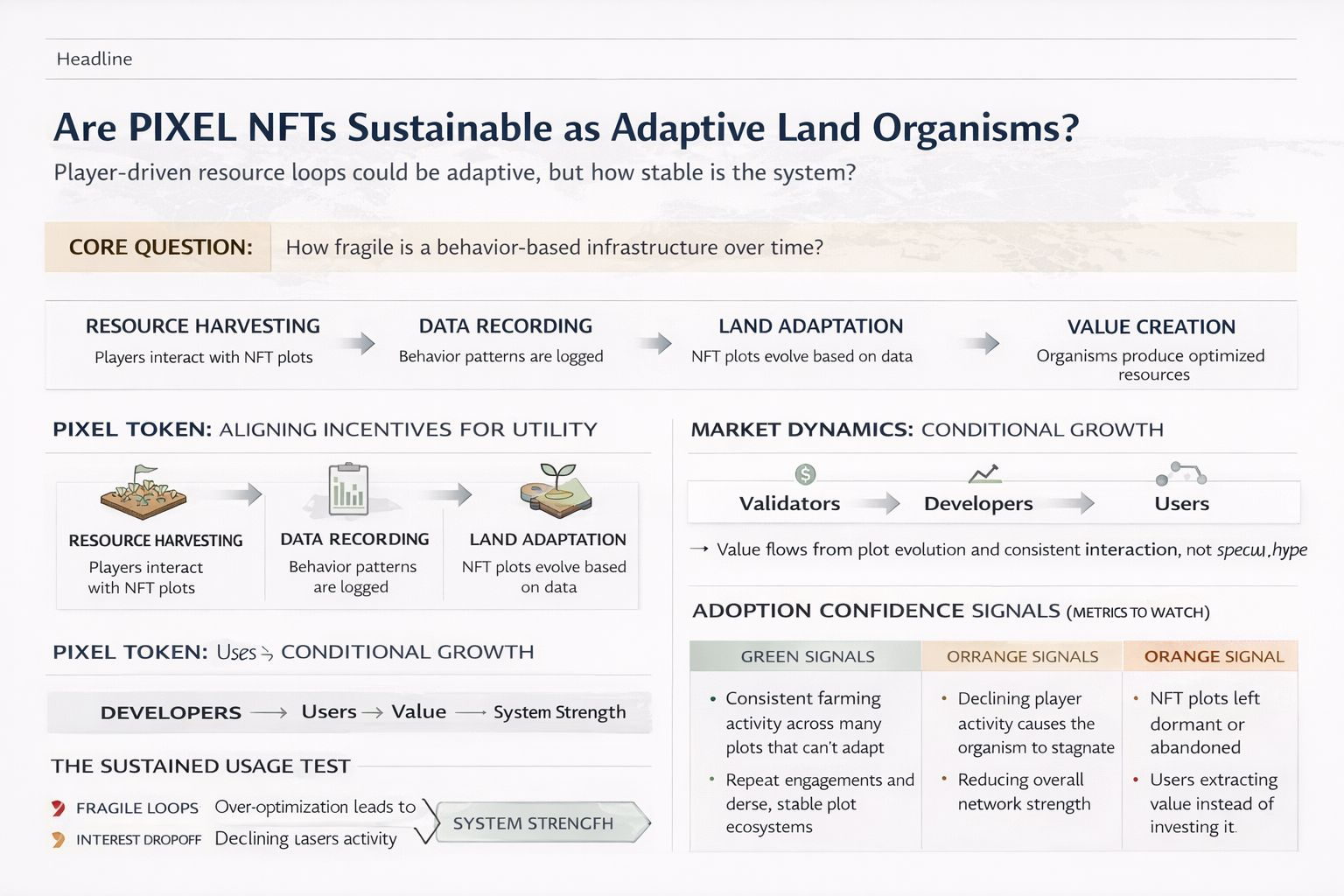
Not “alive” in the usual NFT way where people say it’s dynamic or evolving. This is different. It’s more like the land is quietly reacting… adjusting itself based on who touches it, how often, and why. And I can’t tell if that’s a feature or something we’re just not fully seeing yet.
Because when players farm on a plot, it’s not just yield being generated. It’s behavior being recorded, repeated, and reinforced. The land doesn’t just sit there producing—it starts to lean into whatever pattern is fed into it. More activity doesn’t just mean more output. It starts shaping the land’s role in the network.
That’s the first thing that feels off.
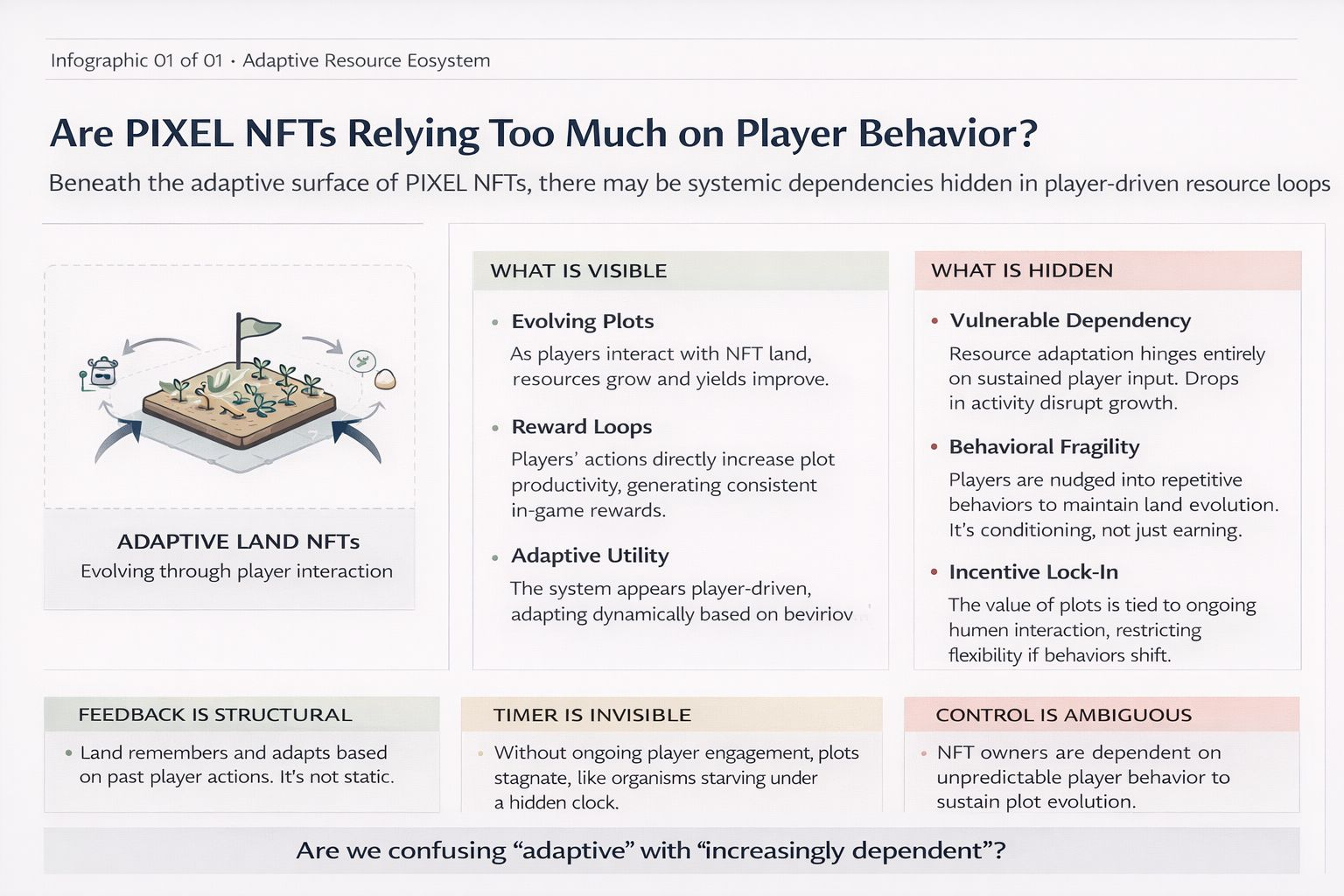
It’s not ownership anymore. It’s conditioning.
If one player consistently uses a piece of land for a specific resource loop, the system begins to orbit around that loop. The land becomes better at being used that way, not because of some upgrade button, but because the flow itself stabilizes. It’s subtle. You don’t notice it immediately. But over time, some plots feel like they’ve “settled” into a personality.
Which is weird to say about land.
And then there’s the second mechanism—dependency. The land doesn’t evolve in isolation. It needs players to keep interacting with it. No interaction, no progression. It’s almost like the land forgets what it was becoming if activity drops.
So now the NFT isn’t just an asset. It’s more like a loop that needs to be maintained. A system that requires continuous input to stay relevant.
That changes how you behave.
Because now you’re not just holding land—you’re managing attention. You start thinking less about “what do I own?” and more about “how do I keep this thing active?” And that shift is quiet, but it’s real. The system nudges you into becoming a coordinator, even if you didn’t sign up for that.
And here’s where it gets uncomfortable.
If the land evolves based on player-driven resource flows, then the real value isn’t the NFT itself—it’s the consistency of human behavior around it. The land is just a surface where that behavior gets stored.
So what are you actually owning?
Because if players leave, or just lose interest, the evolution stalls. The “organism” stops adapting. It doesn’t die exactly, but it becomes… static. And in a system like this, static feels like decay.
Which means the health of your asset is tied to something you don’t control.
That’s a strange position. It’s almost like running a small ecosystem where you don’t control the species inside it.
And people react to that in predictable ways. They optimize. They try to engineer repeatable loops. They incentivize others to interact with their land. Some even over-structure it, trying to lock in behavior so the flow never breaks.
But that creates another tension.
The more you try to control the system, the less “organic” it becomes. The land stops evolving naturally and starts reflecting forced patterns. It becomes efficient, sure—but also fragile. Because if those forced behaviors break, there’s nothing underneath holding it together.
It’s like building a perfectly optimized routine that only works as long as nothing changes.
And things always change.
There’s also this psychological layer that’s easy to miss. When players realize that their actions are shaping the land over time, they start acting differently. Not freely, but strategically. Every move becomes a small input into a larger system. It’s less “play” and more “maintenance.”
The system isn’t rewarding players.
It’s training them.
Training them to repeat behaviors that keep the ecosystem stable. Training them to think in loops, not moments. And once you see that, it’s hard to unsee.
Because now the question isn’t “is this land valuable?”
It’s “is the behavior around this land sustainable?”
And that’s not something you can measure with a floor price.
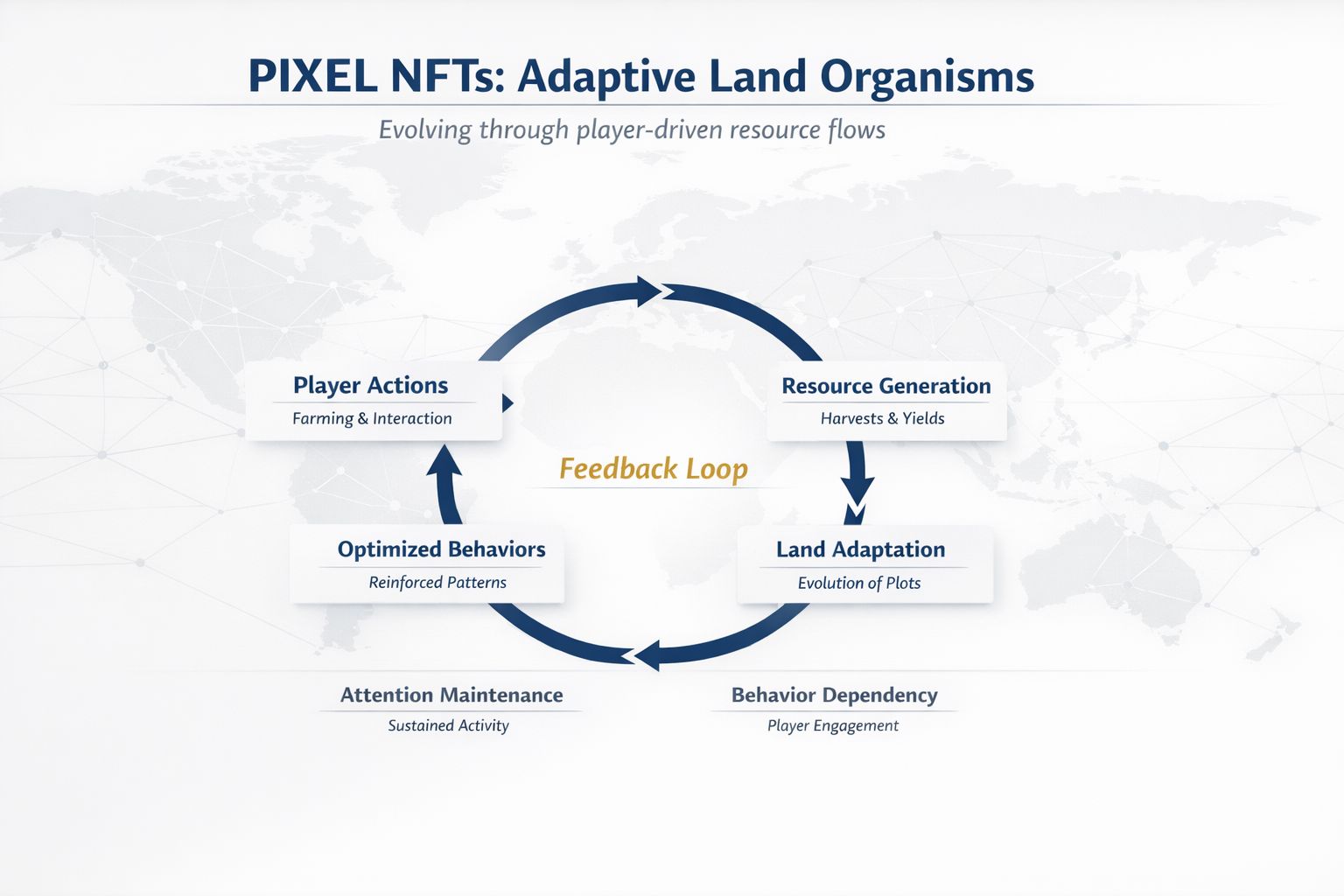
What really gets me, though, is how all of this connects. Player actions → resource flows → land adaptation → more optimized behavior → tighter loops. It feeds into itself. A closed system that looks stable on the surface, but underneath, it’s constantly negotiating between freedom and control.
Too much freedom, and the system becomes chaotic.
Too much control, and it becomes brittle.
So where does it settle?
I’m not sure it does.
Because if these land NFTs are truly adaptive organisms, then they’re only as stable as the behavior feeding them. And human behavior… isn’t exactly known for being stable.
Which makes me wonder—
are we watching land evolve…or just watching patterns of human attention harden into something that looks like evolution?
