

It didn’t really ask for my attention at first.
Pixels looked like something I already understood before even touching it. A farming loop, a shared world, a token somewhere underneath holding it all together. I’ve seen that structure enough times to know how it usually goes. It starts simple, builds momentum, and then slowly turns into something driven more by extraction than experience.
So I didn’t feel any urgency to get into it.
It kept appearing in the background though, mostly around the Ronin Network. That made it harder to completely ignore. Ronin has a certain gravity in this space. Not because everything on it succeeds, but because enough has happened there to make you pay a little more attention than usual.
When I finally spent time with Pixels, what stood out wasn’t anything it claimed to be. It was how little it tried to convince me of anything.
There’s no strong push at the beginning. No moment where it tries to hook you with rewards or urgency. You just start doing small things. Planting, harvesting, moving around. It feels almost uneventful at first, like the game is waiting to see if you’ll stay rather than trying to make you stay.
And that changes how you approach it.
The token, PIXEL, exists, but it doesn’t immediately shape your behavior. You’re not constantly thinking about maximizing it, at least not in the early experience. It sits in the background instead of pulling everything toward it.
That alone makes it feel different, though not necessarily better. Just… quieter.
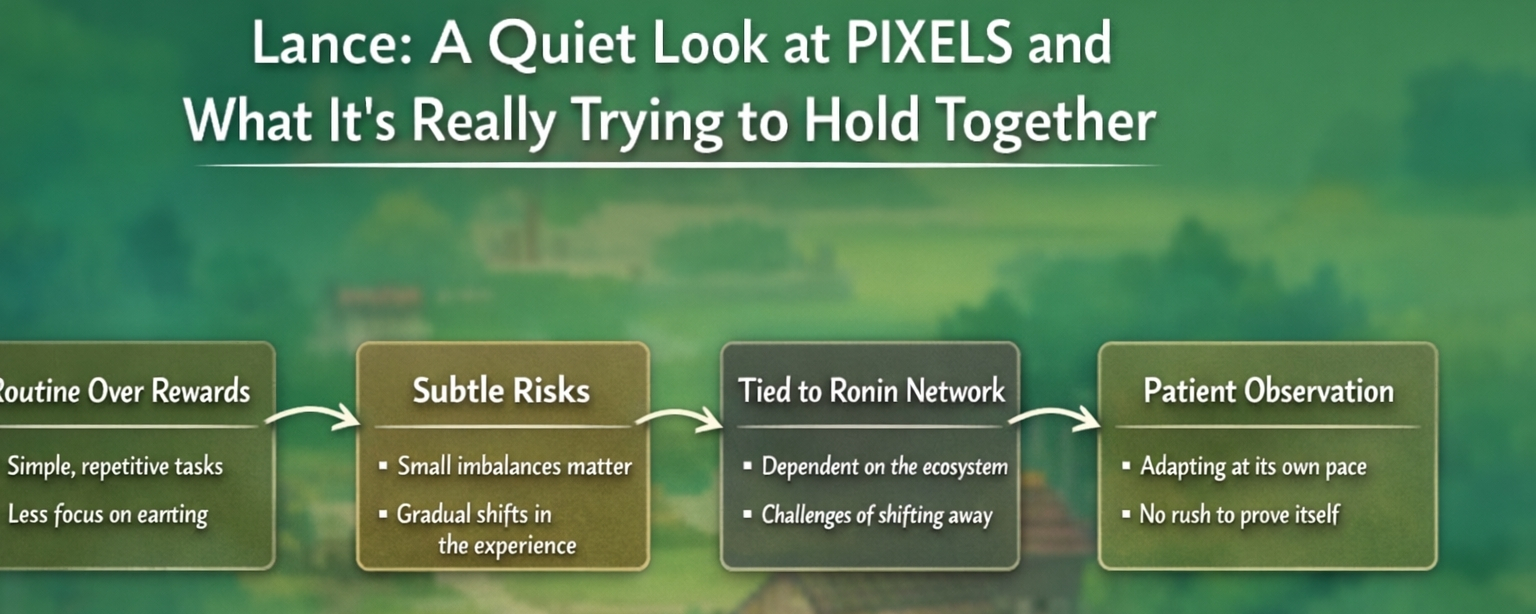
After a while, you start to notice that the game isn’t really built around rewards in the usual sense. It’s built around repetition. Small loops that don’t feel important on their own, but begin to form a kind of rhythm if you stick with them.
That’s where it becomes more interesting.
Not because it suddenly reveals something impressive, but because it doesn’t. It stays consistent in its simplicity. And that makes you wonder what it’s actually trying to do underneath all of that.
It feels like Pixels is testing whether a game in this space can hold attention without constantly giving people a reason to stay. Whether routine can replace incentives, at least to some degree.
I’ve seen a lot of projects try to solve engagement by adding more—more rewards, more mechanics, more pressure to participate. Pixels seems to be moving in the opposite direction. It removes some of that pressure and lets the player decide how much they want to invest.
That sounds reasonable, but it’s also fragile.
Because when you rely on something as subtle as routine, small changes matter more. If the progression starts to feel slow, people notice. If the world feels even slightly empty, it becomes harder to ignore. If players begin focusing more on extracting value than actually playing, the balance shifts quickly.
And none of those things happen all at once. They build gradually, which makes them harder to respond to.
There’s also the fact that Pixels is closely tied to Ronin. That connection gives it a stable environment for now, but it also means it doesn’t fully stand on its own. If the network changes, or if attention moves elsewhere, Pixels will have to move with it—or struggle to.
It’s not a flaw you feel immediately, but it’s there in the background.
What keeps me watching it isn’t excitement. It’s more of a quiet curiosity.
It hasn’t followed the usual pattern yet. It hasn’t tried to overwhelm the player or inflate its own importance. It’s just there, running, letting people engage with it in a way that feels almost indifferent to outcomes.
That doesn’t guarantee anything.
If anything, it makes the outcome harder to predict.
But it’s enough to make me check in from time to time. Not because I expect it to become something big, but because it hasn’t given me a clear reason to write it off either.
And in a space where most things become obvious too quickly, that uncertainty is still worth sitting with for a while.