
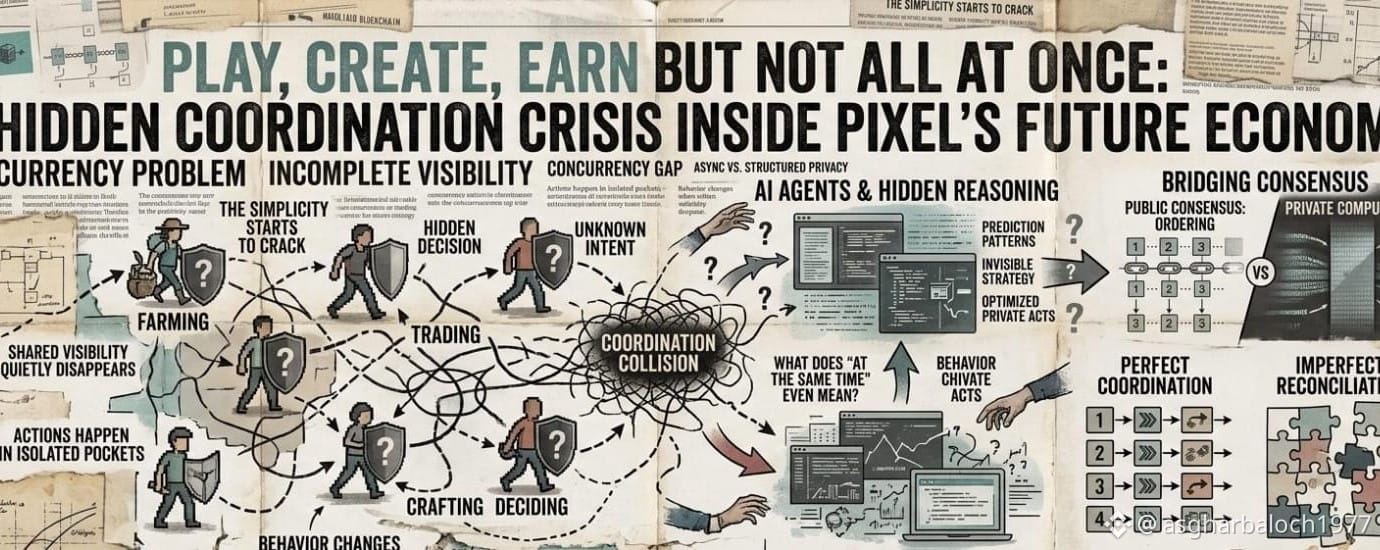
There’s something slightly off about the promise of “play, create, earn.” Not wrong just… too clean. Too smooth for something that’s supposed to involve thousands of people all making decisions at once. It works when everything is visible, when every action can be tracked and understood. But the moment privacy enters the picture, that simplicity starts to crack. What once felt seamless begins to feel layered, uncertain closer to how real systems actually behave.
And that’s where the tension begins.
Private smart contracts sound simple at first. Hide sensitive data, prove everything is valid, and move forward. But that explanation skips over the messy part. PIXEL isn’t a neat, linear system it’s constantly moving. Players are farming, trading, crafting, reacting… all at the same time. Actions overlap, decisions collide. And once those decisions start happening in private, the system loses its ability to “see” clearly.
That shared visibility quietly disappears.
Now actions don’t line up neatly. They happen in isolated pockets, hidden from one another. And afterward, the system has to somehow reconcile everything. It starts to feel less like clean engineering and more like piecing together a story with missing parts.
This is the concurrency problem but calling it just a “problem” almost feels too small.
It’s really a gap in how coordination works when visibility is incomplete.
Because what does “at the same time” even mean if no one can actually observe everything? In a private system, simultaneity becomes blurry. Order isn’t obvious anymore it has to be inferred, reconstructed, or sometimes just approximated.
Zero knowledge proofs don’t solve this. They’re powerful, but limited in scope. They tell you something is correct, but not how it relates to everything else happening around it. They verify outcomes, not interactions. And in a system like PIXEL, those interactions are where most of the meaning lives.
Think about players quietly building up resources, planning their next moves. None of that happens in isolation it’s all connected to shared limits like supply and demand. But if everyone is acting privately, those connections become harder to trace. The system has to resolve conflicts without fully understanding the intent behind each action.
Then AI agents enter the picture.
These aren’t just participants they’re constantly optimizing. Watching patterns, predicting behavior, acting faster than any human could. And if their actions are private, you’re not just hiding data anymore you’re hiding reasoning. Strategy itself becomes invisible.
At that point, the system starts to feel less like a game and more like a living, breathing economy.
Architectures like Nightstream seem to accept this complexity. Instead of forcing everything into strict synchronization, they allow actions to unfold more loosely. Not everything has to be resolved instantly. Kachina, on the other hand, tries to bring structure back, giving the system a way to reason about order without exposing what’s actually happening.
But neither approach fully resolves the tension.
Asynchronous systems can feel inconsistent. Structured privacy can struggle when interactions become dense. Technologies like Tensor Codes and folding proofs help reduce the computational burden, making it easier to process large volumes of private data but they don’t eliminate the coordination challenge.
They just make it more manageable.
Hybrid consensus tries to bridge the gap. Some things stay public like ordering while computation remains private. It’s a practical compromise, but the boundary between public and private becomes fragile. Even small signals timing, patterns can reveal more than intended.
And in PIXEL, this isn’t just infrastructure.
It directly shapes how people play.
When visibility drops, behavior changes. Players stop reacting only to what they see. They start guessing, anticipating, reading between the lines. Markets feel less predictable. Strategies become more thoughtful, more personal.
The system starts to resemble a real economy.
You begin to see hidden layers forming quiet agreements, unseen resource flows, selective reputation systems. Activity that exists beneath the surface but still influences everything above it.
But all of this depends on one fragile thing: the system’s ability to handle many hidden actions happening at once without breaking down.
And right now, that ability is still incomplete.
Which leads to a difficult but honest thought.
Maybe the goal isn’t to perfectly solve privacy and concurrency.
Maybe it’s to design systems that work despite those limitations.
Systems where imperfect coordination still creates meaningful outcomes. Where things don’t need to be perfectly aligned to feel coherent.
Because in a world where no one sees everything, perfection might not even be the point.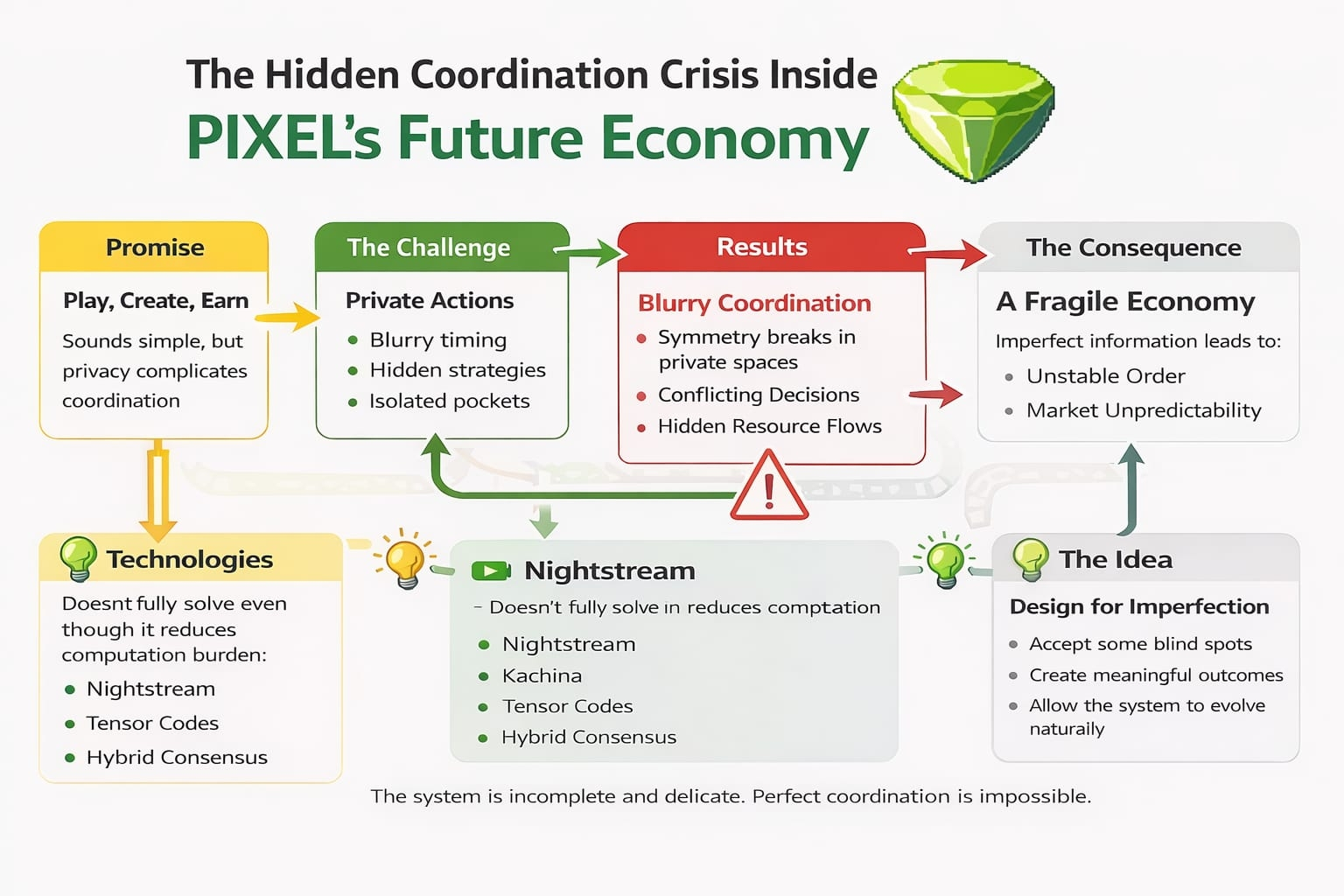
Maybe what matters is that the system holds together just enough to keep evolving.