
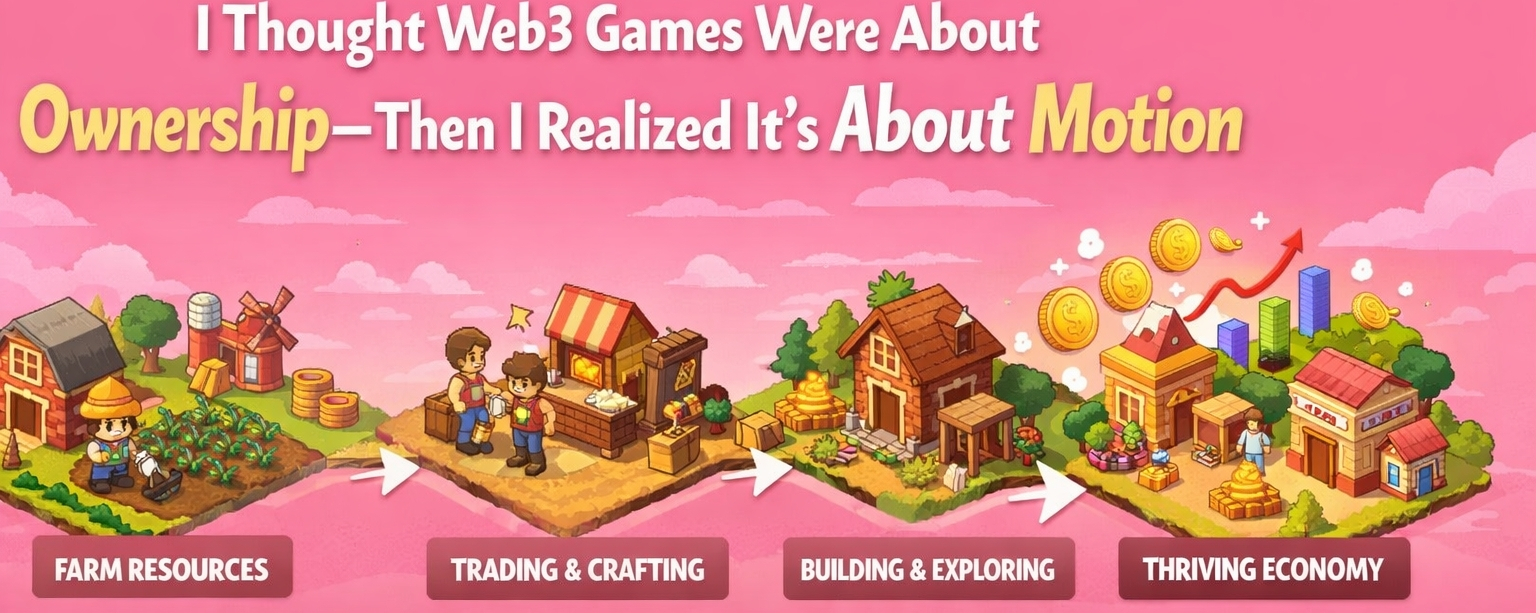

I used to look at Web3 games like Pixels and think I understood the model. Oh it made sense on the surface own your assets farm resources, trade them earn something real. It felt like a clean narrative: gameplay meets ownership, ownership meets value. I thought the breakthrough was simply giving players control. Yeah, that was the story I bought into.
But that perspective was incomplete.
Because creation is the easy part. You can mint assets design worlds build economies but what happens after that? That’s where most systems quietly fail. They create things that look alive but don’t actually move. Like building a marketplace in the middle of a desert and assuming trade will just appear.
When I started looking deeper into how Pixels actually functions, not just what it claims, the shift hit me. This isn’t about farming or NFTs or even gameplay loops. It’s about whether the outputs—crops, resources, land, player actions—continue to circulate, interact, and generate value beyond their point of creation.
Think of it like this: growing crops in a game is like producing goods in a real economy. But if those goods just sit in inventory, unused, untraded, irrelevant… then the system isn’t alive. It’s static. A real system is more like a busy marketplace goods are constantly exchanged repurposed consumed, and recreated. Motion is the signal.
So the real question became: does Pixels produce motion, or just output?
At a structural level, I started seeing the layers more clearly. Players don’t just farm they interact through resource dependencies. One player’s output becomes another player’s input. That’s where things get interesting. If those interactions are frequent and necessary the system starts behaving less like a game and more like a network.
Outputs matter too but only if they’re reusable. A harvested crop isn’t valuable because it exists it’s valuable because it can be traded, crafted into something else, or used to unlock further activity. If outputs keep re-entering the system instead of exiting it, you get loops. And loops are where network effects begin to form.
Over time if enough participants rely on each other’s outputs the system compounds. Not through speculation but through repeated interaction. That’s the difference between a temporary spike in activity and something that actually builds momentum.
Now, okay, from a market perspective, things look more nuanced. Pixels sits in an interesting position it has visibility it has users, it has moments of high activity. But the maturity question is still open. Is the activity consistent, or does it cluster around events, rewards, or incentives? Because those are very different signals.
I’ve noticed that participation still feels somewhat concentrated. There’s engagement, yeah, but whether it’s expanding organically or being pulled by short-term rewards that’s the tension. Potential is clearly there but proven adoption is something else entirely. That only shows up when users stay active without needing a reason every time.
And that brings me to the core risk. If usage is driven by incentives, it fades when those incentives weaken. But if usage is embedded if players log in because the system itself requires their participation then it sustains. Real strength isn’t in how many people show up once. It’s in how many keep showing up without being asked.
So I started asking a different question: do people actually need this system to continue doing what they’re doing? Or is it optional?
Because integration into real activity is everything. If developers build on top of it, if players depend on it, if economies start forming around it then it begins to look like infrastructure. Not just a game, but a layer people operate within.
My framework shifted after that.
Confidence would increase if I see consistent, non-event-driven activity players interacting because the system demands it, not because rewards are temporarily high. If outputs are constantly reused, if new participants can plug in without friction, if the economy keeps moving even when attention fades—that’s when it becomes real.
But I stay cautious when activity spikes feel artificial. When engagement drops sharply after incentives. When outputs accumulate instead of circulate. Those are signs of a system that creates, but doesn’t sustain.
Oh, and that’s the distinction I can’t ignore anymore.
Systems that matter aren’t the ones that simply produce assets, tokens, or experiences. They’re the ones where those things keep moving flowing through users, being reshaped, reused, integrated into everyday behavior. Not because people are told to use them, but because the system quietly becomes part of what they do.