
I remember the first time I noticed it. Not as a loud announcement or a sudden trend, but as a subtle shift. Like something moving beneath the surface. Ronin Network had already been known for powering digital worlds, but this felt different. This felt quieter. More deliberate. Pixels PIXEL did not arrive like a spectacle. It appeared more like a signal. Something small at first, almost easy to overlook. Yet the more I looked at it, the more it felt like an awakening. Not just of a game, but of a different way of building digital systems.
At first glance, I saw farmland. Simple land. Crops growing slowly. Characters walking around with purpose but without urgency. It looked calm. Almost too calm for a space that is usually driven by noise and speed. But that calmness began to feel intentional. I started to realize this was not just design. It was control. A kind of quiet structure shaping everything underneath.
The world of Pixels does not rush you. It lets you settle in. I noticed how farming was not just an activity. It was rhythm. A loop that repeats. But in that repetition, something interesting happens. Actions become predictable. Patterns begin to form. And suddenly, I was not just playing. I was observing a system that was designed to be understood over time.
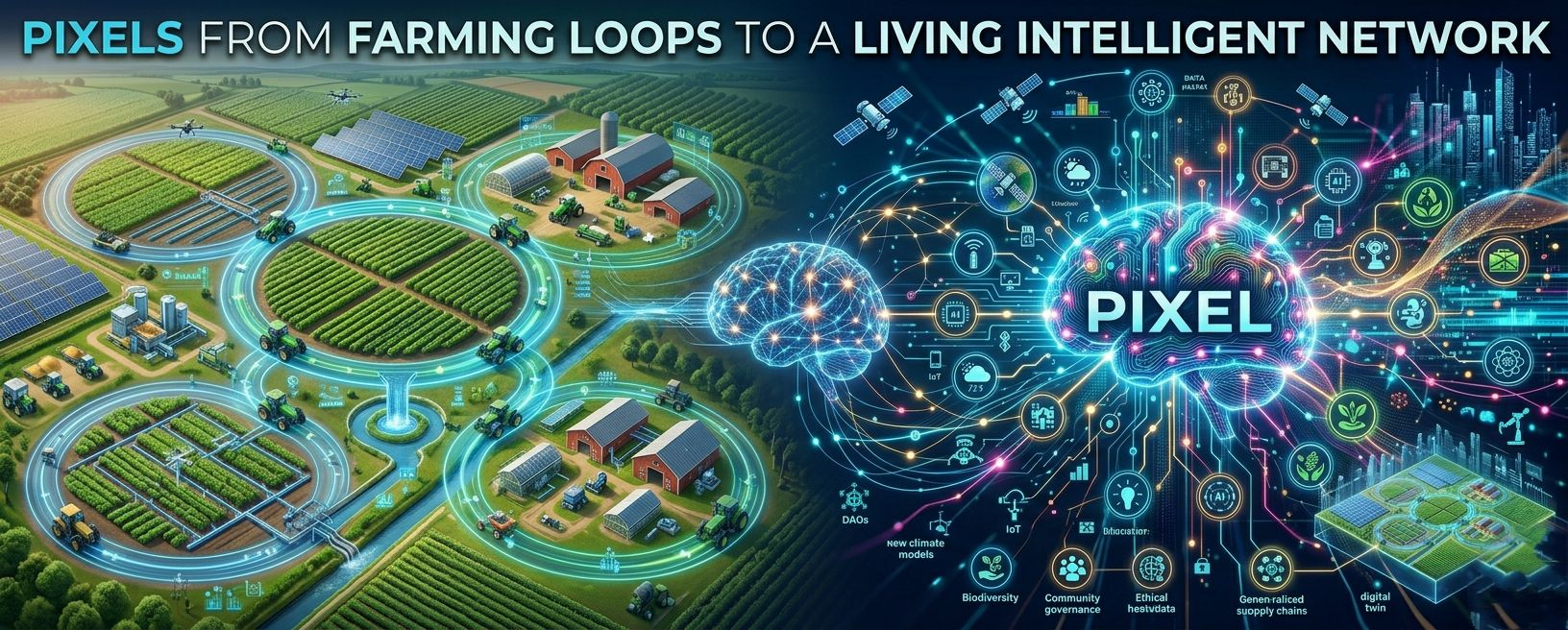
As I stayed longer, I began to see the deeper layer. The one that is not visible immediately. Beneath the surface of farming and exploration, there is a living infrastructure. It feels almost organic. Smart contracts move quietly in the background, like veins carrying instructions through the system. They do not draw attention to themselves, yet everything depends on them. Every action, every reward, every interaction flows through this hidden network.
Liquidity feels like blood in this world. It circulates constantly. Moving value from one place to another. Feeding different parts of the ecosystem. When activity increases, the flow becomes stronger. When things slow down, it settles. I could almost feel the pulse of the system changing depending on how people interacted with it. It was not static. It was alive.
Then there is governance. And this is where things start to feel more conscious. Decisions are not just imposed. They evolve. Slowly. Through participation. Through behavior. Through signals coming from users, builders, and traders. It feels less like control and more like awareness. As if the system is learning how to shape itself based on how it is used.
I began to understand that Pixels is not trying to impress at first glance. It is trying to sustain itself over time. That is a very different goal. Most systems aim to capture attention. This one seems focused on holding it quietly. Building trust not through hype, but through consistency.
When I looked at how users experience this world, I noticed something subtle but powerful. There is transformation, but it does not happen all at once. It unfolds slowly. A player starts with simple actions. Planting. Harvesting. Exploring small areas. But over time, those actions begin to connect. They start to feel meaningful. Not because they are complex, but because they are consistent.
For traders, the experience feels different. They do not just see prices or movement. They begin to see behavior. Patterns of activity. Flow of resources. It becomes less about chasing quick outcomes and more about understanding how value moves through the system. That shift changes how decisions are made. It feels calmer. More grounded.
Builders experience something even deeper. They interact with the system as if they are part of its structure. Not just users, but contributors. They start to see how limitations actually create clarity. When a system is not overloaded with endless possibilities, it becomes easier to build within it. Easier to predict outcomes. Easier to maintain stability.
This is where I felt the real difference. Pixels does not try to remove constraints. It embraces them. And in doing so, it creates a space where behavior becomes easier to track, verify, and trust. That may not sound exciting at first, but over time, it becomes incredibly powerful.
I found myself thinking about how most digital environments feel chaotic. Too many variables. Too many unknowns. But here, things feel contained. Not limited, but structured. And that structure creates confidence. It allows the system to operate without constantly breaking under pressure.
Even the way information is exposed feels carefully balanced. I noticed that important state changes remain visible. You can see what is happening. You can trace actions. But unnecessary details are not pushed forward. This balance between transparency and privacy feels deliberate. It protects the system while still allowing it to be understood.
As I continued to observe, I started to see how everything connects. The simple farming loop. The underlying smart contracts. The flow of liquidity. The evolving governance. It all forms a single system. Not separate parts, but a unified structure that moves together.
There is something almost biological about it. Like watching an ecosystem develop. Each part plays a role. Each action contributes to the whole. And over time, the system becomes more stable. More predictable. More trustworthy.
I realized that this is where the real innovation lies. Not in complexity, but in clarity. Not in speed, but in consistency. Pixels does not try to overwhelm. It tries to align. To bring behavior, infrastructure, and value into a single rhythm.
And that rhythm creates something rare. A digital environment that feels reliable. Not just for players, but for everyone interacting with it. Developers can build with confidence. Operators can maintain it with less uncertainty. Users can engage without constantly questioning what might break next.
As I step back and look at the bigger picture, it becomes clear that Pixels is not just a game. It is a model. A way of thinking about how digital systems can evolve. Instead of chasing endless expansion, it focuses on controlled growth. Instead of adding more, it refines what already exists.
This approach may seem quiet now. But quiet systems often last longer. They adapt better. They survive pressure because they are built with awareness of real constraints.
And this is where I start to see its place in the future. Not as a dominant force trying to replace everything, but as a foundational layer that others can learn from. A system that shows how human behavior and machine logic can align without friction.
I imagine a future where digital environments are not just interactive, but understandable. Where users do not feel lost inside complexity, but guided by structure. Where systems do not just function, but evolve with intention.
Pixels feels like an early step toward that future. Not fully realized, but clearly moving in that direction. It does not try to answer everything. It simply builds a framework where answers can emerge over time.
And maybe that is what makes it powerful. It does not demand attention. It earns it slowly. Through consistency. Through clarity. Through quiet reliability.
When I look at it now, I no longer see just farmland or simple loops. I see a living system. One that breathes through smart contracts, moves through liquidity, and thinks through governance. A system that grows not by expanding outward, but by deepening inward.
It feels less like a game and more like a signal of what is coming next. A shift toward systems that are not just built, but cultivated. Not just used, but understood.
And as that realization settles in, everything becomes still for a moment. The noise fades. The urgency disappears. What remains is a quiet sense of direction.
Something is changing. Slowly. Carefully. And Pixels is already part of it.
