
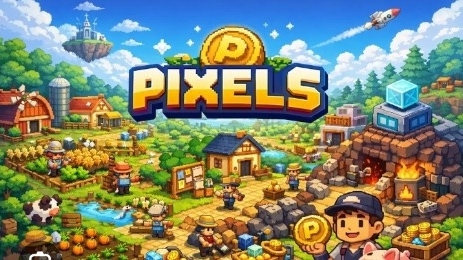
I didn’t expect much the first time I stepped into Pixels. From the outside, it looked like another pixel-art farming game, something nostalgic and easy to understand. I thought I would plant crops, wander around, maybe trade a few items, and log off. But the longer I stayed, the more I realized that I wasn’t just playing a game I was stepping into a system that quietly challenges how I think about time, ownership, and even work itself.
As I moved through the world, I noticed how everything I did had weight. When I planted crops, gathered resources, or crafted items, it didn’t feel like meaningless repetition. It felt like I was contributing to something persistent, something that existed beyond my single session. That’s when it hit me: Pixels is not just built for entertainment, it’s built around an economy. Every action I take can connect to value, and that changes how I behave in ways I didn’t expect.
I found myself thinking strategically almost immediately. Instead of asking what I felt like doing, I started asking what would be most efficient. Which crops should I plant to maximize returns? Which tasks give me the best output for my time? I didn’t consciously decide to think this way it just happened. The design of the game nudged me toward optimization, and I followed without resistance. That shift made me slightly uncomfortable, because I realized I was no longer just playing. I was calculating.
At the same time, I couldn’t deny how empowering it felt. For once, I wasn’t just earning points or unlocking cosmetic rewards that would disappear into a closed system. I was participating in something where ownership actually mattered. The idea that my time could translate into something tangible even if small gave my actions a different kind of meaning. I wasn’t just progressing through a game; I was building something that belonged to me.
But as I spent more time in Pixels, I started to see a deeper pattern. The game reflects real-world economics more closely than it first appears. Early players seem to have an advantage, accumulating land and resources before demand increases. When I arrived, I could already feel that shift. Some opportunities were harder to access, and the competition felt more intense. It reminded me of how markets work outside the game timing often matters just as much as effort.
I also noticed how quickly routine can turn into obligation. There were moments when I logged in not because I was excited, but because I didn’t want to fall behind. Crops needed attention, resources needed to be gathered, and opportunities felt time-sensitive. It was subtle, but powerful. The game didn’t force me to play it made me feel like I should. That distinction stayed with me, because it blurred the line between enjoyment and responsibility.
Still, there’s something undeniably calming about the experience. I found a strange sense of peace in the slow rhythm of farming. Waiting for crops to grow, planning my next move, watching the world evolve around me it created a kind of digital stillness that’s rare online. In a space where everything usually moves fast, Pixels encourages patience. I didn’t just rush from one task to another; I lingered, observed, and sometimes just existed within the environment.
What surprised me most was how social the experience became. I didn’t expect to care about other players, but I did. I saw people collaborating, trading, sharing strategies, and even helping newcomers find their footing. It didn’t feel like a competitive battlefield it felt like a community slowly shaping itself. Those interactions gave the game a layer of meaning that went beyond mechanics or economics. I wasn’t just part of a system; I was part of a shared story.
But even within that community, I could sense underlying tensions. Not everyone approaches the game the same way. Some players are there to explore and enjoy the experience, while others treat it like a serious income opportunity. I found myself somewhere in between, constantly shifting between curiosity and calculation. That duality is what makes Pixels so fascinating to me. It doesn’t lock me into one identity it lets me move between roles, sometimes without even realizing it.
I started questioning whether this kind of system is sustainable. If more players join, competition increases, and rewards might become harder to earn. If fewer players join, the economy could slow down. It feels like a delicate balance, one that depends on continuous engagement and growth. I couldn’t help but wonder what happens in the long run. Is this a stable model, or something that thrives only in its early stages?
At the same time, I don’t think Pixels is trying to provide a final answer. To me, it feels more like an experiment one that explores what happens when gaming, economics, and ownership collide. It doesn’t hide its mechanics, but it also doesn’t fully explain them. Instead, it lets me experience the system firsthand, leaving me to interpret what it all means.
I’ve also realized that Pixels changes how I value my own time. When I spend an hour in the game, I don’t see it as “just playing” anymore. I see it as an investment, even if the returns are uncertain. That shift in perspective is subtle but significant. It makes me more aware of how I choose to spend my time, both inside and outside the game. It raises questions I didn’t expect to ask, like how I define productivity and whether enjoyment alone is enough to justify my attention.
In many ways, Pixels feels like a mirror. It reflects not just how digital economies function, but how I respond to them. It shows me my tendencies my desire to optimize, my fear of missing out, my need for both structure and freedom. It doesn’t judge those tendencies; it simply makes them visible.
And maybe that’s why it stays with me. Because it’s not just about farming or tokens or virtual land. It’s about something deeper, something harder to define. It’s about how I navigate a world where the boundaries between work and play are no longer clear, where value can emerge from the most unexpected places, and where even a simple act like planting a crop can carry meaning beyond the screen.
I don’t know exactly what Pixels will become in the future. It could evolve into something bigger, or it could fade as trends shift and new ideas take its place. But for now, it feels like a glimpse into a changing landscape one where digital spaces are no longer just places to escape, but places to build, earn, and question.
