
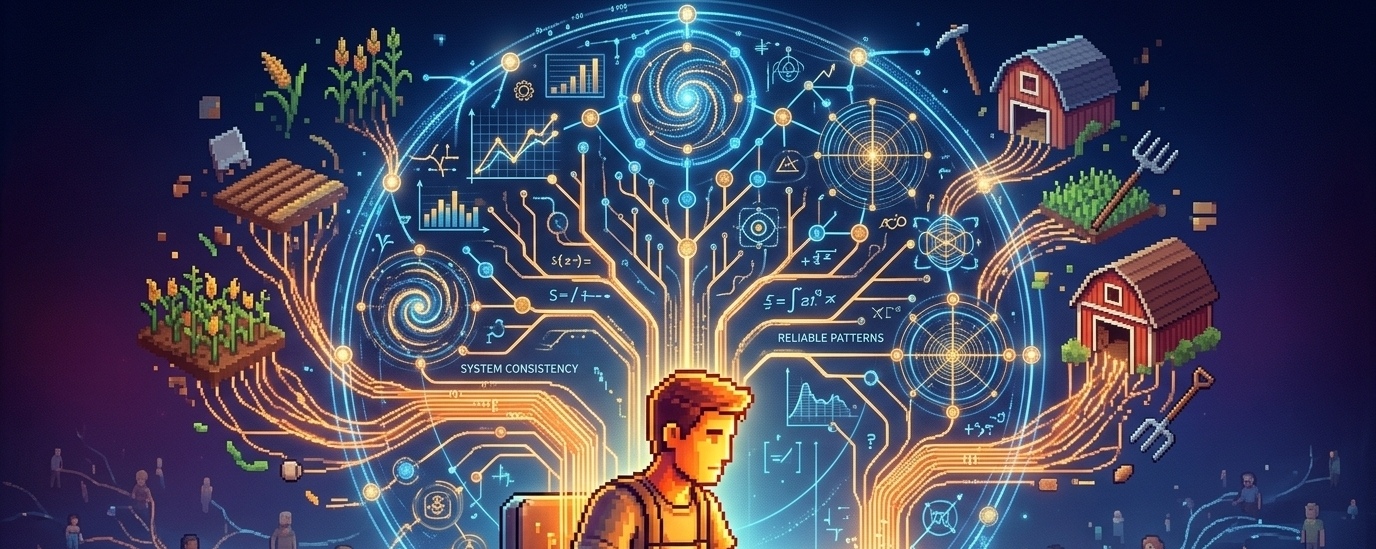
@Pixels I didn’t walk into Pixels expecting anything unusual. At the beginning, it felt exactly like every other farming loop I’ve seen before—log in, plant, harvest, repeat, and collect whatever comes out of it. It’s the kind of structure that doesn’t invite too many questions because it’s already familiar. But after spending more time inside it, a strange feeling started to grow, something subtle enough to ignore at first but persistent enough that I couldn’t shake it off. It wasn’t about bugs or imbalance in the obvious sense. It was more like the system wasn’t treating time the same way for everyone, even when the effort looked similar on the surface.
What made it harder to explain was that the difference didn’t feel tied to skill or randomness. Two players could follow nearly identical routines and still drift apart in outcomes over time. That’s when I stopped looking at what players were doing and started paying attention to how their time was being structured. Because inside Pixels, time doesn’t always behave like a flat input. Some patterns seem to carry more weight, not because they are more intense, but because they are more consistent. And once that consistency locks in, something shifts. Progress stops feeling scattered and starts flowing in a way that feels almost guided.
It’s not something the system announces. There’s no clear indicator telling you that you’ve found the “right” way to play. Instead, it reveals itself quietly. Certain routines begin to smooth out friction. Rewards don’t necessarily explode, but they stop feeling unpredictable. The game starts responding with a kind of stability that makes you lean into that pattern even more. At that point, it no longer feels like you’re just farming. It feels like you’re aligning with something the system prefers, even if you don’t fully understand what that preference is.
That’s where $PIXEL begins to take on a different role. On the surface, it still looks like a standard reward token—something you earn for participation and activity. But when the system starts favoring certain behaviors, the token becomes part of a deeper process. It’s no longer just paying for time spent; it’s indirectly reflecting how that time is shaped. Predictable behavior seems to translate into smoother accumulation, which suggests that the system isn’t neutral about how engagement happens. It’s not judging players in a human sense, but it is responding to patterns in a way that influences outcomes.
This reminds me of how other platforms quietly evolved over time. At some point, they stopped rewarding raw effort and began prioritizing reliability. Not the loudest or most active participants, but the ones who showed up in a consistent, repeatable way. Over time, those patterns became easier for the system to recognize and support. Pixels carries a similar feeling, just in a softer, less visible form. You can still experiment, still play loosely, but that kind of behavior doesn’t seem to compound the same way. It exists, but it doesn’t build momentum.
And once you notice that, it becomes difficult to ignore. Players start adjusting, first unconsciously and then very deliberately. The goal shifts from simply playing the game to understanding what the system responds to. That’s where things get interesting, because the more people optimize for what “works,” the more behavior starts to converge. The system becomes cleaner, more predictable, but also more narrow. Diversity in playstyle slowly fades, replaced by routines that feel efficient but slightly repetitive.
There’s also an underlying tension in all of this. Most of what’s happening isn’t fully transparent. Players can feel the difference in outcomes, but they can’t clearly see how or why it’s happening. That creates a gap where people rely on guesswork or copy patterns from others who seem to be progressing faster. From a distance, it still looks like a simple game economy. But if the token is partly tied to how effectively the system can recognize and reinforce behavior, then its value isn’t just about user growth or activity levels. It’s also about how well the system can organize time into something usable.
That kind of growth doesn’t show up in obvious ways. It’s quieter, slower, and harder to measure. More players don’t necessarily mean more value if their behavior is scattered. But if those players begin to form stable, repeatable patterns, then the system becomes more efficient at processing them. And that’s where the idea of time as an asset starts to make sense. Not in a direct, tradable way, but as something that gains structure and meaning through repetition.
I’m still not completely certain whether this is intentional design or just an emergent effect of enough players interacting with the same mechanics. Systems often appear more intelligent than they actually are when patterns begin to overlap at scale. But even if that’s the case, the outcome still matters. Because what looks like a simple farming loop on the surface may actually be doing something far more selective underneath—quietly identifying which forms of player behavior are stable enough to carry forward.
And if that’s true, then what Pixels is really producing isn’t just tokens or rewards. It’s something less visible but potentially more important: structured time, shaped by behavior and refined by the system itself.