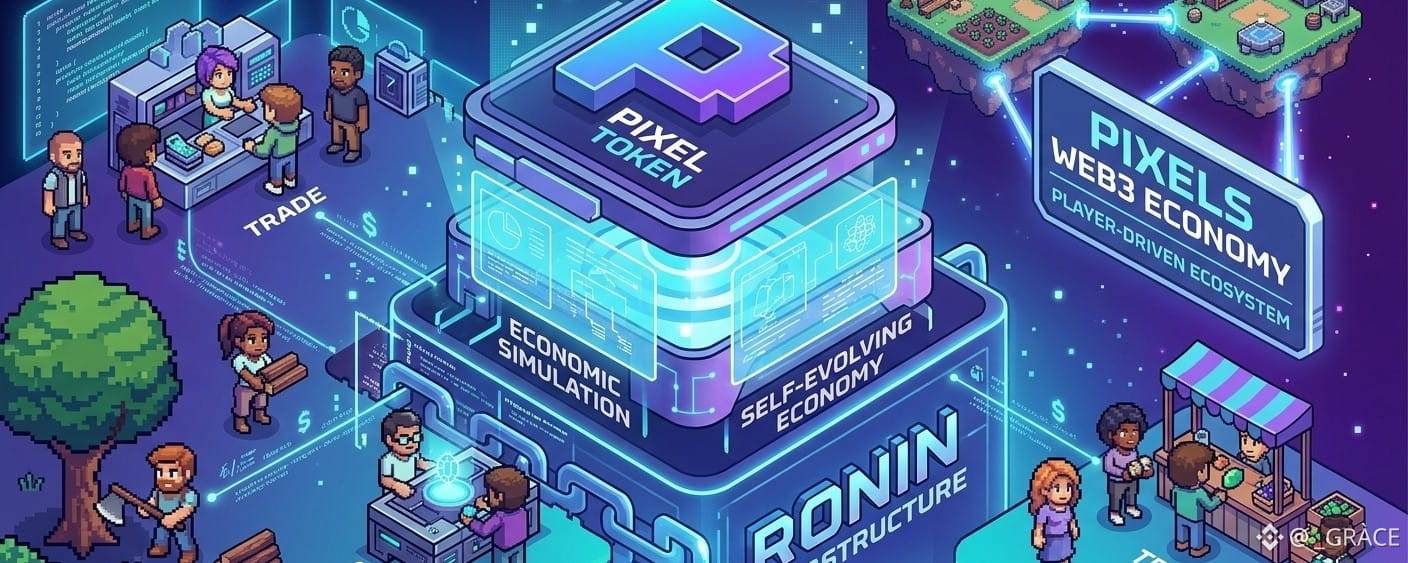

Pixels is evolving into a Web3 ecosystem where the focus is not just on gameplay, but on how player behavior actively shapes the in-game economy. Instead of treating the game world as static, Pixels is designed as a responsive system where every action contributes to ongoing economic movement.
Built on the Ronin Network, the game benefits from infrastructure built specifically for interactive gaming environments. This allows large-scale participation without slowing down gameplay or increasing transaction friction. That foundation is essential for maintaining a stable ecosystem where thousands of micro-interactions happen continuously.
What makes Pixels interesting is how it links user participation with system evolution. The world is not just something players explore — it reacts to how they interact with it. Resource usage, crafting decisions, and progression paths all influence how the internal economy behaves over time.
At the center of this structure is the PIXEL, which acts as the primary economic layer connecting gameplay actions to measurable value flow. Instead of existing as a separate reward system, the token is embedded into the core mechanics of progression and interaction.
One of the most important design decisions in Pixels is its focus on behavioral economics within gameplay. Every player action has a small but cumulative impact on the system. This creates a feedback loop where engagement influences economy, and economy influences engagement. The result is a dynamic environment that evolves continuously.
Unlike traditional games where economies are fixed or manually adjusted, Pixels uses a more organic model. The system adapts based on how players use resources, how often they interact with mechanics, and how demand flows through the ecosystem. This creates a more flexible and responsive structure.
Another key element is how progression is designed. Instead of linear advancement, progression is distributed across multiple systems. Players can develop in different directions depending on how they choose to interact with the world. This diversity ensures that no single path dominates the ecosystem.
The role of Ronin infrastructure is critical here. Because Pixels involves frequent interactions tied to assets and tokens, transaction efficiency matters. The Ronin Network allows these interactions to happen seamlessly without disrupting gameplay flow, which is essential for maintaining engagement at scale.
Economic circulation within Pixels is also carefully balanced. The system is structured to ensure that value is continuously moving rather than accumulating in isolated pockets. This keeps the ecosystem active and prevents stagnation.
Another important aspect is user distribution across systems. Instead of concentrating all activity in one mechanic, Pixels encourages engagement across multiple layers of gameplay. This spreads activity more evenly and reduces pressure on any single system component.
The PIXEL token acts as a connecting layer across all of this. It does not function in isolation but interacts with different parts of the ecosystem depending on player behavior. This makes it a dynamic asset rather than a static reward.
From a system design perspective, Pixels reflects a shift toward simulation-style economies in Web3 gaming. Rather than predefined outcomes, the system allows emergent behavior driven by user participation. This is closer to a living ecosystem than a traditional game structure.
This design also helps address one of the biggest challenges in Web3 gaming: sustainability. Many earlier projects struggled because their economies depended heavily on external inflows or temporary reward systems. Pixels instead builds internal circulation loops that rely on ongoing participation.
Another important feature is adaptability. As player behavior changes, the system responds. This means the economy is not locked into fixed parameters but adjusts over time based on real usage patterns.
The combination of gameplay and economic simulation creates a deeper layer of engagement. Players are not just interacting with a game they are indirectly influencing a system that reacts to collective behavior.
Scalability is another key strength. Because the system is built on Ronin, it can support large volumes of interactions without degrading performance. This is important because economic simulation requires constant data flow between users and the system.
Over time, this structure creates a self-reinforcing loop. Players engage with the system, the system responds, and those responses influence future engagement patterns. This cycle is what gives Pixels its evolving nature.
In conclusion, Pixels represents a shift toward behavior-driven Web3 gaming ecosystems. Supported by the Ronin Network and powered through the PIXEL, it creates a living economic environment where user activity continuously shapes system behavior.