
it took me a while to notice it, mostly because nothing inside Pixels gives you a reason to question how things are working. everything feels smooth from the beginning, almost too smooth, like the system is designed to remove friction before you even realize where it could exist.
you log in, move through the farm, tasks line up without effort, something completes, and pixels appears. it feels immediate, contained, like the loop closes perfectly every time. there is no pause, no delay, nothing that breaks the rhythm while you are inside it.
and that consistency becomes the baseline. you stop thinking about how it works because it always works.
but the longer i stayed, the more i started noticing that this smoothness only really exists in one direction. everything that happens inside the farm moves forward without resistance, but there is another direction that does not feel as open.
leaving.
it is not something the system blocks in a clear way. there is no hard stop that tells you that you cannot move your value out. but the experience shifts the moment you think about it. the same system that felt instant and responsive starts behaving differently, almost like it is no longer operating under the same rules.
and that difference is subtle enough that you can ignore it at first.
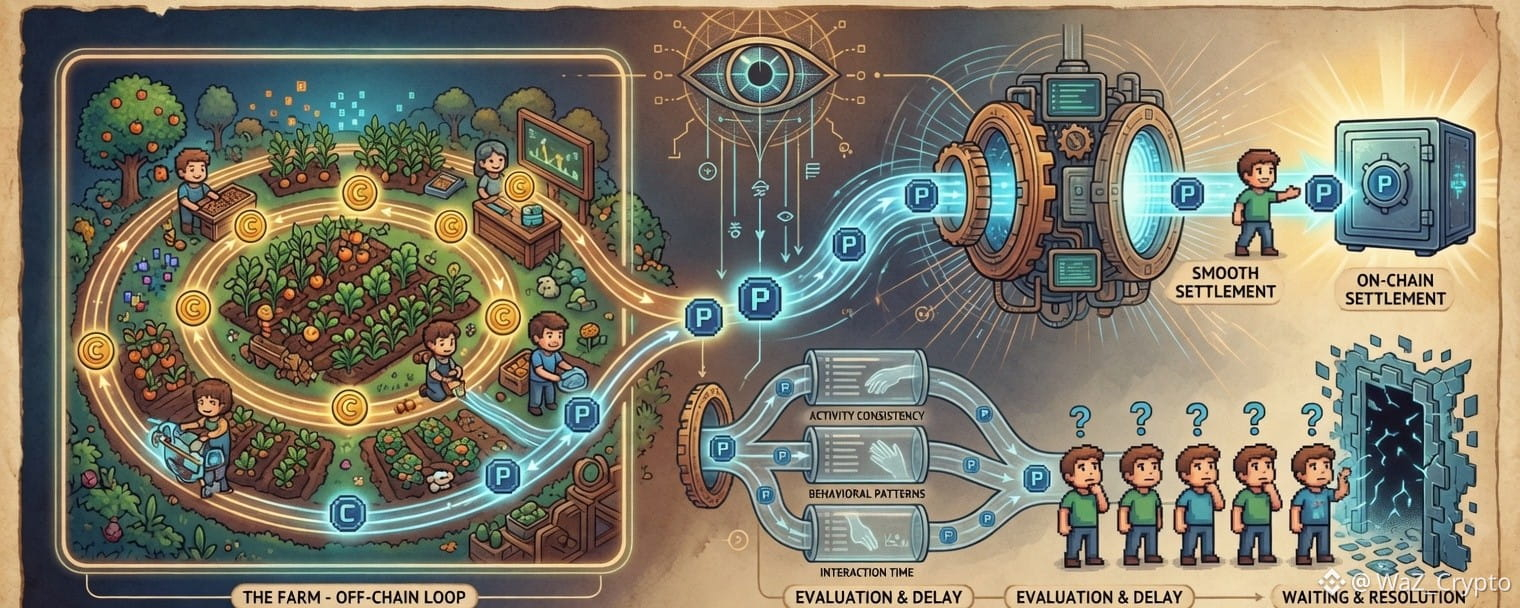
inside the farm, Coins keep circulating endlessly. they absorb activity, recycle value, and keep the loop alive without ever needing to resolve anything outside of itself. tasks refresh, energy returns, actions keep chaining into each other. it feels like a complete environment that does not depend on anything beyond it.
but Pixels, the token, does not fully belong to that loop.
it moves through it, appears within it, but its purpose is tied to something beyond it. it is meant to cross from that off chain environment into something that settles elsewhere. and that crossing is where things stop feeling as simple.
because not everything crosses the same way.
two players can follow similar paths, complete similar tasks, spend similar time, and still experience that transition differently. one settles quickly, another takes longer, and sometimes there is no clear explanation for why.
it does not feel random. it feels like the system is observing something that is not immediately visible.
that is where the idea of control starts to shift.
at first, it feels like the system is just rewarding actions. you do something, you get pixels, and that is the end of it. but over time, it starts to feel like earning is only one part of a longer process, and not necessarily the most important one.
the real decision seems to happen later.
the system does not just decide what gets rewarded. it decides what gets released.
and those are not the same thing.
inside the loop, value can exist freely. it can circulate, accumulate, and continue moving without ever needing to resolve into something final. but the moment that value tries to leave, it becomes something else. it is no longer part of a closed system. it becomes external, independent, and permanent in a way that the loop cannot pull back.
that creates pressure.
because if too much value leaves too quickly, the system loses its ability to sustain itself. the loop depends on circulation, not just distribution. and that means exit cannot be treated the same as earning.
so it is handled differently.
not through obvious restrictions, but through subtle adjustments. timing changes, delays appear, certain behaviors seem to pass through more easily than others. nothing is clearly explained, but the pattern starts forming if you stay long enough.
it begins to feel like the system is not just tracking what you do, but how you do it over time.
consistency, behavior, interaction, all of it feeds into something that decides how smoothly you move from one side of the system to the other. not blocked, not denied, but not entirely neutral either.
that is where the experience changes.
because once you notice that exit is not guaranteed to feel the same for everyone, everything before it starts to look different. the farm is no longer just a place where you earn. it becomes a place where you are being evaluated, even if that evaluation is never directly shown to you.
and that evaluation shapes the outcome that comes later.
it is not aggressive. it does not interrupt your play. in fact, it lets you continue without ever making you feel restricted. but it introduces a layer of uncertainty that was not there at the beginning.
you start thinking about things you were not thinking about before.
not just how to earn more, but how to move what you earn. not just how to complete tasks, but how those tasks translate into something that actually leaves the system.
and that shift is quiet, but it changes everything.
because now the loop is not just about progression. it is about qualification.
qualification for exit.
in most systems, once something is earned, it is yours immediately. here, it feels like ownership sits somewhere in between. not fully inside the system, not fully outside of it, but waiting at a point where the system decides whether it is ready to let it go.
and that point becomes the most important part of the entire structure.
not the farm, not the tasks, not even the rewards themselves.
but the moment where value stops being part of the loop and becomes something the system can no longer control.
that moment does not feel automatic.
it feels decided.
and once that idea settles in, it becomes hard to look at the rest of the system the same way again......
