
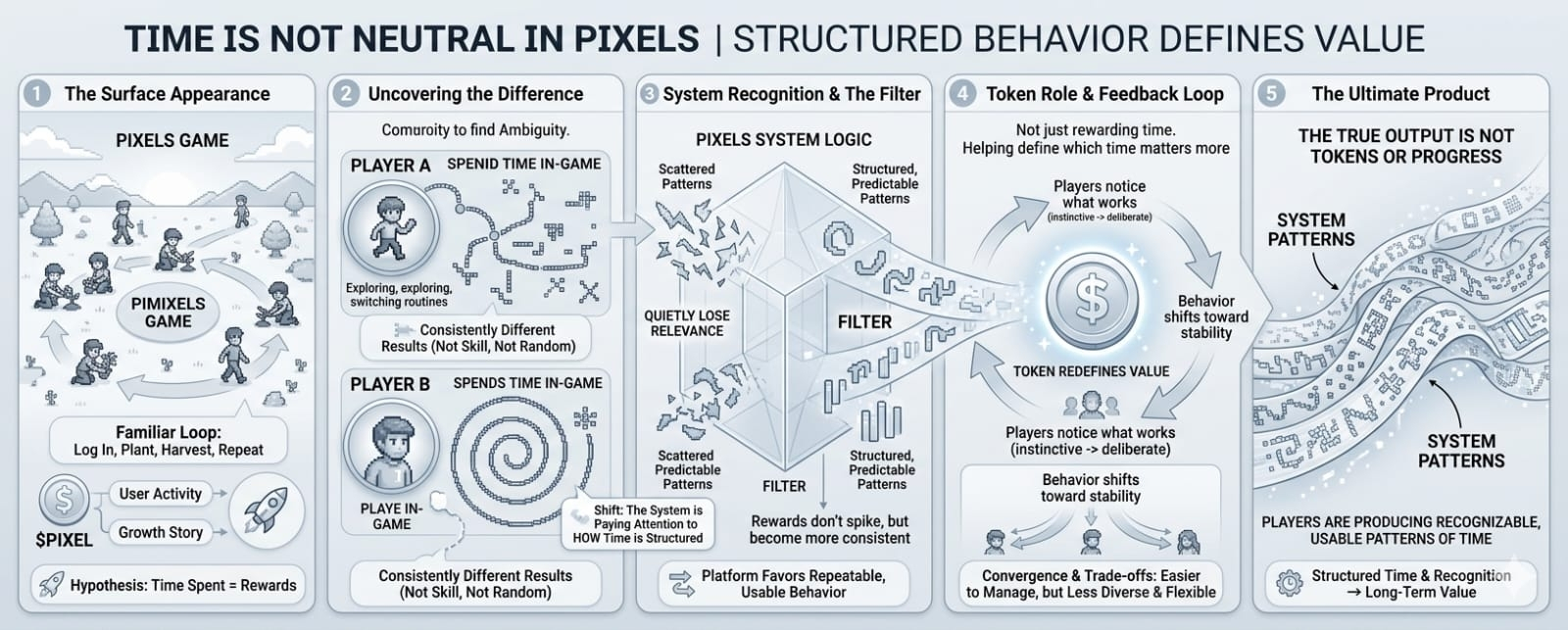
Most projects in this space tend to follow a familiar script. They wrap simple loops in big narratives, attach a token to user activity, and rely on growth to carry the story. On the surface it works, but underneath it often feels repetitive. The mechanics are easy to understand, yet rarely evolve into something deeper. Participation gets rewarded, but not really interpreted.
Pixels looks like it belongs in that category at first. You log in, plant, harvest, repeat. It feels almost too familiar to question. But after spending enough time inside it, that assumption starts to break down. Not in an obvious way, nothing dramatic or broken, just small inconsistencies that don’t quite fit the usual explanations.
Two players can put in similar time and walk away with different results. Not wildly different, but consistently enough to notice. It doesn’t feel like skill is the deciding factor, and it’s not random either. The difference sits somewhere quieter, harder to define.
That’s where the idea of time begins to shift.
We usually treat time in these systems as neutral. An hour is an hour. If outcomes differ, we assume someone optimized better. But Pixels doesn’t fully behave like that. It feels like the system is paying attention to how time is structured, not just how much of it is spent.
Some patterns settle into place more easily. Progress stops feeling jagged and starts to smooth out. Rewards don’t spike, but they become more consistent. It’s subtle enough that most people probably just call it improvement and move on. But it doesn’t feel like simple optimization. It feels like recognition.
That’s an important difference.
In many digital systems outside of gaming, effort alone isn’t what gets rewarded over time. Consistency does. Platforms start to favor behavior that is predictable, repeatable, and easy to integrate. Not because it’s “better” in a human sense, but because it’s more usable from a system perspective.
Pixels gives off a similar signal, just without saying it out loud.
You can play in a scattered way, trying different things, exploring, switching routines. It works, but it doesn’t really compound. Then at some point, often without realizing it, you fall into a rhythm. And suddenly things feel smoother. Less friction, fewer interruptions, more continuity between actions.
That shift matters more than it seems.
Because once behavior becomes consistent, it becomes something the system can recognize. And once it can recognize it, it can start organizing around it. Not publicly, not with clear labels, but internally. Some patterns get reinforced. Others quietly lose relevance.
That’s where the farming loop starts to look less like a loop and more like a filter.
And this is also where $PIXEL starts to feel different. On the surface, it behaves like a normal reward token. You do something, you earn it. Simple enough. But when the system begins to respond differently to different patterns of behavior, the token becomes part of that structure.
It’s no longer just rewarding time. It’s helping define which time matters more.
Not in a moral sense, just in how the system processes it. Some actions seem to “land” better. They integrate more cleanly into whatever logic is running underneath. Over time, those actions lead to smoother progression, not because they are more intense or more complex, but because they align better with what the system seems to favor.
That creates a strange kind of feedback loop.
Players start to notice what works. At first it’s instinctive, then it becomes deliberate. Behavior shifts toward whatever produces the most stable outcomes. Exploration narrows, efficiency takes over, and gradually everyone starts moving in similar ways.
That’s useful for the system, but it comes with trade-offs.
As behavior converges, diversity drops. The system becomes easier to manage and predict, but also less flexible. New approaches have a harder time breaking through because they don’t immediately fit into the patterns that are already being reinforced.
There’s also the issue of visibility. Most of this isn’t explained anywhere. Players feel the difference, but they can’t fully articulate it. So they rely on observation, copying what seems to work for others, or repeating what has worked before.
That gap between experience and understanding is where things get interesting.
Because from the outside, Pixel still looks like a typical game token. Its value should come from player growth, activity, and demand. But if it’s also tied to how the system organizes behavior, then part of its value is coming from something less visible.
Not just how many players there are, but how usable their patterns become.
That’s a very different kind of growth. It doesn’t scale linearly. More players don’t automatically create more value. What matters is whether their behavior can be structured, recognized, and built on.
And that kind of value builds slowly.
It doesn’t show up clearly on charts. It doesn’t spike with hype. It accumulates quietly as the system becomes better at identifying and reinforcing certain types of interaction.
Of course, it’s still early. There’s a real chance that some of this is just emergent behavior rather than intentional design. Complex systems often look smarter than they actually are when enough people interact with them.
But even if that’s the case, the effect is still there.
Time inside Pixels doesn’t feel flat. It feels shaped. Some versions of it move through the system more easily than others. Some get carried forward, while others fade into the background.
And if that’s true, then what players are really producing isn’t just tokens or progress.
They’re producing patterns.
Structured time that the system can recognize, organize, and potentially reuse.
