

I have watched a lot of game reward systems drift away from the game itself.
At frist they look generous, even clever, but after a while the whole experience starts feeling like a queue for incentives instead of a world people actually want to stay in.
That is why this direction caught my attention. It feels less like adding another reward feature and more like rethinking what a game economy is supposed to protect.
The real problem is not that players want rewards. That part is normal.
The problem is that most reward systems are built title by title, campaign by campaign, with no durable memory across the wider ecosystem. One game learns something about user behavior, another game starts from zero, and a third ends up rewarding whatever is easiest to measure rather than what is actually healthy for long-term participation. Over time that creates waste.
Good players are treated like anonymous traffic, studios overpay for shallow engagement, and the economy becomes noisy because incentives are reacting to fragments instead of a full picture.
It is like trying to build a city where every neighborhood uses a different map of the same streets.
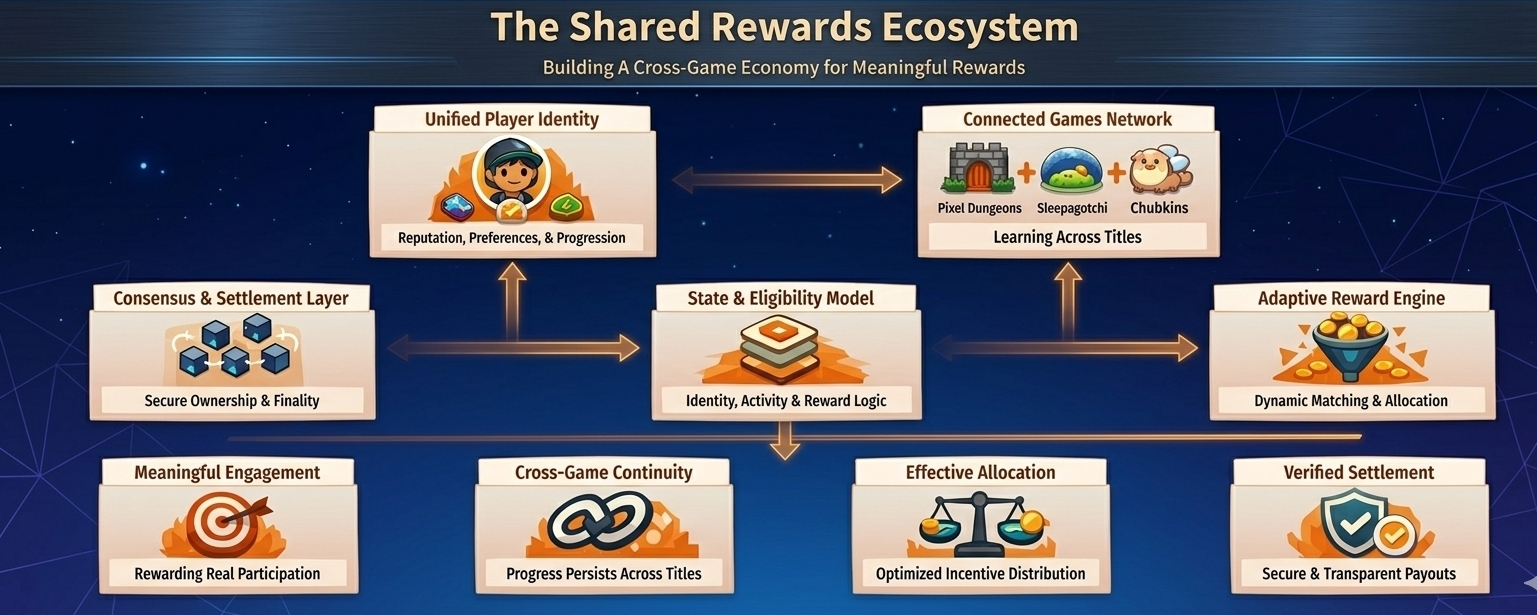
What stands out to me here is the shift from isolated games to a shared rewards layer.
That sounds simple on paper, but structurally it changes the meaning of progression. Instead of treating one title as a closed loop and the next title as a separate reset, the network starts to build continuity.
A player identity can carry learning, reputation, preference, and matching logic across products. The reward system is no longer just a payout tool.
It becomes an allocation layer for attention, retention, discovery, and contribution across a broader environment.
That matters because the ecosystem is not being described as one product anymore.
It started with one game, but now the logic is expanding across Pixel Dungeons, Sleepagotchi, and Chubkins, with Stacked acting as the shared reward rail across the $PIXEL environment.
I think that is the more serious move. Not because “more games” automatically means more value, but because shared infrastructure gives each title a way to learn from the others.
A player who engages well in one context does not need to become invisible the moment they move somewhere else.
From a design perspective, the first layer is consensus selection, and I do not think this should be over-romanticized.
The reward engine does not need every behavioral decision to become a public consensus event. Consensus should be reserved for settlement, ownership, and final state guarantees where tamper resistance actually matters.
The moment every quest adjustment, reward match, or engagement test is forced into that layer, the system becomes slower, more expensive, and less adaptive. So the clean approach is separation: use the chain for finality and use the reward layer for continuous decision-making.
The second layer is the state model. This is where many game economies quietly break.
There is player identity state, game activity state, reward eligibility state, and asset settlement state.
Those are related, but they are not identical. If they are merged too aggressively, every change in one area contaminates the others.
A better structure is to let identity persist across titles, let gameplay events remain local to each game, and let reward eligibility be computed through a shared model that can compare patterns over time.
Settlement then becomes the last step, not the whole system. That order is important because it keeps experimentation flexible without weakening the credibility of distribution.
Then there is the model layer, which is probably the most interesting part. A shared rewards system only works if matching gets better over time. Otherwise it is just a bigger faucet.
The value of Stacked is that it appears to treat rewards as an ongoing matching problem rather than a fixed emission schedule.
Who should earn, for what behavior, in which title, under what context, and with what expected effect on retention or ecosystem health? Those are not cosmetic questions. They are pricing questions.
They decide whether the economy is paying for meaningful activity or just paying for movement.
That is where I see the negotiation detail becoming more subtle. Price negotiation here is not only about token price in the market.
It is also about the internal price of attention, loyalty, and contribution. If one action is over-rewarded, the system invites farming.
If another is under-rewarded, the system ignores the behaviors it actually needs. A shared layer gives the network more room to adjust that exchange rate carefully.
It can negotiate reward intensity through data, cross-title learning, and player matching instead of using the same blunt logic everywhere.
The cryptographic flow should stay quiet in the background.
A player identity needs to be recognized consistently, game actions need to be attributed correctly, and rewards need to be settled in a verifiable way.
But none of that requires turning the user experience into a constant ceremony of visible complexity.
Good infrastructure should preserve trust without demanding attention every second.
In practice, that means signatures, account linkage, and settlement proofs should serve the economy rather than dominate it.
Utility also becomes easier to read when the architecture is split this way. Fees belong to the settlement side because distribution and transfers need discipline.
Staking belongs to the coordination side, but the team has already been careful in saying more details around staking and broader reward evolution will come separately, which I think is the right approach.
Governance should come after the operating logic is mature enough to govern. If those pieces arrive too early, they often become decorative language.
If they arrive later, after the reward layer has proven what it is optimizing for, they can shape the system with more credibility.
What I like most is that this does not frame rewards as a shortcut to growth.
It frames them as infrastructure for a multi-game economy.
More shared identity, better matching, more room for creator and social loops, and more learnings flowing across titles all point to the same idea: rewards should become more precise as the ecosystem expands, not more chaotic.
To me, that is the future worth paying attention to. Not louder incentives, but better coordination between games, players, and the logic that decides what participation is actually worth.
