
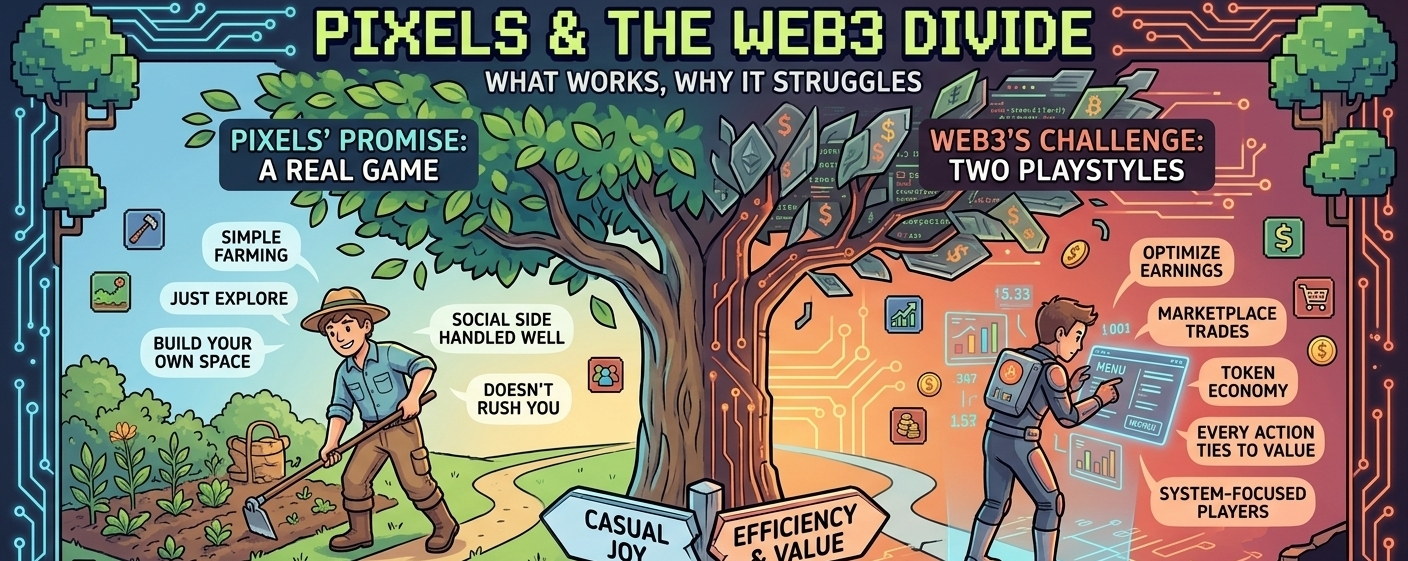
Pixels is one of those games that almost gets it right.
At first, it feels like a normal game. That’s already a big win compared to most Web3 titles. You don’t get hit with complicated systems right away. You don’t feel like you need to understand blockchain just to move your character.
You just start playing.
You farm. You explore. You slowly build something of your own. The game doesn’t rush you. It doesn’t overwhelm you. It gives you space to just exist in it, and that’s something a lot of modern games forget to do.
The social side is also handled well. Players are around, but not in an annoying way. You can interact if you want, or ignore everyone completely. The game doesn’t force you into anything. It just lets things happen.
That’s where Pixels feels different.
It doesn’t feel like a marketplace pretending to be a game. At least not at the start.
But the deeper you go, the more you see the other side.
Because at its core, Pixels still runs on a Web3 system. There’s a token involved. There’s an economy. There’s a reason why certain actions matter more than others. And once you notice that, it changes how the whole experience feels.
Some players lean into it. They optimize everything. They treat the game like a system to earn from. Every action becomes a decision tied to value.
Others just want to play casually. They don’t care about tokens. They don’t care about markets. They just want the game.
And those two playstyles don’t really mix.
That’s where Pixels starts to struggle.
It’s trying to serve both groups at the same time. The casual players who want a relaxing experience, and the system-focused players who want efficiency and value. And while it doesn’t completely fail, it also doesn’t fully satisfy either side.
The Ronin Network helps make things smoother. Transactions are faster. Costs are lower. It removes some of the biggest problems older blockchain games had.
But it doesn’t fix the core issue.
The game still asks you, in subtle ways, to care about things outside the game. And not everyone wants that.
That’s the challenge with Web3 games in general.
They promise ownership and value, but those things come with trade-offs. They change player behavior. They shift focus away from pure enjoyment. Even when the game itself is good, those systems sit in the background influencing everything.
Pixels is interesting because it shows both sides clearly.
It shows that a Web3 game can actually feel like a real game. But it also shows how hard it is to keep that feeling once the underlying systems start to matter.
There’s something good here. No doubt about that.
But it’s still trying to figure out what it wants to be.
And until that balance is solved, Pixels will always feel like two ideas sharing the same space, instead of one complete experience.