

I’ve spent enough time around crypto projects to develop a kind of instinct not quite cynicism, but something adjacent to it. You start recognizing patterns: the same promises wrapped in slightly different language, the same token models dressed up as innovation, the same visions of “ownership” that somehow still depend on centralized coordination behind the scenes. So when I first came across Pixels, I didn’t approach it with excitement. I approached it the way I approach most things now with curiosity, but also with a quiet expectation that I’ve seen this movie before.
And yet, after spending some time with it, I found myself pausing more than usual. Not because it felt revolutionary, but because it seemed to understand something many Web3 games don’t.
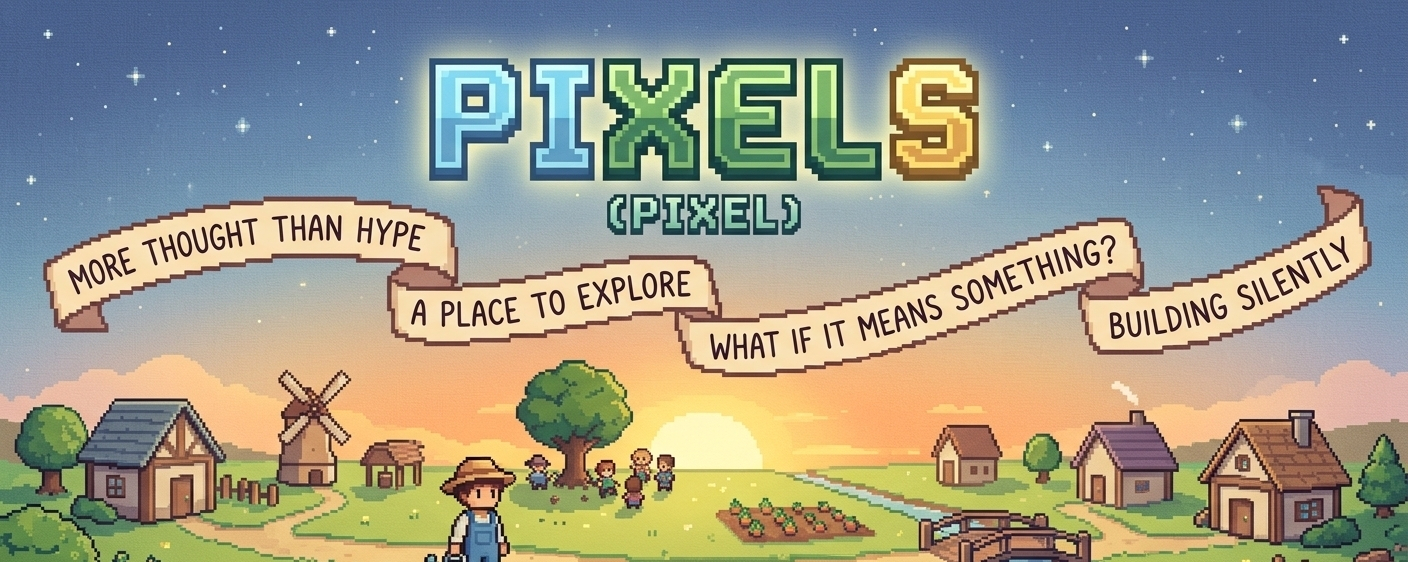
Pixels presents itself as a social, casual farming game built on the Ronin Network. At a glance, that sounds almost disarmingly simple. Farming, exploration, crafting these are mechanics that have existed in games for decades. There’s nothing inherently novel about planting crops, managing resources, or walking through a pixelated world. In fact, if anything, the simplicity makes it easy to underestimate.
But maybe that’s the point.
Most blockchain games I’ve seen try to lead with complexity. They emphasize tokenomics, layered reward systems, NFTs with intricate attributes, and economies that often feel more like spreadsheets than games. Pixels, at least on the surface, seems to reverse that order. It starts with the game itself the loop, the feel, the accessibility and only then layers in the blockchain elements.
That design choice immediately raises a question in my mind: is Pixels actually trying to solve a problem, or is it just refining an approach that others have overcomplicated.
Because if we’re being honest, the “problem” most Web3 games claim to solve is still somewhat ambiguous. Ownership of in-game assets is often cited as the core value proposition. And yes, in theory, giving players control over their items, land, or currency sounds meaningful. But in practice, that ownership only matters if the game itself is worth engaging with. Otherwise, it’s just speculative infrastructure attached to something people wouldn’t play without financial incentives.
Pixels seems aware of this tension. It doesn’t aggressively push the idea that you’re here to earn. Instead, it leans into being a place you might actually spend time in. That’s a subtle but important distinction.
As I moved through the game world, what stood out wasn’t any single mechanic, but the pacing. It feels intentionally slow. You plant something, you wait. You explore, you gather. There’s no immediate pressure to optimize everything for maximum yield. That alone makes it feel different from many “play-to-earn” models, where efficiency quickly becomes the dominant strategy and enjoyment fades into the background.
But then I start wondering can that slower, more organic design coexist with a tokenized economy?
This is where things get interesting, and also where my skepticism kicks in again. The introduction of the PIXEL token inevitably changes player behavior. Even if the game doesn’t explicitly push earning, the mere presence of a tradable asset creates incentives. People start thinking in terms of value extraction, not just participation. It’s almost unavoidable.
So the real challenge Pixels faces isn’t just building a good game. It’s maintaining that sense of playfulness in an environment where financialization is always lurking beneath the surface.
And this, I think, connects to a broader issue in the crypto gaming space. The industry often assumes that adding economic incentives will enhance engagement. But more often than not, it distorts it. Games become jobs. Players become workers. And suddenly, the question isn’t “Is this fun?” but “Is this worth my time financially.
Pixels seems to be walking a delicate line here. By focusing on casual gameplay and social interaction, it’s trying to anchor the experience in something more human. Something less transactional. Whether that balance can hold over time is another question entirely.
The choice of the Ronin Network is also worth thinking about. Ronin has a history rooted in gaming, particularly with projects that have already tested the limits of play-to-earn models. That context matters. It suggests that Pixels isn’t operating in isolation it’s part of an ecosystem that has already gone through cycles of hype, growth, and correction.
That gives me a bit more confidence in the infrastructure side of things. But it also raises expectations. If the underlying network has learned from past mistakes, then the applications built on top of it should reflect that learning.
What I find somewhat refreshing about Pixels is that it doesn’t try to present itself as a grand solution to everything wrong with Web3 gaming. It’s not claiming to reinvent ownership or redefine digital economies. It’s just… building a game. And then carefully integrating blockchain elements where they might make sense.
That restraint is rare.
At the same time, I can’t ignore the uncertainties. For one, sustainability is always a looming question. Any system involving tokens has to grapple with supply, demand, and long-term value. If new players are needed to sustain the economy, then we’re back in familiar territory. If not, then the game needs to generate intrinsic value that doesn’t rely on constant growth.
That’s easier said than done.
There’s also the question of depth. Casual games can be incredibly engaging, but they can also plateau quickly. Once the novelty wears off, what keeps players coming back? Is it the social layer? The progression system? The economy? Or some combination of all three
Pixels seems to be betting on the idea that community and creativity will play a big role. The open-world aspect, the ability to interact with others, the sense of shared space these are elements that can extend a game’s lifespan beyond its core mechanics. But they’re also difficult to design well. They require more than just features; they require.
