
I’m noticing how easy it is to look at Pixels and think you already understand it.
A farming game. A social world. A Web3 project on Ronin. Those descriptions are not wrong, but they feel too flat for something that has clearly been changing shape in public. The more I sit with it, the more it feels like Pixels is not really asking to be seen as a finished product. It feels more like a world in negotiation with itself, still deciding what kind of experience it wants to leave in people after the screen goes dark.
There is something strangely intimate about that.
A lot of projects in this space try to overwhelm you with certainty. They want to sound inevitable. They want every update to feel like proof. Pixels feels different when you strip away the noise. Under the bright colors and the familiar loops of planting, crafting, and wandering, there is a project wrestling with a harder truth: people do not stay just because a system exists. They stay because something about the rhythm begins to matter to them. Because repetition becomes comfort. Because tasks stop feeling like chores and start feeling like part of a place.
That is what I keep coming back to when I think about Pixels now. Not the surface. The rhythm.
The world itself has a gentle kind of pull. It does not shout. It invites. You move through it collecting, building, tending, upgrading, talking, returning. At first that sounds simple, almost too simple. But simplicity in games is deceptive. The real question is never whether a loop is easy to explain. It is whether it keeps revealing small reasons to care. Pixels seems more aware of that now than it used to be.
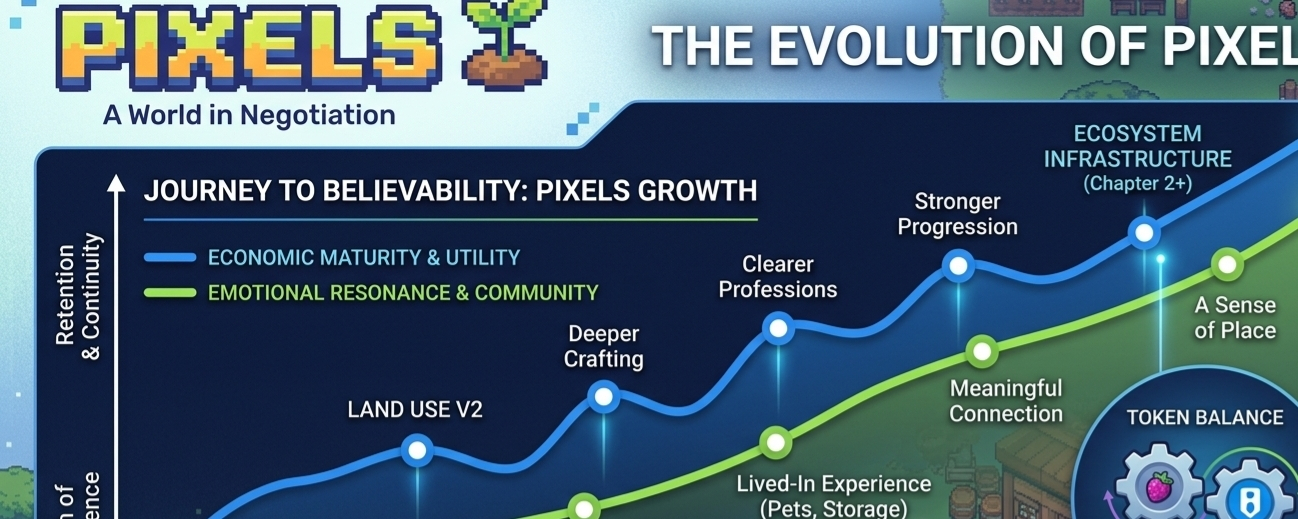
Its more recent development feels less like expansion for its own sake and more like an effort to make the world feel internally true. The current era of the game has leaned into stronger progression, clearer professions, deeper crafting logic, and more meaningful land use. That matters because players can feel when a world is only piling on features. They can also feel when those features begin to connect. Pixels seems to be chasing connection now. Not just more activity, but better continuity.
And continuity is such an underrated thing. It is what makes a game feel less like a menu and more like a place you return to with memory.
I think that is why even the smaller systems in Pixels feel important. Quests are not just checklists when they are handled well. They become a thread. They give shape to movement. They tell you that the world is not static, that it has an idea of where you have been and where you might go next. The same can be said for the quieter additions around pets, storage, utility, and land management. These are not the kinds of things that create dramatic headlines, but they do something more lasting. They make the experience feel a little more lived in. A little less abstract.
And then there is the broader evolution of the project, which may actually say the most. Pixels does not seem content anymore with only being a game people play. It is starting to look like a team trying to turn its own lessons into a system that reaches beyond its own borders. That shift fascinates me. It suggests that what Pixels has learned from retention, reward design, player habits, and ecosystem behavior has become valuable in its own right. Not just as internal knowledge, but as infrastructure.
That kind of move tells a story. It tells you this project has spent enough time inside the messiness of live game economies to understand that building a world is not just about content. It is about balance. Timing. Incentives. Fatigue. Return. Churn. All the invisible things that shape whether a game feels alive or simply active. There is a difference between those two states, and Pixels seems to know that now in a deeper way.
What I appreciate is that this makes the project feel more human, not less. There is an honesty in a team building from observation instead of fantasy. An honesty in admitting, even indirectly, that growth numbers are not the same as loyalty, and rewards are not the same as meaning. That is a lesson many projects never quite learn. Or maybe they learn it too late.
Pixels still carries the contradictions of Web3, of course. It cannot escape them. The token remains part of the story, and with it comes all the pressure that tokens bring. Market attention, supply concerns, unlock conversations, speculation—these things sit beside the softer promise of a cozy social world in a way that can feel uneasy. But maybe that unease is part of what makes the project feel real. It is not floating above the tensions of its category. It is inside them, trying to build anyway.
And maybe that is more interesting than confidence.
Because confidence is easy to perform. Endurance is harder. So is adaptation. So is staying open enough to reshape what you are building while people are already inside it. Pixels seems to be doing that now. Not perfectly. Not cleanly. But sincerely enough that you can feel the effort underneath the design.
I think that is why it lingers in the mind. It is not because it presents itself as flawless. It is because it does not. It feels like a project still listening. Still adjusting its weight. Still trying to understand how to create a world where utility does not suffocate atmosphere, where progression does not erase wonder, where economics and emotion can somehow occupy the same soil without one poisoning the other.
That is not an easy thing to do. Maybe it is one of the hardest things to do in this entire space.
And yet Pixels keeps leaning toward that challenge in its own quiet way. It keeps choosing refinement over pure noise, texture over empty speed, structure over spectacle. That does not guarantee anything. It does not promise permanence. But it does make the project feel more grounded, more self-aware, and somehow more worth watching than a louder, simpler version of itself would be.
When I think about Pixels now, I do not really think about whether it is winning or losing in the usual sense. I think about whether it is becoming more believable. Whether it is turning from an idea into a place. Whether the routines inside it are beginning to feel less like mechanics and more like habits people carry with them for reasons they cannot fully explain.
That, to me, is always the more interesting transformation.
Because the digital worlds that stay with people are rarely the ones that only offered value. They are the ones that, somehow, managed to create a feeling. Something familiar. Something repeatable. Something small but real enough to miss when it is gone.
Pixels feels like it is still reaching for that kind of reality.
And there is something quietly moving about watching a world try to become more than its own promise. #pixel $PIXEL
