
I first opened the Pixels marketplace with a pretty simple trader brain.
Find the cheap stuff. Move fast. Undercut if needed. Let the market do what markets do.
That was my first mistake.
Because the more I looked at how Pixels handles trading, the more I realized this isn’t some open bazaar where everybody just throws items into the wild and price decides everything. There are brakes everywhere. Some are obvious. Some are quiet. And honestly, a few of them only start making sense after they annoy you first.
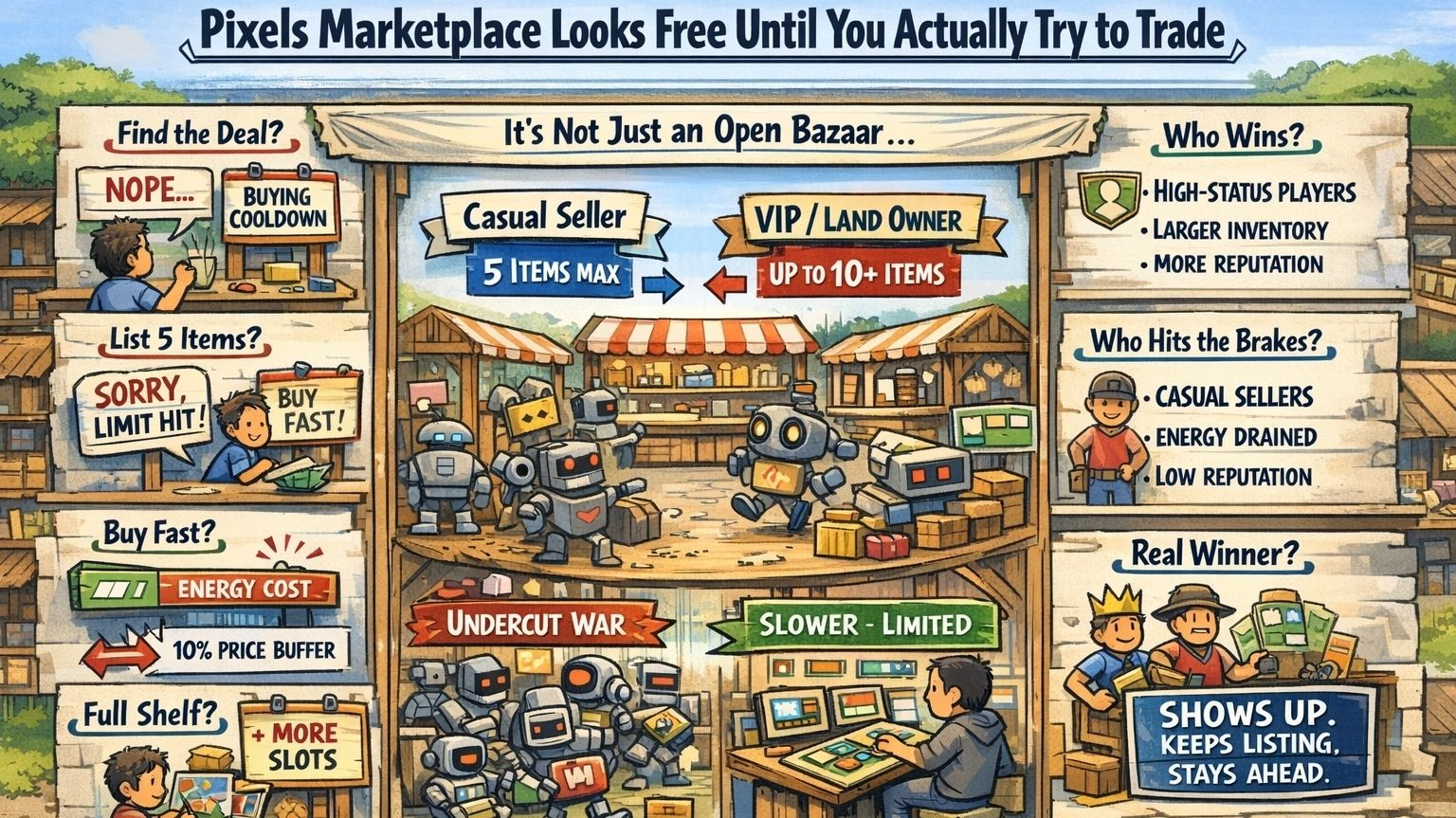
Buying cooldowns. Listing caps. Extra listing room for VIP and Land Owners. Energy cost when buying. Reputation-linked rules. That 10% price buffer around the cheapest listing.
At first, each rule looks small by itself. Fine. Normal game design stuff. But when they all sit together, the marketplace starts feeling different. It’s still a market, yes. But it’s not a fully free market. It’s more like a controlled trading floor where the devs are saying, “You can trade, but not too fast, not too much, and not always on equal terms.”
And look, I get why they’d do it.
A fully open in-game market gets ugly fast. I’ve seen this movie before. Bots start sniping faster than real players can blink. High-volume sellers flood the board. Someone undercuts by one tiny amount, then the next guy undercuts him, then everyone starts racing to the bottom like idiots. Before long, the market stops feeling like a game economy and starts feeling like a bot farm with cute graphics slapped on top.
So yeah, Pixels putting brakes on the marketplace makes sense.
But here’s the part traders should pay attention to.
Protection always creates winners too.
A casual seller with a few good items is not playing the same market as someone with VIP status or Land Owner expansion. Both have inventory. Both can list. But one guy gets more shelf space. One guy can stay visible longer. One guy can push more liquidity into the market while the smaller player keeps bumping into caps.
That’s not a small detail. That’s market reach.
And owning inventory isn’t the same as having market reach. I think that’s the real lesson here.
In normal trading, people obsess over price. Who is cheapest? Who can undercut? Who has supply? But in Pixels, price is only one part of the fight. You also need listing capacity. You need reputation. You need enough energy rhythm to keep buying. You need account status that gives you more room to operate. Basically, the marketplace isn’t just asking, “What do you want to sell?”
It’s asking, “How much permission do you have to sell properly?”
That part actually annoyed me, but it also impressed me a little.
Because from a design point of view, it’s clever. The marketplace is not just measuring demand. It’s filtering participation. It decides how many items can be shown, how fast buyers can move, how much sellers can pressure prices down, and which players can actually supply liquidity at scale.
The 10% price buffer is a perfect example.
In a pure market, the cheapest listing should eat all the attention. Lowest price wins. Simple. Brutal. Clean.
But Pixels softens that. If nearby listings still fall inside the buying range, the cheapest seller doesn’t fully control the board. That can protect sellers from getting destroyed by constant undercutting. It can also make pricing feel less sharp and less pure. Same rule. Two very different reactions.
That’s what makes this marketplace interesting to me.
It isn’t just a side menu where players dump extra items. It’s part of the actual economic machine of Pixels. The game isn’t only about farming, crafting, earning, and grinding tasks. It’s also about how easily value can move after those items exist.
And that movement is being managed.
For PIXEL readers, this matters more than people think. Marketplace health affects trust. If trading gets too wild, players feel like bots and whales are eating the game. If trading gets too restricted, normal players feel boxed in and start asking why they can’t just sell what they earned.
Pixels is trying to stand in the middle of those two problems.
Open enough so value can move.
Throttled enough so the market doesn’t eat the game alive.
That balance is smart. But it isn’t neutral. No market rule ever is.
To me, the real winner in Pixels may not always be the cheapest seller. It may be the seller who can keep showing up, keep listing, keep buying, and keep operating inside the rules while smaller players hit the brakes earlier.
And that changes how I look at the whole thing.
The Pixels marketplace is not just where players trade value.
It’s where the game quietly decides how much trading power each type of player actually gets.
