
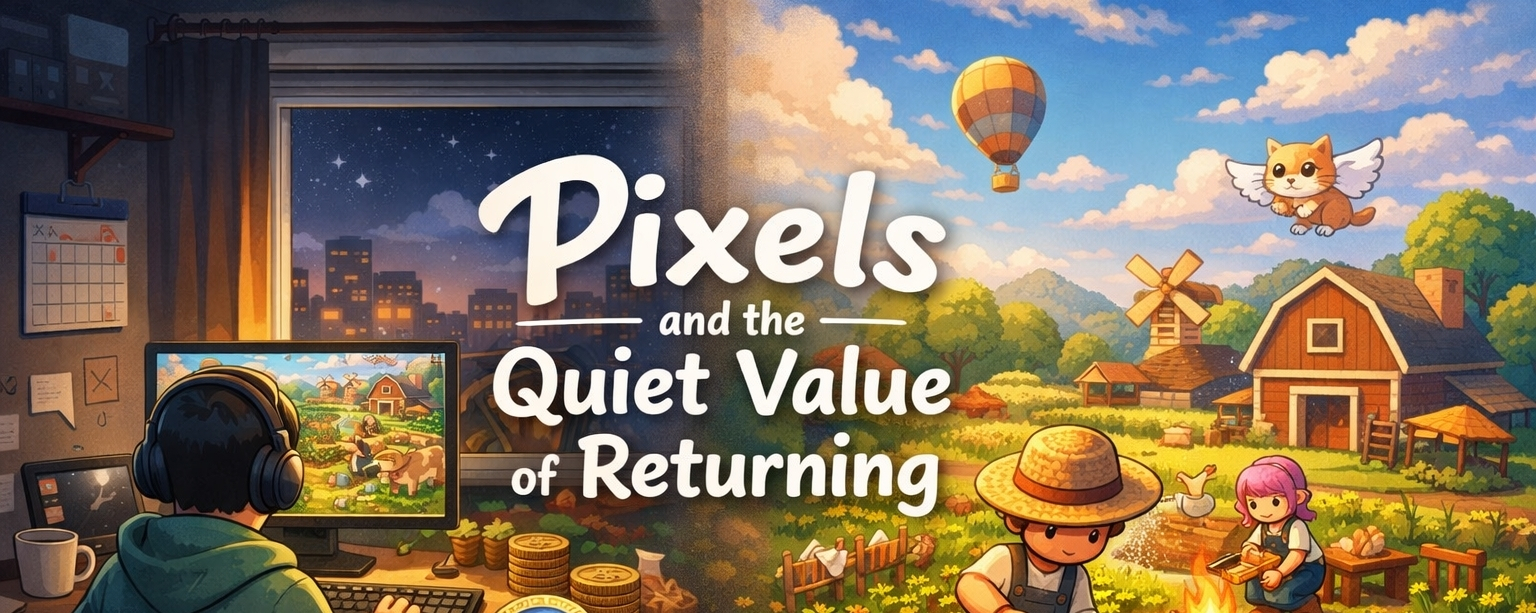
When I first came across Pixels, I honestly did not think much of it.
It looked familiar. A farming game, a social world, a token in the background. In Web3, that usually tells you enough to make a quick judgment. You expect the usual cycle. People show up early, talk about rewards, chase momentum, and then slowly disappear when the excitement wears off. I have seen that pattern enough times that I have started to recognize it almost immediately.
So that is what I thought Pixels was too.
But after sitting with it a little longer, I started feeling like I had read it too quickly.
Not because it was doing something loud or completely new. Actually, it was the opposite. What felt different about Pixels was something small. The kind of thing you do not notice right away because it does not try to impress you.
People kept coming back.
And not always for the reasons I expected.
They were not just showing up because of some big update or because the token was getting attention. A lot of the return felt quieter than that. People would log in, do a few tasks, walk around, farm, check on things, spend time there. Nothing dramatic. Nothing that sounds very important when you say it out loud. But that was kind of the point.
It did not feel like everyone was only there to extract something and leave.
That stood out to me because a lot of Web3 still feels built around urgency. Everything pushes you to think in terms of timing. Get in early. Maximize the opportunity. Watch the numbers. Stay alert. Even when a project talks about community or fun or culture, you can usually still feel the pressure underneath it. The whole experience often feels like it is asking one question over and over again: what is in this for me right now?
Pixels still has some of that too. I do not think it is free from it. The token matters. Attention matters. Market energy matters. I am not pretending those things are not part of the picture.
But what made me pause was that Pixels seemed to be asking for something else at the same time.
Not just attention. Routine.
And I think that is what I was slow to understand.
A lot of projects can create a spike. They can attract curiosity. They can get people talking. But getting people to come back when nothing major is happening is a different kind of achievement. That kind of return usually means the product has started to fit into someone’s life in a smaller, more natural way.
Not as an event. Just as a habit.
That may sound like a small thing, but it feels important. Especially in Web3, where so much depends on noise, novelty, and momentum. Most things in this space want to be noticed all the time. Pixels, at least to me, felt more interesting in the moments where it stopped trying so hard and just became a place people casually returned to.
That made me think differently about value.
We talk about value in Web3 in such a narrow way most of the time. Usually we mean price, rewards, attention, volume, growth. And those things do matter. But there is another kind of value that is harder to measure and easier to miss. It shows up when something starts to feel normal. When people stop needing a reason every single time they come back.
That is what I kept noticing with Pixels.
Not perfection. Not some magical new model. Just a different texture.
Sometimes it felt like a game. Sometimes it still felt like an economy wearing a game’s clothes. Sometimes it felt caught in between those two things. And I do not think that tension has gone away. In fact, it is probably still the biggest question hanging over projects like this. What happens when the excitement cools down? What remains when the rewards matter less? Does the world still hold people, or does everything start to feel empty once the outside incentive weakens?
I do not think I have a clean answer to that.
But I do think Pixels made me question one of my own assumptions.
I had started to believe that in Web3, the market is always the real product. Everything else is just packaging around it. And maybe that is still true more often than not. But Pixels made me feel like there are moments when something softer starts to form around the market. A rhythm. A routine. A place people do not just visit, but slowly settle into.
That does not mean it is solved. It does not mean it is lasting. It does not even mean I fully trust it yet.
It just means I noticed something I did not expect to notice.
What stayed with me was not the token. Not the promise. Not even the idea of the game on paper.
It was the feeling that, for some people, Pixels had started becoming part of their normal flow. Something light. Something easy to return to. Something that did not always need to justify itself in big, dramatic ways.
And maybe that is harder to build than we admit.
In a space where so many things are designed to pull your attention, there is something strangely interesting about a project that makes returning feel casual.
I am still not fully sure what Pixels becomes from here.
But I think I understand now why it felt different to me.
It was not because it looked bigger than other Web3 projects.
It was because, in a quiet way, it felt more lived in.
And that difference is small enough to miss at first.
Maybe that is why it stayed with me.
If you'd like, I can turn this into an even more personal, first-person article that sounds closer to a real human blog post than polished AI writing.