

I’ve been around crypto long enough to notice something uncomfortable: excitement doesn’t mean much anymore. It used to. There was a time when energy around a project felt like a signal, like maybe something real was forming underneath. Now it mostly feels like a reflex. A launch happens, people get loud, timelines fill up, numbers move, and for a brief moment everything looks alive. Then it fades. Not always immediately, but predictably enough that you start seeing the pattern before it finishes playing out.
That repetition changes how you look at things. It makes you slower to react, a bit more distant. I don’t really trust noise anymore. I pay more attention to what happens after the noise disappears. Who is still there when there’s nothing obvious to gain? Who keeps showing up when the rewards stop feeling exciting? That’s usually where the truth begins to show itself.
When I think about a project like Pixels, I don’t immediately focus on what it promises. I’ve heard too many polished promises in this space. The idea sounds familiar on the surface — players creating games around digital collectibles and owned progress. Crypto has been circling that idea for years. But familiarity isn’t necessarily a weakness. Sometimes it just means the industry is still trying to figure out something it hasn’t quite solved yet.
And the thing it hasn’t solved is actually pretty simple to describe, but difficult to build: how do you make digital ownership feel real?
Not technically real. That part is already solved. Wallets prove ownership perfectly well. You can hold something, move it, sell it, display it. But none of that guarantees you care about it. That’s the gap most projects underestimate. Possession is easy. Attachment is not.
I’ve owned plenty of digital assets that meant absolutely nothing to me. They were mine, but they didn’t feel like part of my life. No memory attached to them. No sense of effort. No story. Just objects sitting in a wallet, waiting for a better price. And that’s where a lot of crypto quietly breaks down. It assumes ownership automatically creates meaning. It doesn’t.
Meaning comes from repetition. From time. From doing something again and again until it starts to feel familiar. That’s true in games, in real life, in anything that holds emotional weight. You don’t care about something because you acquired it. You care because you lived with it.
This is where most crypto projects rush too fast. They try to install the narrative before the experience exists. They talk about worlds before there are habits inside those worlds. They design economies before players even have a reason to come back twice. It’s backwards, and you can feel it almost immediately when you interact with these systems.
You log in, and instead of being pulled into something, you’re pushed toward extracting something.
That subtle difference changes everything.
When a system is built around extraction, the user adapts quickly. Even if they don’t realize it consciously, their behavior shifts. They stop asking, “Do I enjoy this?” and start asking, “Is this worth it?” That one question drains meaning out of the experience faster than anything else. Because now every action is measured, not felt.
And once that mindset settles in, it’s hard to reverse.
I’ve seen it happen over and over. Projects attract users with incentives, and for a while it looks like growth. Activity goes up. Engagement metrics look healthy. But underneath, something is missing. People aren’t building a relationship with the system. They’re interacting with it like a temporary opportunity. And when the opportunity weakens, they leave just as quickly as they arrived.
It’s not even malicious. It’s learned behavior.
Crypto has trained people to think this way.
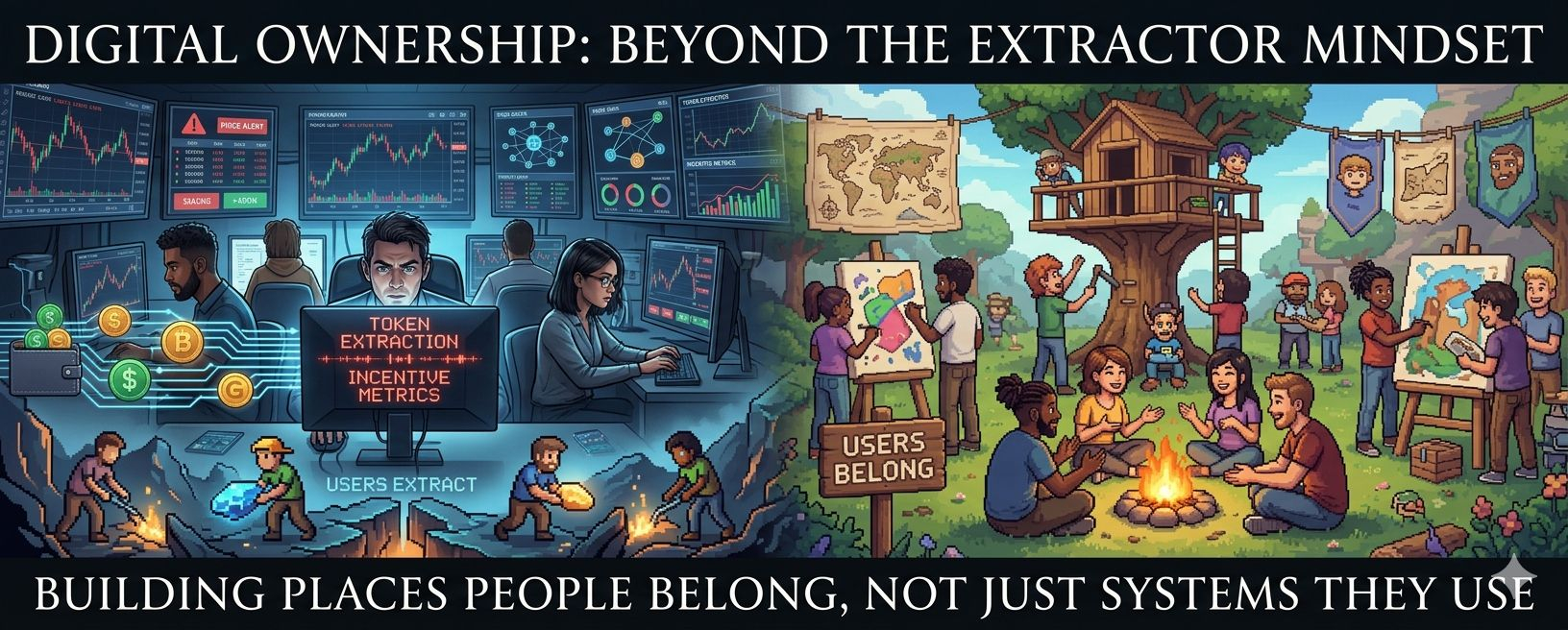
That’s why the difference between users who extract and users who belong matters more than most people realize. Extractors are always scanning for value. They move fast, they adapt quickly, and they rarely stay longer than necessary. Belonging is slower. It’s quieter. It doesn’t announce itself. But it shows up in small ways — consistency, familiarity, a kind of emotional residue that builds over time.
And that kind of behavior can’t be forced through token design.
It has to emerge.
That’s where something like owned progress becomes interesting, but only if it’s handled carefully. Progress has the potential to create continuity. It tells a user that what they did yesterday still matters today. It gives shape to time. But if that progress is immediately financialized, it loses that effect. It stops feeling like a personal history and starts feeling like a balance sheet.
And balance sheets don’t create attachment. They create decisions.
There’s also something fragile about introducing money into spaces that are supposed to feel like worlds. Money simplifies things. It compresses meaning into numbers. That can be useful in some contexts, but in digital environments, it often strips away depth. Actions stop being about expression or exploration and start being about optimization.
Once everything has a price, very little has meaning.
That’s one of the reasons crypto gaming has struggled. Not because the technology isn’t there, but because the emotional structure isn’t. Good games aren’t just systems. They’re environments where time accumulates in a way that feels personal. Where small actions build into something recognizable. Where players develop a sense of presence.
Crypto tends to interrupt that process. It adds a layer of awareness that pulls people out of the experience. You’re not just playing anymore. You’re calculating, even if it’s in the background.
And when that happens, the world never fully forms.
So when I look at Pixels, I don’t really care if it can generate excitement. That part is temporary by default. I care about whether it can create a rhythm that people fall into without thinking about it too much. Whether players come back because something inside the world is waiting for them, not because something is being offered to them.
It’s a small difference in wording, but a massive difference in outcome.
I pay attention to quieter signals now. Are people building things without immediately trying to monetize them? Do players recognize their own progress in a way that feels personal, not just measurable? Does the system allow space for memory to form before turning everything into an economy?
Those things don’t show up in announcements. You have to watch behavior over time.
And even then, it’s not always clear.
Because the truth is, crypto is still trying to figure out whether it can support real emotional structures, or if it will always lean toward financial ones. Maybe it can do both, but so far, the balance has been uneven. Too much emphasis on incentives, not enough on experience.
I’m not cynical about it. Just cautious.
I’ve seen enough cycles to know that what sounds right and what actually works are often very different things. And I’ve learned to respect the gap between them.
So I find myself thinking about questions more than conclusions.
What would it take for a digital object to feel like part of someone’s life, not just part of their portfolio? Can ownership evolve into something that carries memory, not just value? Can a system built on incentives also support genuine attachment, or do those two things eventually pull in opposite directions?
And maybe the bigger question that sits underneath all of this — even if we don’t say it out loud — is whether we are building places people want to belong to, or just systems people know how to use.
I don’t think we’ve answered that yet.
