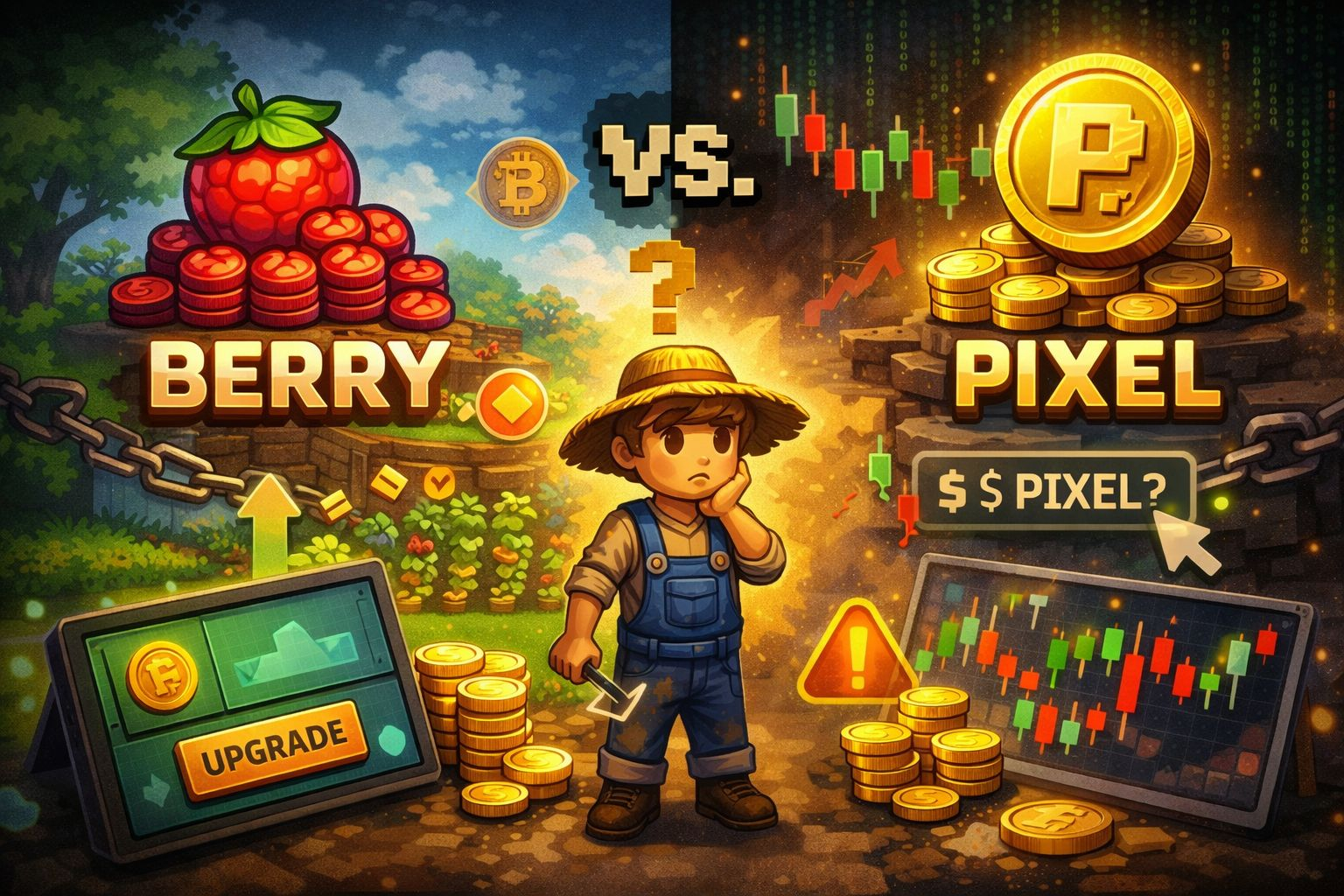
I almost upgraded my tools in Pixels yesterday, had the $PIXEL ready… then I backed out at the last second. Not because I couldn’t afford it, but because I caught myself thinking, “wait, what’s this worth outside the game right now?”
That hesitation wasn’t random. It made me realize how much the shift from BERRY to PIXEL has actually changed the way I play.
When I first got into Pixels, everything revolved around BERRY. It was simple. You farm, you earn, you spend. No overthinking. It felt like a proper game loop—effort in, reward out, upgrade, repeat. I never once opened a chart before deciding whether to plant crops or buy something. The currency lived inside the game, and so did my decisions.
But looking back now, that system had a flaw that wasn’t obvious at first. BERRY was too easy to accumulate. The more you played, the more it piled up—and eventually, it stopped meaning much. I remember sitting on a decent amount and not really feeling any urgency to spend it. That’s when you know something’s off. If a currency doesn’t push decisions, it starts losing its role in the economy.
That’s where PIXEL comes in—and honestly, I think people underestimate how big that shift really was.
PIXEL didn’t just replace BERRY. It changed the unit of thinking. Now every action has a second layer attached to it. It’s not just “do I need this upgrade?” it’s also “is this worth spending a tradable token on?” That’s a completely different mindset.
I tested this on myself without even realizing it. I bought a small bag of PIXEL a while back—not a huge position, just enough to feel involved. Since then, I’ve noticed I hesitate more in-game. I delay upgrades. I calculate more. Sometimes I even log out instead of spending.
That’s not random behavior. That’s what happens when your in-game currency becomes financially meaningful.
Here’s the part I find most interesting—and honestly, a bit uncomfortable. The game hasn’t just become more “valuable.” It’s become more conditional. My willingness to progress now depends on how I feel about PIXEL’s value at that moment. If I think it’s undervalued, I’d rather hold. If I think it’s overpriced, I hesitate to buy more or spend it.
So gameplay decisions start syncing with market perception, even when they shouldn’t.
And that’s the real shift most people miss. It’s not just about inflation vs scarcity, or BERRY vs PIXEL. It’s about how the player’s brain gets rewired.
With BERRY, I was thinking like a player.
With PIXEL, I’m thinking like a participant in an economy.
I don’t think this is purely good or bad—it’s just different. On one hand, it adds real stakes. What you earn and spend actually matters beyond the game. On the other hand, it introduces hesitation into places where there used to be flow. Even something as basic as upgrading tools now carries opportunity cost in a way it didn’t before.
And yeah, I’ve felt that friction personally. I’ve skipped upgrades I probably should’ve taken just because I didn’t want to part with my PIXEL. That’s not a gameplay limitation—that’s a psychological one introduced by the token design.
The move from BERRY to PIXEL wasn’t just a tokenomic fix. It was a decision about what Pixels wants to be.
Before, it felt like a game with an economy.
Now, it feels like an economy with a game attached.
Some people will prefer the old model—the simplicity, the freedom to just play without overanalyzing every move. Others will prefer the current setup, where time spent can translate into something with real-world value.
As for me, I’m still somewhere in between. I’m holding my small PIXEL position, still logging in, still playing—but more aware now. More calculated.
That one moment of hesitation before an upgrade told me more about the system than any whitepaper could.
And I don’t think I can unsee it now.
@Pixels #pixel $PIXEL