
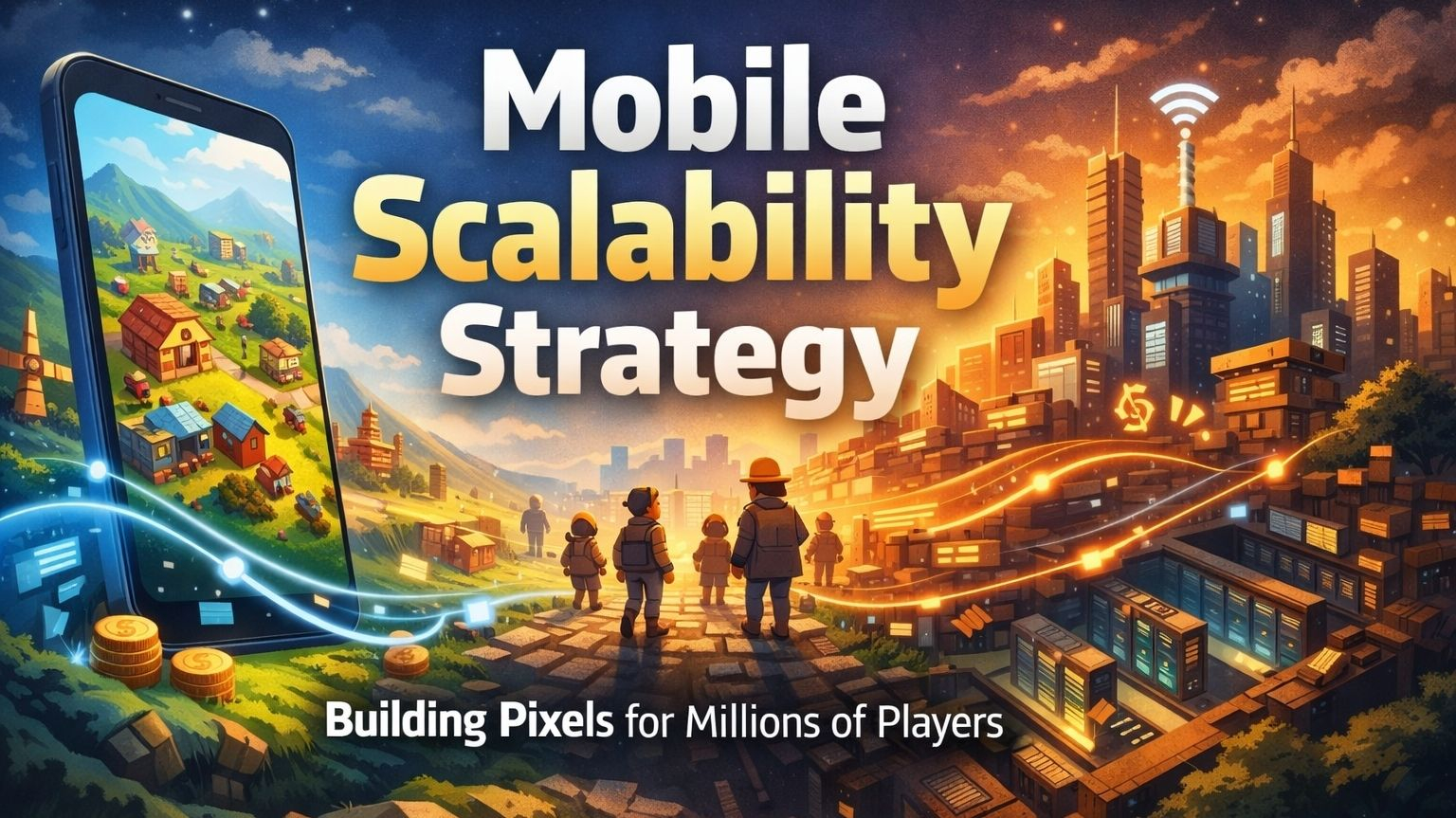
What actually happens when a game prepares itself not for thousands… but for millions of players at the same time?
I mean, we often say “mobile expansion” like it’s just another feature. Better access, more users, bigger reach. Sounds simple. But the more I think about it, the more it feels like mobile scalability is not just about access… it’s about redefining what the game is capable of becoming.
Because when a game moves to mobile at scale, it’s not just shrinking the experience to fit a smaller screen. Something deeper is being restructured.
At first glance, @Pixels going mobile looks like a natural step. More players can join. Barriers drop. Anyone with a phone can enter the world. That’s growth… right?
But then I started thinking what kind of system can actually handle that level of participation?
Not just technically… but economically, behaviorally, structurally.
Because adding millions of players doesn’t just increase activity. It multiplies complexity.
More interactions.
More transactions.
More data.
More unpredictability.
And suddenly, mobile scalability doesn’t feel like a design choice anymore. It starts to look like an infrastructure challenge.
When you go deeper, it becomes less about gameplay and more about coordination.
How do you maintain smooth interaction when thousands of players act at the same time?
How do you ensure fairness when reward systems are under constant pressure?
How do you keep the experience consistent across different devices, speeds, and behaviors?
It makes me wonder… is mobile really about convenience, or is it about building a system that can survive scale?
Because scale changes everything.
And in Pixels, it feels like scale is not an afterthought it’s being designed from the beginning.
Then there’s the data layer.
More players means more behavior. And more behavior means more signals.
Every tap, every movement, every decision—it all feeds into the system. At a small scale, this might not matter much. But at mobile scale… it becomes the core.
Because now, the system has enough information to actually learn.
Learn what works.
Learn what keeps players engaged.
Learn how the economy flows.
And that’s where things start to shift.
Because mobile scalability is no longer just about handling more users it’s about transforming the game into a constantly evolving system.
Maybe this is not about gameplay anymore.
Maybe this is about building an environment where millions of players can exist within a shared structure without breaking it.
Because once you reach that level, the game starts to behave differently.
It becomes less like a static experience…
and more like a living network.
One interaction,rastructure supports massive concurrency.
Data continuously refines the system.
And incentives adapt to large-scale behaviorm
And that’s where Pixels starts to feel less like a single game… and more like a platform designed for mass participation.
For developers, this opens up a different kind of opportunity.
Building for mobile inside this kind of ecosystem isn’t just about optimization. It’s about compatibility with scale. Because the system itself is evolving to handle millions, and anything built within it needs to align with that reality.
So the question shifts again.
Not just “can this game run on mobile?”
But “can this game exist at scale?”
That’s a much bigger question.
But there’s also something else that keeps coming to mind.
When everything becomes optimized for scale…
when systems are designed to handle millions…
when behavior is constantly being tracked and adjusted…
What happens to the smaller, unpredictable moments?
The randomness. The chaos. The things that don’t scale neatly.
Because those have always been part of what makes games feel alive.
So maybe the real challenge here isn’t just scaling the system…
But scaling it without losing that feeling.
And that’s where I find myself thinking again…
If a game successfully builds for mobile at massive scale handling millions of players, continuous data flow, and real-time interaction
is it still just expanding its reach?
Or is it quietly transforming into something closer to a digital infrastructure where gameplay is only one part of a much larger system… 👀