
I remember a friend of mine last year who got deep into a Web3 farming game. He wasn’t even interested in the gameplay. He built spreadsheets before he built anything in-game. I watched him calculate optimal routes, daily reward loops, token emissions everything except whether the game was actually fun. For a few weeks, it worked. He made money. Then the token slipped, rewards adjusted, and within a month, he stopped logging in. Not gradually completely.
That pattern stuck with me. And it’s exactly why Pixels feels different… but not immune.
When I first started digging into Pixels, I didn’t expect much. Another farming sim with a token attached. But then I noticed something unusual. People weren’t just optimizing they were staying. I tried it myself. I planted crops, wandered around, chatted with random players. It felt simple, almost slow. But that was the point. I wasn’t rushing to extract value. I was just playing.
That’s a small shift, but it changes everything.
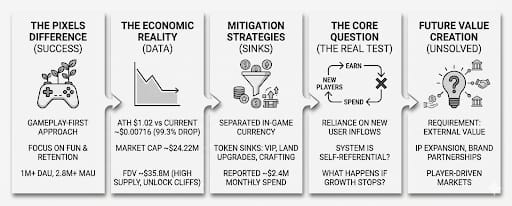
Most Web3 games collapse because they’re built like financial loops disguised as games. Pixels leaned the other way. Gameplay first, extraction second. Farming, progression, social loops these weren’t just mechanics, they were the reason to log in. That’s how it managed to scale to over 1M DAU and 2.8M MAU after moving to Ronin, with earlier data showing 180K+ DAU in 2023 and later milestones like 5M lifetime wallets and 200K+ VIP users.
That’s not fake activity. That’s real usage.
But usage alone doesn’t solve the deeper issue.
Let’s look at the token side for a second, because that’s where reality hits. As of April 20, 2026, $PIXEL is trading around $0.00716. Market cap sits near $24.22M, with about $9.86M in 24-hour volume. Fully diluted valuation is roughly $35.8M, based on a max supply of 5B tokens and a circulating supply of about 3.38B.
Now compare that to its all-time high of $1.02 in March 2024. That’s a drop of around 99.3%.
You don’t get that kind of drawdown unless the market has aggressively repriced expectations. The hype is gone. The “easy yield” narrative is gone. What’s left is the actual system and whether it works.
I noticed something else when looking at the unlock structure. Tokenomist data shows about 15.42% of supply unlocked (around 771M tokens), with the next unlock scheduled for May 19, 2026, and vesting continuing through 2029. The structure leans heavily on cliffs, which means supply doesn’t drip, it hits in chunks.
That matters. Because every unlock is a test of whether real demand exists.
And this is where the core issue comes back.
Pixels did something smart with its economy. It separated in-game currency from the main token, reducing immediate sell pressure. It created sinks like VIP memberships, land upgrades, and crafting loops. Monthly in-game spending reportedly reached around $2.4M in $PIXEL, roughly 4.45M tokens used per month at one point.
That’s a strong signal. It means people are actually spending, not just extracting.
But I’ve seen systems like this before just not executed as well.
A while ago, I tried flipping items in another game economy. At first, it worked perfectly. Buy low, sell high, reinvest rewards. But after a few weeks, I noticed something subtle. The buyers weren’t new players. They were the same group cycling value around. When fewer new players joined, liquidity dried up. Prices didn’t crash instantly they just stopped moving. That’s when I exited.
Pixels hasn’t hit that wall yet. But the structure still points in that direction.
If you break it down simply, the system still relies on a loop: players earn → players spend → players extract. For this to stay healthy, new demand has to keep entering. Not just new players but new money, new reasons to hold, new value entering from outside the loop.
Otherwise, it becomes self-referential.
The token allocation also hints at future pressure. Ecosystem rewards take 34%, treasury 17%, private investors 14%, team 12.5%, advisors 9.5%, and smaller portions across launchpool, alpha rewards, and liquidity. That’s a lot of supply that will eventually meet the market.
So the question isn’t whether Pixels built a better game. It did.
The question is whether it built a system that can survive without constant growth.
Because growth hides problems. It absorbs emissions. It masks inefficiencies. Everything looks stable when new users are flowing in. The real stress test begins when that slows down.
And I think we’re getting closer to that phase.
To be fair, Pixels is evolving. The Ronin migration was a major step. The introduction of VIP systems, land mechanics, and deeper progression loops shows they’re trying to build retention beyond rewards. There’s also a gradual shift toward making the ecosystem feel more like a platform than a single game.
That’s the right direction.
But from where I stand, one thing still isn’t fully solved: external value creation.
Where does the money come from when no new players arrive?
Is it from IP expansion? Creator economies? Off-chain integrations? Brand partnerships? Deeper player-driven markets?
Because if value only circulates internally, it eventually hits a ceiling.
I’m not bearish on Pixels. If anything, I think it’s one of the most important experiments in Web3 gaming right now. It already proved that people will show up and stay if the experience is good enough.
But I’m also not convinced it has fully escaped the old cycle.
It just slowed it down.
So now I’m watching a different metric not DAU, not token price, but something harder to see. Whether the system can generate demand that doesn’t depend on new users entering the funnel.
Because that’s where most projects quietly fail.
And maybe the better question is this:
If growth stopped tomorrow, would Pixels still feel alive or would it start unraveling slowly?
And if you’re holding or playing… what would make you stay if the rewards dropped another 50%?

#StrategyBTCPurchase #WhatNextForUSIranConflict #RAVEWildMoves #KelpDAOFacesAttack