
Something about Pixels feels different—and I don’t say that lightly.
I’ve spent enough time around crypto games to recognize recycled ideas the moment I see them. Same loops. Same incentives. Same short-lived excitement followed by slow decay. Most projects don’t even realize they’re repeating the same mistakes.
But Pixels… it doesn’t feel careless.
At first glance, it’s simple. Farming, exploration, social interaction. No overwhelming mechanics. No forced complexity. It’s the kind of experience that lets you ease in without friction. And that’s exactly why it works—it respects attention.
But what really keeps me watching isn’t the gameplay.
It’s the structure behind it.
I don’t look at Pixels like a typical game anymore. I see it as a carefully designed ecosystem—one that understands something most Web3 projects learned the hard way: uncontrolled rewards kill longevity.
Pixels doesn’t chase noise. It manages flow.
Every action inside the game feels intentional. Activity isn’t just encouraged—it’s shaped. The system rewards consistency, participation, and alignment with the ecosystem in a way that feels natural, not forced.
And that’s a big shift.
Because the old “play-to-earn” model was broken from the start. It rewarded extraction over contribution. People came in, farmed aggressively, and left. That wasn’t growth. That was leakage.
Pixels flips that dynamic.
Instead of rewarding everyone equally, it creates an environment where value stays in motion. Where players who actually engage with the system benefit the most. Where behavior matters.
That’s not just good design—that’s survival thinking.
And I respect that.
What also stands out to me is how smoothly everything is layered. The social side isn’t just there for decoration. It creates connection. It builds identity. It gives players a reason to stay beyond just rewards.
That kind of stickiness can’t be faked.
It’s subtle, but powerful.
Because when players feel part of something, they don’t behave like short-term extractors anymore. They become participants. And that changes the entire economy.
This is where Pixels separates itself.
It’s not trying to impress with complexity. It’s trying to last.
And in this space, that’s rare.
I’m not saying it’s perfect. No system is. But what I see here is direction. A project that’s thinking beyond the usual cycle of hype → farming → dumping → decline.
Instead, it’s building a loop that actually makes sense long term.
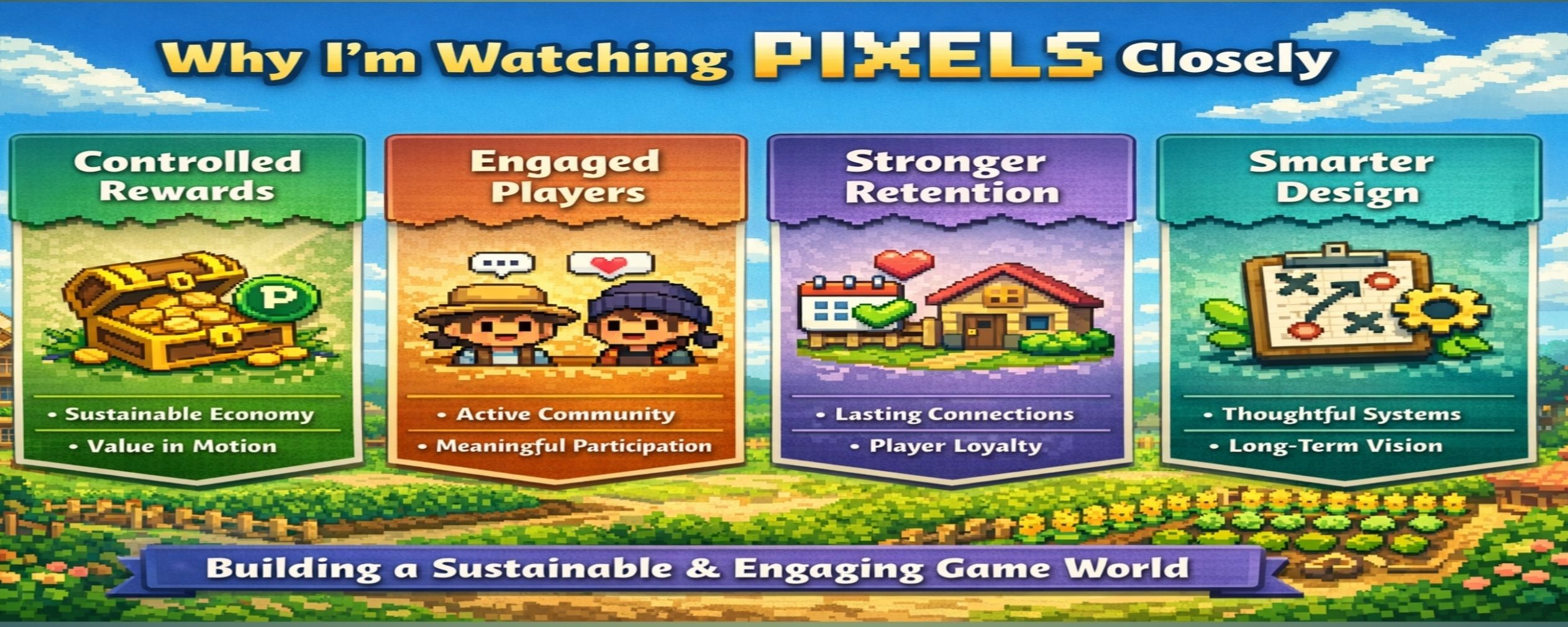
Controlled rewards.
Engaged players.
Stronger retention.
Smarter design.
That combination matters more than flashy promises.
So yeah—I’m watching Pixels closely.
Not because it’s loud.
But because it’s deliberate.
And in a space full of noise, the projects that move quietly with intention are usually the ones worth paying attention to.
