
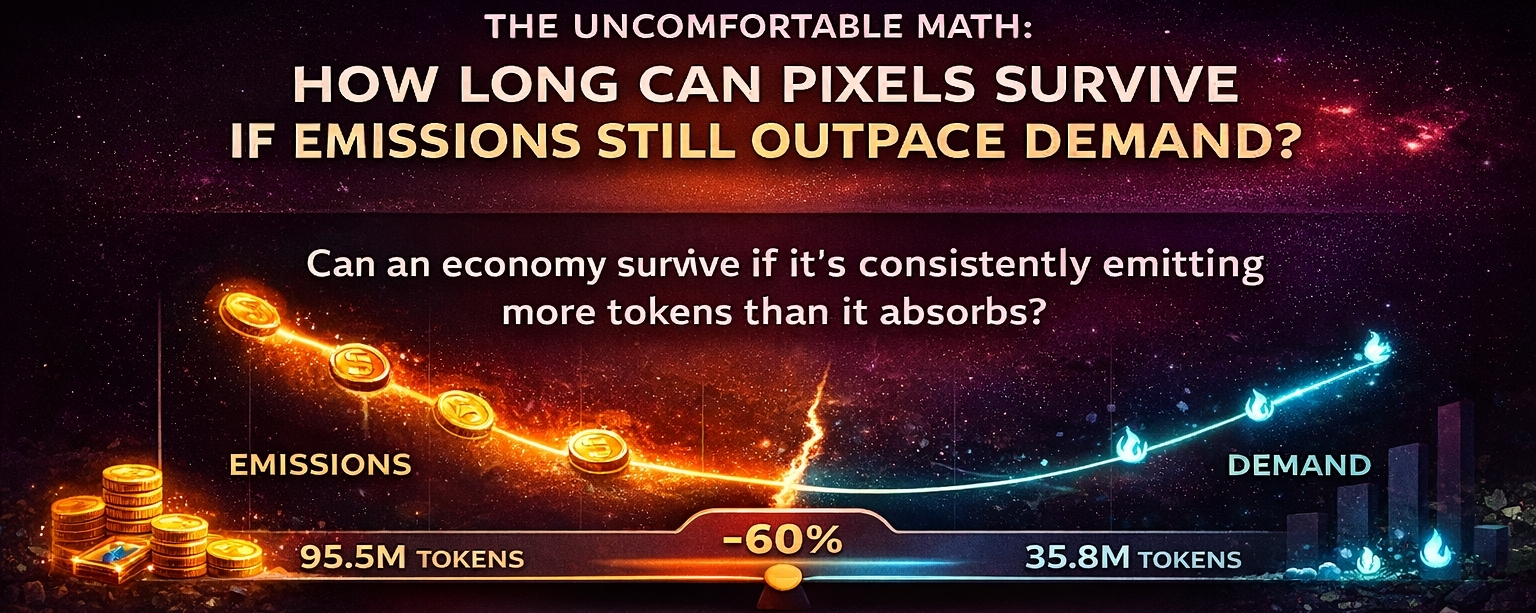
I’ve been spending more time digging into Pixels lately not just the surface-level metrics everyone shares, but the underlying mechanics that actually determine whether this thing lasts. And the deeper I go, the more I keep coming back to one uncomfortable question:
How long can an economy survive when it’s consistently putting out more value than it’s taking in?
At a glance, Pixels still looks like a success story. It has crossed 1M+ daily active users at its peak, with millions of total accounts created. Even today, activity remains strong relative to most Web3 games. On paper, it’s exactly what the industry has been trying to build for years: scale.
But scale alone doesn’t equal sustainability. And that’s where the math starts to get uncomfortable.
When I look at Pixels, I don’t just see a game—I see an economy. And like any economy, it runs on two forces: emissions and demand.
Emissions are what the system gives out—token rewards, incentives, farming yields. Demand is what players give back—time, attention, spending, or reasons to hold the token beyond extracting value.
The problem is, in most play-to-earn systems—including Pixels, at least historically—emissions come first, and demand tries to catch up later.
That imbalance works… until it doesn’t.
At its peak growth phase, Pixels leaned heavily on incentives to bootstrap activity. And to be clear, that strategy worked. You don’t reach hundreds of thousands—or even millions—of users without doing something right.
But here’s the part most people ignore:
not all users are equal.
A large portion of that activity was driven by what I’d call “extractive behavior.” Players weren’t necessarily there to play—they were there to earn. They optimized for output, not enjoyment. They farmed efficiently, withdrew consistently, and moved on when rewards dropped.
From a metrics perspective, this still shows up as growth. DAU goes up. Engagement spikes. XP generation increases.
But economically? It creates constant sell pressure.
If more value is being emitted than absorbed, the system slowly starts leaking. Not all at once—but gradually, quietly, and then suddenly.
And this is where the math becomes unavoidable.
Let’s simplify it.
If a game distributes millions of dollars worth of tokens over time, there are only a few ways that value doesn’t immediately exit:
Players spend it back into the game
Players hold it for future utility
New demand enters to absorb it
If none of those scale fast enough, emissions win. And when emissions win, the token—and eventually the economy—starts to weaken.
What makes Pixels interesting right now is that it seems fully aware of this problem.
If you look closely at recent changes and messaging, there’s a clear shift happening. The game is moving away from a pure “play-to-earn” loop and toward something more complex: a broader ecosystem where value can circulate instead of just exit.
We’re starting to see:
Expanded utility for the $PIXEL token
Early signs of staking mechanics
A push toward integrating multiple games into one shared economy
Less emphasis on raw rewards, more focus on participation and retention
In theory, this is exactly the direction it needs to go.
Because the real goal isn’t just to attract players—it’s to convert them from extractors into participants.
But that transition is where things get difficult.
You can incentivize users to show up. That’s easy.
You can’t easily incentivize them to care.
And without real engagement—without reasons to stay beyond rewards—demand remains fragile.
I’ve seen this pattern before across multiple Web3 games. The early phase is explosive. Incentives drive growth, numbers look incredible, and it feels like product-market fit has been achieved.
Then emissions continue… but attention fades.
The strongest projects are the ones that manage to bend that curve—where demand eventually overtakes emissions. Where players start valuing the experience itself, not just the rewards attached to it.
Pixels isn’t there yet. But it’s not ignoring the problem either.
Right now, it feels like the project is sitting in a transitional phase:
Still benefiting from its early growth
Still carrying the weight of its emission-heavy past
Trying to build a future where the economy sustains itself
That’s a difficult balance.
Because here’s the reality:
emissions are immediate, but demand takes time.
And time is exactly what high-emission systems don’t have much of.
If I had to frame it simply, Pixels is no longer in its growth phase—it’s in its conversion phase.
The question is no longer: “How many users can it attract?”
It’s: “How many of those users will stay when the incentives aren’t enough?”
That’s the real test. And it’s the one metric that matters more than anything else.
Because if demand doesn’t catch up—if players don’t transition from farmers to actual users—the math eventually forces an outcome.
Not through hype cycles or sentiment shifts.
But through simple economics.
And economics, unlike narratives, doesn’t bend easily.
From where I stand, Pixels still has a real shot. The scale is there. The awareness is there. The willingness to evolve is clearly there.
But the window isn’t unlimited.
The longer emissions outpace demand, the narrower that window becomes.
And that’s the uncomfortable math no one can ignore forever.