
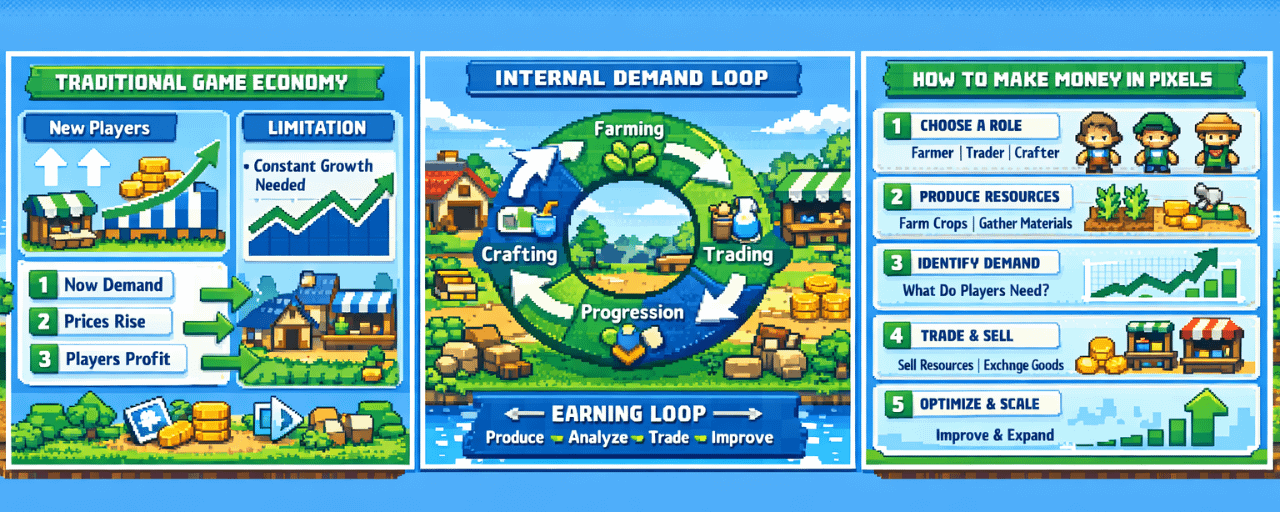
I used to think most game economies only worked as long as new players kept coming in. More users meant more demand, more demand meant higher prices, and higher prices kept people interested.
It felt like a system that depended heavily on constant growth, where momentum came from outside rather than within. And once that flow of new users slowed down, everything else seemed to weaken with it.
So naturally, I assumed @Pixels would follow the same pattern, because that’s what most systems rely on.
But the more I paid attention, the more I started to question that assumption. At first glance, Pixels looks familiar—players farm, craft, and trade like in many other games. But underneath that, something feels different.
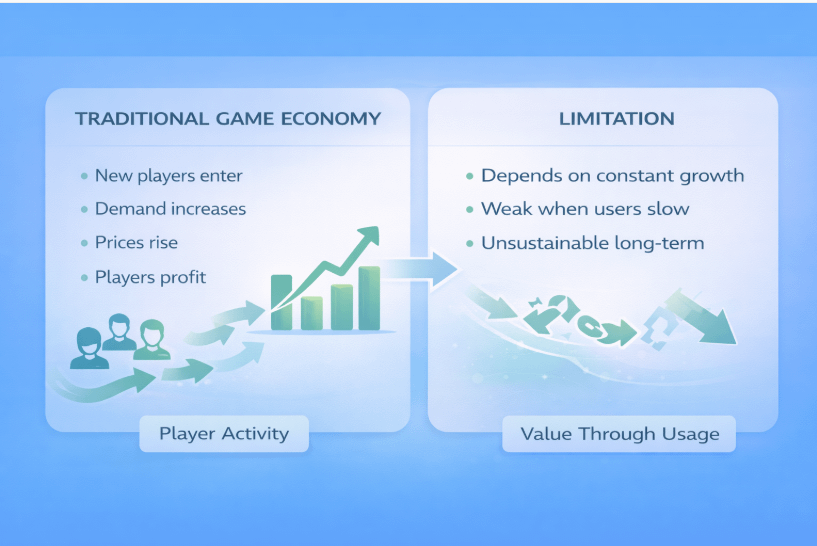
Instead of value being driven mainly by new players entering the system, it starts to look like value is being driven by how existing players interact with each other. That shift might seem small, but it changes how the entire system behaves.
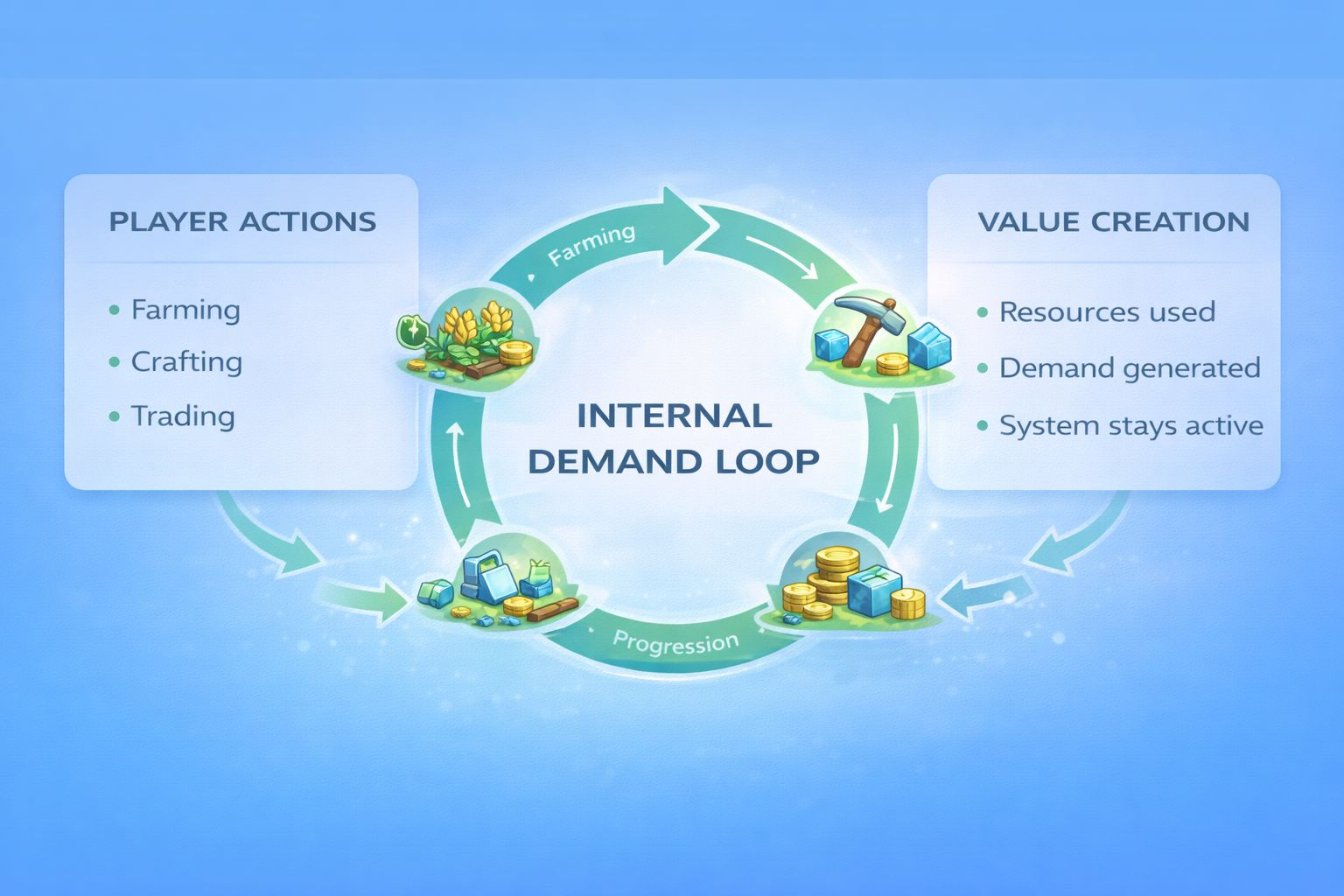
In many systems, demand is external. New players arrive, they need resources, and that pushes value upward. But Pixels seems to lean toward something else—demand generated from within the system itself. Resources aren’t just produced to be sold; they’re used.
Crops become inputs for crafting, crafted items support progression, and progression creates new needs. Those needs then feed back into demand, creating a loop that isn’t dependent on constant expansion. It’s not just a cycle of earning—it’s a cycle of usage.
That changes the dynamic in a meaningful way. Because now, demand can come from existing players continuing to engage with the system rather than relying entirely on new ones. If one player farms, another might need those resources for crafting.
If crafting increases, trading becomes more active. If trading becomes more efficient, more players can progress. And as players progress, new requirements emerge. The system begins to reinforce itself through interaction, creating a kind of internal momentum.
This leads to a bigger question. Can an economy sustain itself primarily through internal interaction? Because if it can, it reduces one of the biggest risks most systems face—the need for constant external growth.
It doesn’t remove that need entirely, but it changes how dependent the system is on it. Instead of growth being the only driver, activity becomes just as important.
It also shifts how players think. In systems driven by external demand, behavior tends to focus on timing—getting in early, extracting value, and exiting before things slow down. But when demand comes from interaction, the focus changes.
Players begin to think about participation instead. Where can I contribute? What is currently needed? How do I stay relevant within the system? The mindset becomes less about extraction and more about positioning within an evolving environment.
Of course, this raises challenges as well. Internal demand isn’t guaranteed to be enough, and player behavior can change over time. Activity levels may fluctuate, and without proper balance, even internally driven systems can lose momentum.
So it’s not a perfect solution, and it doesn’t eliminate risk. But it does introduce a different approach—one that doesn’t rely entirely on constant expansion to survive.
That’s what makes Pixels interesting to me. It’s not just building a game; it’s experimenting with how value can be sustained through interaction. It’s exploring whether a system can remain active because players need each other, not just because new players keep arriving.
That idea isn’t fully proven yet, and it will depend on how the system evolves, but it’s enough to change how I look at it.
So now I’m thinking about it differently. Not as a system that needs continuous growth to function, but as one that might be able to sustain itself—at least partially—through how players engage with each other. And that brings me back to the question that keeps coming up. If internal demand is strong enough, do you still need constant new users to keep an economy alive? Or can interaction itself become the foundation?
Curious how others see this. Is this a real shift in how game economies can work, or does every system eventually come back to needing growth from the outside?
#pixel $PIXEL
