
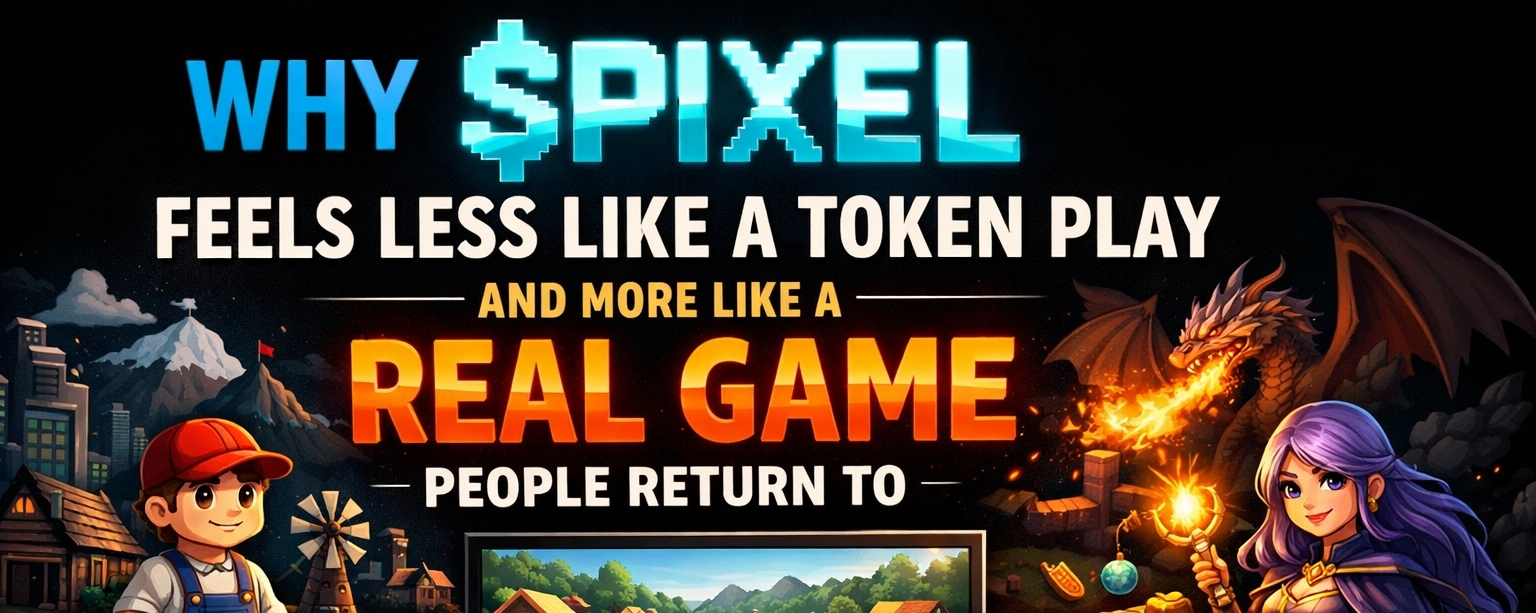
What keeps pulling me back to Pixels is that it does not feel like it was built just to keep a token alive.
That sounds obvious, but in crypto it really is not. Most projects reveal themselves faster than people admit. You spend a bit of time around them and the pattern becomes hard to ignore. The product exists to justify the chart. The community exists to defend sentiment. The roadmap exists to buy more time. Even when everything looks polished on the surface, you can usually feel when the real center of gravity is speculation rather than genuine user interest.
Pixels gave me a different feeling.
Not right away. At first, I almost dismissed it the same way many people probably do. A pixel-style farming game tied to crypto does not sound like the kind of thing that should create serious conviction. It sounds lightweight. Maybe even temporary. The kind of project people visit for a while, collect what they can, and leave behind once the rewards become less attractive or attention shifts somewhere else.
But the longer I looked, the harder it became to reduce it to that.
What makes Pixels interesting is not that it looks revolutionary. It is that it seems to understand something a lot of crypto gaming projects never really understood. People need a reason to care before they need a reason to earn.
That order matters more than most teams realize.
A lot of GameFi projects made the same mistake. They built the economy first and hoped the game would eventually justify it. They treated rewards as the hook and assumed behavior would naturally follow. What actually happened was predictable. Users came for extraction, not attachment. The moment incentives weakened, activity started to fade. There was never enough underneath to make people stay.
Pixels feels like it was built with a better instinct. The world comes first. Routine comes first. Social behavior comes first. The token is not pretending to be the whole experience. It exists inside an experience that already has its own rhythm.
And once a project reaches that point, you start noticing a different kind of strength.
The thing that stayed with me most was how people seemed to exist inside Pixels rather than just pass through it. That difference is easy to miss if you are only looking from a distance. But once you spend time observing a project, you can tell whether users are there because they are chasing a short-term opportunity or because they have actually built habits around it.
With Pixels, it feels more like habit.
People are not only talking about price. They are talking about what they are doing, how they are progressing, how they are using land, how they are thinking about efficiency, how they fit into the world. That may not sound dramatic, but in crypto that is one of the clearest signs that something is healthier than it first appears.
Because once people begin building routines, the project stops depending only on hype.
That is where I think the market may still be underestimating Pixels. A lot of investors are trained to respond only to loud signals. Big announcements. Sharp moves. Sudden narrative rotations. But some of the more durable projects grow differently. They become part of people’s daily behavior before the market fully understands what that means. They look small until one day it becomes clear they were building stickiness while everyone else was building noise.
Pixels has some of that feeling.
I also think its design choices deserve more credit than they usually get. It does not feel desperate to prove itself. That might sound like a strange compliment, but I mean it seriously. So many crypto games overcomplicate themselves because they are trying to appear more impressive than they actually are. They mistake complexity for depth. Pixels feels more comfortable being playable, accessible, and socially alive. It lowers friction instead of turning every interaction into some elaborate test of patience.
That restraint matters.
Crypto gaming was never going to win by copying traditional gaming badly. It does not need to overpower AAA studios with spectacle alone. It needs to offer something else. A world that is easy to enter, rewarding to return to, and strong enough to support ownership and economy without collapsing into pure speculation. Pixels feels closer to that balance than many of its peers.
What also stands out is the tone of the project itself. It feels less like a financial product disguised as a game and more like an actual environment that happens to have an economy attached to it. That distinction is subtle, but it changes how people behave. When users feel like they are inside a place rather than inside a monetization loop, they engage differently. They become more patient. More invested. More willing to return for reasons that cannot be reduced to price alone.
And that kind of engagement is hard to fake.
Still, none of this means the project is above criticism.
Gaming is hard even without crypto attached to it. Attention is fragile. Retention is difficult. Content has to keep evolving. Economies have to be balanced carefully or they become either too extractive or too hollow. A healthy loop today can become stale later if the team stops adapting. And in crypto, even strong products can be misunderstood, flattened into simple narratives, and traded far below what their actual user behavior might deserve.
Pixels still has real questions ahead of it.
Can it keep users engaged over a longer cycle? Can it expand without losing what makes it feel natural in the first place? Can its economy remain useful without becoming overwhelming? Can it stay culturally relevant when the market inevitably becomes distracted by something louder and newer?
Those questions matter.
But I find them more meaningful than the usual questions crypto forces you to ask. I would rather spend time thinking about whether a real player ecosystem can deepen than whether another empty token can survive on momentum alone.
That is probably the clearest way to explain why Pixels stayed with me.
It does not feel flawless. It does not feel guaranteed. It does not even feel like the kind of project trying too hard to convince you. It just feels more grounded than most of what surrounds it. More aware that lasting value usually forms where people genuinely want to spend time.
And maybe that is why it feels different.
The more I looked at it, the less it felt like another scheme dressed up as an ecosystem. The less it felt like something built mainly for rotation and speculation. It started to feel like a product with its own gravity, and in this market that is rarer than people think.
Conviction usually does not arrive all at once. It forms quietly. You spend time observing, comparing, doubting, coming back, noticing small things other people overlook. Then one day you realize you are no longer asking whether the project can create temporary attention. You are asking whether the market has fully understood what is already there.
That is where Pixels sits for me.
Not as some perfect answer. Not as a guaranteed winner. Just as one of the few projects in this part of the market that feels like it was built to be lived in, not merely traded around.
And that difference is big enough to remember.
