
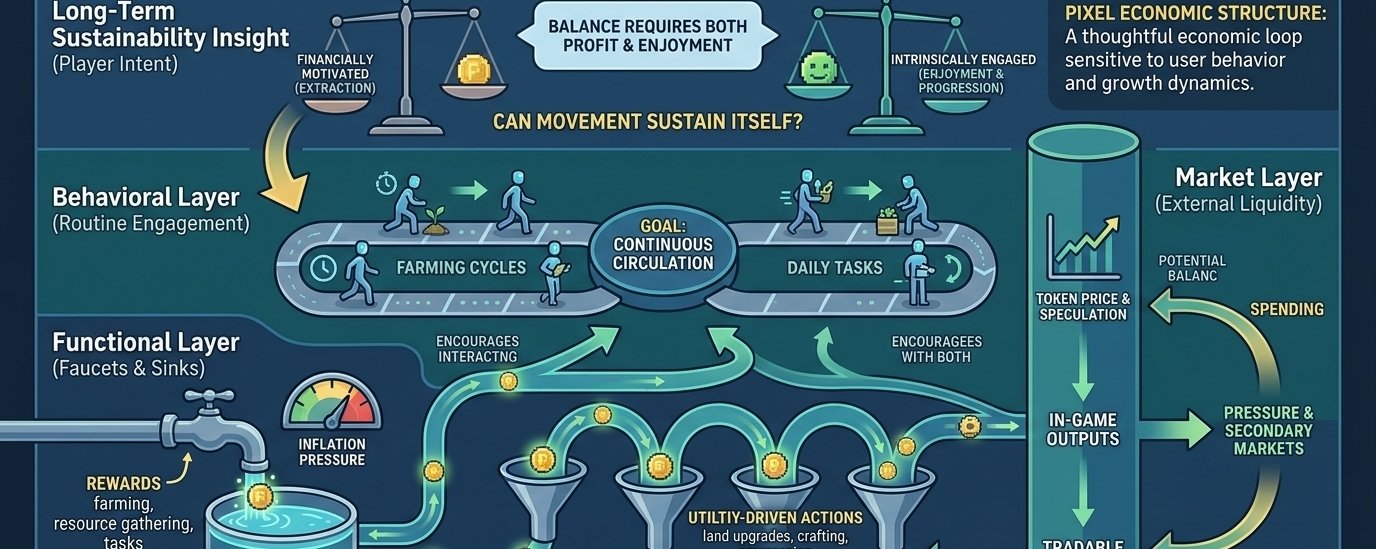
Most people misunderstand projects like Pixel because they focus on the surface layer — the token price, the rewards, or the “play-to-earn” label. The actual system is not defined by how much users earn, but by how value moves through the ecosystem and whether that movement can sustain itself.
At a functional level, Pixel operates as a closed-loop game economy with controlled inputs and outputs.
First, value enters the system through reward mechanisms. Players earn PIXEL tokens by completing tasks such as farming, resource gathering, and participating in in-game activities. These are the primary “faucets.” They continuously inject tokens into circulation based on player activity.
Second, the system attempts to counterbalance this through “sinks.” Tokens are spent on land upgrades, crafting, progression mechanics, and other utility-driven actions. These sinks are critical because they determine whether tokens accumulate in player wallets or get recycled back into the system.
Third, there is a behavioral layer. The game is designed to encourage routine actions rather than one-time extraction. Daily tasks, time-based farming cycles, and incremental progression systems push users to stay engaged and repeatedly interact with both faucets and sinks. This is not accidental. The goal is to slow down token outflow by tying rewards to ongoing participation instead of immediate liquidation.
Fourth, there is a market layer. Players can convert in-game outputs into tradable value, which introduces external liquidity dynamics. At this point, the system is no longer purely internal. Token price, speculation, and secondary markets begin influencing player behavior. If players prioritize selling over spending, sinks weaken and inflation pressure increases.
The reason this design might work is because it acknowledges a core issue that many Web3 games ignore: distribution alone is not enough. By embedding multiple spending pathways and encouraging habitual engagement, Pixel attempts to create continuous circulation rather than one-directional extraction. If players consistently reinvest tokens into the game, the economy can maintain relative balance even with ongoing emissions.
However, the system has clear failure points.
If reward rates outpace sink demand, tokens will accumulate and lose value. If sinks feel optional or lack meaningful utility, players will avoid spending. If player growth slows, new value entering the system decreases while existing supply remains, increasing sell pressure. Additionally, if a significant portion of users are financially motivated rather than intrinsically engaged, behavior will skew toward extraction regardless of design.
One critical long-term sustainability insight is that the system depends less on tokenomics alone and more on player intent. Even well-designed sinks cannot compensate for a user base that consistently exits value. Sustainable balance requires a mix of players who spend for progression or enjoyment, not just profit. This shifts the challenge from purely economic design to product design — the game itself must be compelling enough to justify reinvestment.
In conclusion, Pixel is structured around a relatively thoughtful economic loop that tries to balance token issuance with enforced utility. The mechanics are not inherently flawed, but they are highly sensitive to user behavior and growth dynamics. Its success depends on maintaining equilibrium between earning and spending while keeping players engaged for reasons beyond short-term financial gain.