
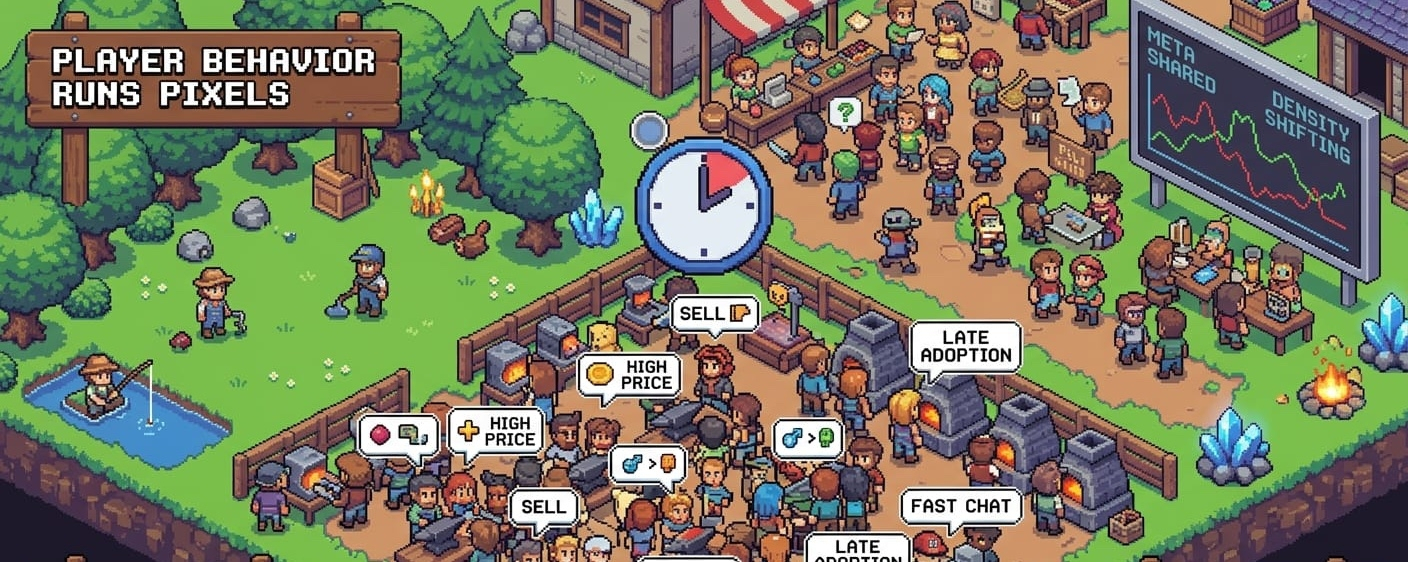

Pixels looks straightforward at first.
You farm, you craft, you trade. Same loop you’ve seen in a dozen other Web3 games.
And early on, it kind of feels like you can “figure it out.” You pick something—maybe a crafting route, maybe a farming loop—and for a while it behaves exactly how you expect it to. Numbers make sense. Time in equals value out. Nothing feels chaotic yet.
Then it shifts.
Not dramatically. More like things slowly stop behaving the same way.
I remember noticing it with a simple crafting setup. It wasn’t even optimized properly—I just stuck with it because it was easy to run alongside other things. For a couple of days it felt fine. Not amazing, just steady. I didn’t really question it.
Then suddenly it wasn’t steady anymore.
Same inputs. Same routine. Different outcome.
What actually changed wasn’t the system. It was people.
More players moved into the same activity at the same time. You could almost feel it happening without seeing it directly. Items started moving slower. Prices didn’t crash exactly, but they softened in a way that made everything feel less worth the effort.
That’s the part that takes a bit to internalize in Pixels.
Nothing is really “stable” in the way players expect it to be.
If something works, it spreads. And if it spreads, it stops working the same way.
Not because it gets nerfed or patched—but because the player base compresses into it.
At that point, you’re not really dealing with mechanics anymore. You’re dealing with crowd behavior.
And crowd behavior is fast.
One player posts something useful, a few people test it, and then it starts spreading through Discords, chats, streams. By the time it reaches you, it already has momentum behind it.
So you try it. It works… briefly. Sometimes even better than expected, because you’re catching the tail end of efficiency before saturation kicks in.
But that window is short.
What felt like discovery is usually just late adoption of something that’s already on its way to becoming crowded.
That’s where Pixels starts to feel different from most games.
There isn’t really a fixed “best way” to play. There are just phases.
Early phase: things feel underused, almost quiet.
Middle phase: efficiency peaks, everyone piles in.
Late phase: returns shrink, people rotate out.
And it loops.
I’ve seen this happen with small resource chains that didn’t look important at first. You ignore them, then suddenly they become “meta,” and then just as quickly they become oversaturated and awkward to run again. Sometimes within a week.
It’s a bit uncomfortable if you’re used to games where once you learn something, it stays valid for a long time. Pixels doesn’t really give you that stability.
Instead, it gives you timing.
You’re constantly slightly late or slightly early. Rarely perfectly positioned.
And that’s where most of the confusion comes from, I think.
People look at it and assume something is unbalanced or inconsistent. But most of the time it’s just density shifting inside the player base. Too many people in one place at the same time doing the same calculation.
When that happens, even good setups start to feel bad. Not because they stopped being valid, but because they got crowded out.
So the real skill isn’t just finding profitable loops. It’s recognizing when a loop is about to stop being quiet.
That’s a very different kind of thinking.
Less about optimization. More about observation.
And maybe that’s the core of Pixels that isn’t obvious at first glance.
You’re not playing against the system.
You’re playing against how quickly other people learn the system at the same time you do.
