
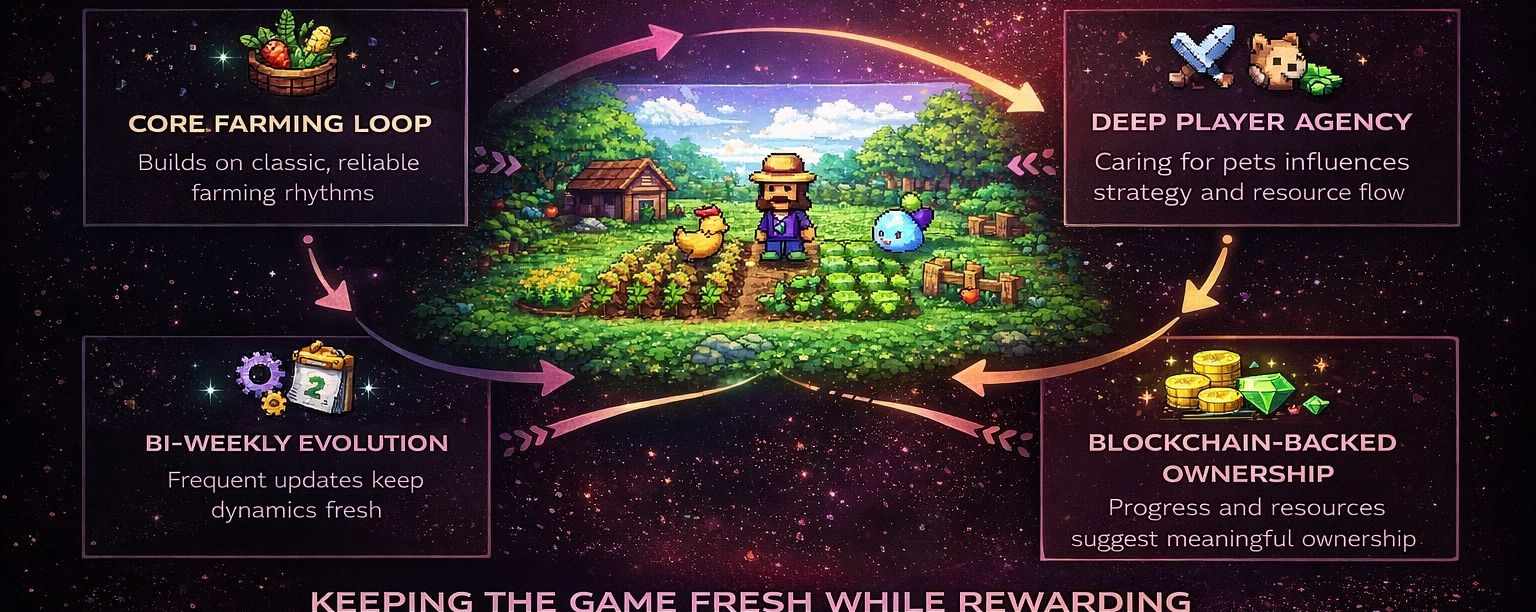
I am noticing a pattern in games that try to evolve while staying playable…..The one that last are not the ones that add the most features, but the ones that keep reinterpreting their core loop without breaking it.Pixels seems to understand this tension. It builds around a simple farming rhythm, but then continuously stretches what that rhythm can support.
Harvesting in Pixels is not just a repetitive task. Over time it becomes a trigger point. Each action feeds into something larger, whether it is skill progression, resource circulation, or interaction with other players…..That shift from isolated activity to interconnected outcome is where imagination starts to play a role. You are not just following a loop. You are shaping how that loop evolves.
Animal care adds another layer to this system. What initially feels like a soft, emotional feature begins to carry functional weight. Pets are not just there for attachment.They influence how you approach progression and resource management…..I find this particularly interesting because it blurs the boundary between design intention and player behavior. A feature meant to humanize the experience ends up structuring it as well.
At the same time, Pixels introduces change at a steady pace. The bi-weekly updates are not just content drops. They act as small recalibrations of the system. New mechanics, adjusted incentives, subtle shifts in balance. This creates a living environment where the rules are not fixed. from a design perspective this keeps the ecosystem responsive. But from a player perspective, it introduces a different kind of demand.
Consistency versuS adaptation.
Not every player enjoys having to continuously adjust. Some prefer stability, especially in a farming context where routine is part of the appeal. Pixels challenges that expectation by making evolution part of the experience itself. i think this is a bold choice but also a risky one. It rewards engaged players who are willing to track changes and adapt strategies, while potentially distancing those who just want a predictable escape.
The blockchain layer ties all of this together, but not always in obvious ways. Progress is not just saved. It is structured in a way that suggests persistence and ownership. Resources, assets, and time investment begin to feel more consequential. This can deepen engagement, but it also reframes motivation. Players start to think not only about what they enjoy doing, but what is worth doing.
That is a subtle but important shift.
I am always saying that Pixels is at its strongest when these layers feel optional rather than mandatory. When players can choose to engage deeply or simply enjoy the surface loop, the system feels flexible and inclusive. When the economic or strategic layers become too central, the experience risks losing the simplicity that makes it approachable in the first place.
What i get from Pixels is not that it has fully solved the balance between creativity, progression and ownership….but that it is actively experimenting with it. The ecosystem is not static, and neither is the player experience. That makes it uneven at times, but also genuinely interesting.
And that in a space full of predictable loops is worth paying attention to…☺️