

The first time I spent real time looking at Pixels, nothing about it felt dramatic. It felt light. Familiar. Almost a little too smooth. I could log in, do a few loops, make some progress, and leave without feeling like the game was screaming at me to optimize every second.
That was what made it interesting..... it did not feel aggressive.
It felt like one of those systems that lets you relax just enough that you stop asking what is actually happening underneath. And for a while, that was my read. I thought Pixels was just trying to make Web3 gaming feel less heavy, less transactional, less obvious.
Then I started noticing something I could not really explain.
Some players did not just progress..... they seemed to stick.
Not faster. Not louder. Not even richer in any obvious way. They just moved through the system with a kind of continuity that felt different. Like the game was not only recording what they did, but quietly remembering the shape of how they did it.
That is the part I keep coming back to.
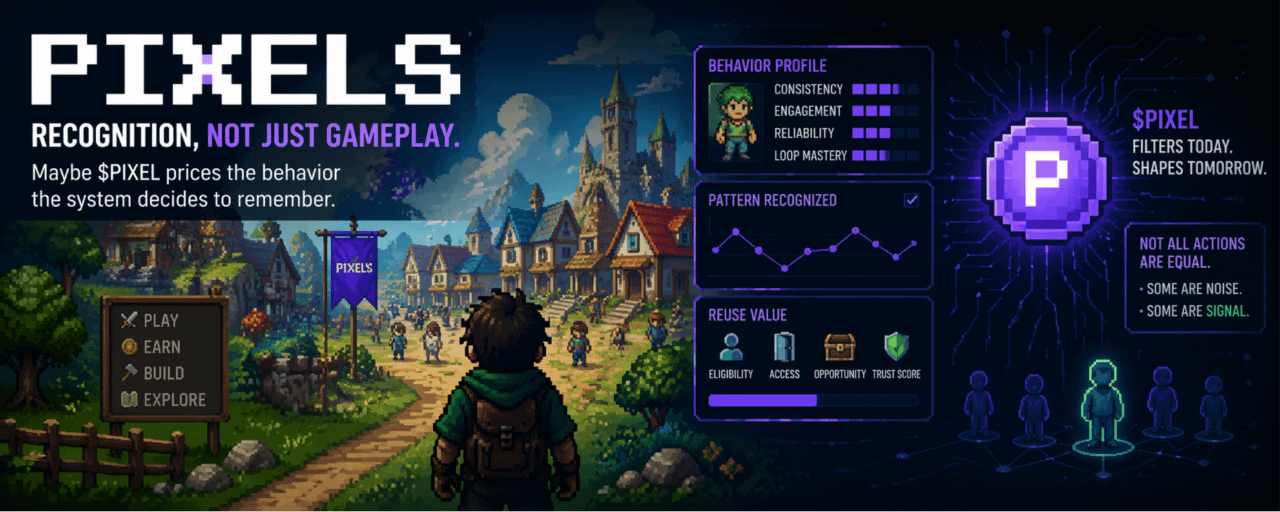
Because the more I think about it, the less I believe PIXEL is only pricing gameplay. I think it may be sitting closer to something more subtle than that. Something more structural. Something closer to which player behaviors the system decides are worth keeping.
And that changes the whole way I look at it.
Most game economies are easier to explain. You play. You earn. You spend. The token reacts to updates, demand, activity, and hype. That is the normal logic. Clean enough. Familiar enough. Easy to sell to people.
But Pixels does not fully feel like that to me.
It feels like the surface activity matters less than the patterns underneath it. Who keeps showing up. Who moves in stable loops. Who becomes legible over time. Who starts behaving in ways the system can predict without having to question them.
That is where I think the real value might be forming..... not around action, but around recognition.
And I think that is a very different model.
Because once a system starts recognizing behavior, it can start reusing that behavior. Not officially. Not in some big flashing message on the screen. But quietly. Through smoother access. Better fit. More reinforcement. More trust in players whose patterns already make sense to the system.
That is what makes this feel bigger than a normal GameFi loop.
If I am right, then PIXEL is not just sitting inside a reward economy. It is sitting near a filtering system. A system that may be deciding, over time, which players are becoming reliable enough to matter beyond a single session.
That sounds abstract..... but I do not think it is.
Platforms do this all the time. They say everyone can participate, and technically that is true. But over time, they learn which behaviors are stable, useful, and easy to build around. Then they quietly start leaning toward those behaviors. Not because they are morally better. Just because they reduce uncertainty.
I think Pixels may be drifting into that same territory.
And if it is, that creates a strange kind of value.
Not value from pure spending.
Not value from pure speculation.
Value from becoming the kind of player the system can reuse.
That is where I get interested.
And also where I get uncomfortable.
Because this kind of model only works while the signal stays clean. The second players realize that certain behaviors “stick,” they will start trying to copy them. Then the system fills with imitation. And once imitation gets cheap enough, recognition stops meaning much.
That is the fragility here..... a signal only matters while it stays hard to fake.
If everyone starts optimizing toward the same readable pattern, the game may become more efficient but less alive. Less experimentation. Less weirdness. Less room for people to play in ways that are not immediately useful to the machine underneath.
That would be a loss, even if the economy looked healthier on paper.
There is another problem too. Transparency.
Right now, most of this feels invisible. You can sense it, but you cannot point to it cleanly. And that works for a while. Early systems can get away with that. But over time, invisible sorting starts creating frustration. Players begin to feel that some behaviors matter more than others, even if nobody explains why.
That kind of opacity builds slowly..... and then all at once.
And I do not think Pixels has fully solved that tension yet.
The other question is whether PIXEL actually sits at the center of this layer in a meaningful way. That part matters a lot. It is one thing for behavior to be recognized and reused. It is another thing for the token to truly capture that reuse.
If players can move through those reinforced loops without needing PIXEL in any serious way, then the whole thesis weakens. Then the token is nearby, but not essential. Present, but not central. And if that happens, the market will eventually notice the gap.
That is why I do not think this is just a normal story about token utility.
For me, the deeper question is whether Pixels is building a system where behavior itself becomes scarce, reusable, and economically important. If it is, then PIXEL could matter for reasons that go well beyond gameplay rewards. If it is not, then the token risks being treated like a shadow of the real system instead of the center of it.
So yeah, I keep coming back to the same thought.
Maybe the real game inside Pixels is not about doing more.
Maybe it is about becoming recognizable enough that the system starts carrying parts of you forward..... and making that continuity matter.