
The first week in Pixels is where most people go wrong. They rush. They click everything. They try to look productive instead of actually learning the game. And Pixels punishes that kind of play quietly. It does not scream at you. It just makes you feel late, a little lost, and a little behind.
The better way to start is much simpler: slow down and let the game show you what it cares about.
Pixels is built around farming, quests, cooking, land, and a growing social world, so the first few days are not about mastering everything. They are about getting a feel for the way those systems sit on top of each other. The game looks casual on the surface, but underneath it has a very clear structure. If you notice that early, you stop wasting energy on random movement and start using your time like it matters.
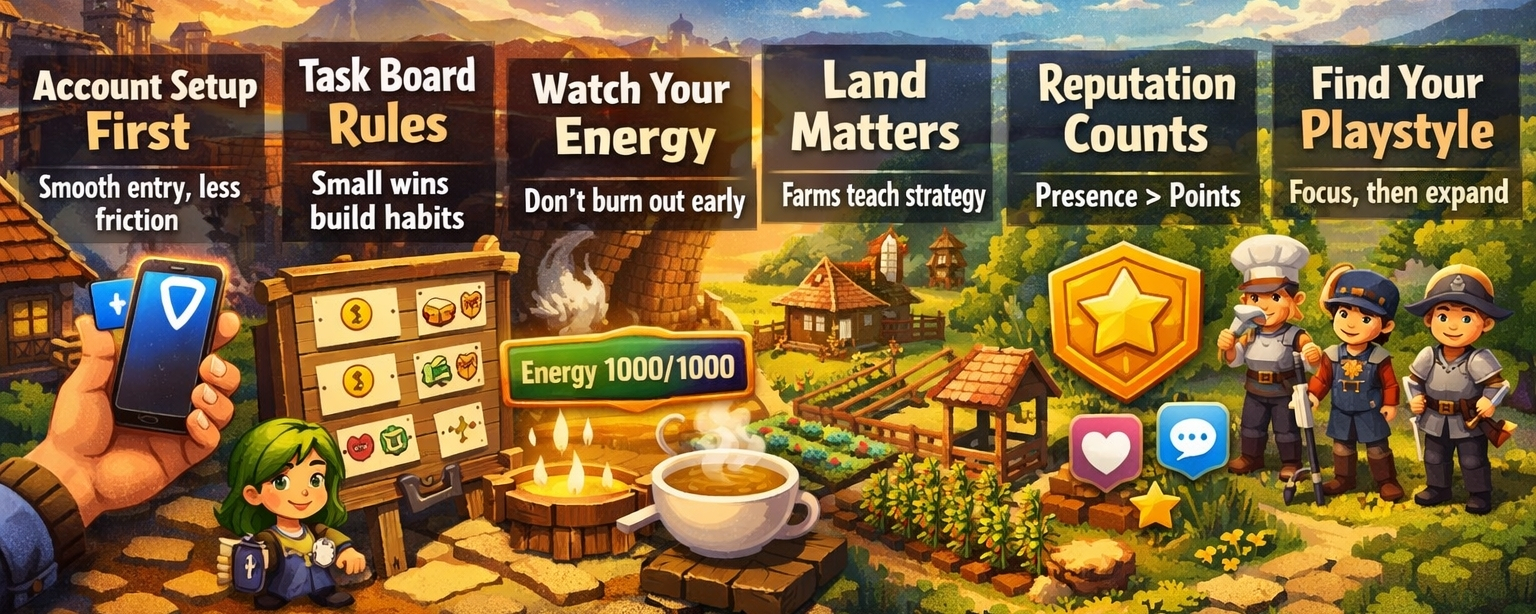
That starts the moment you log in. Even account setup matters more than people think. Pixels supports sign-up through email, phone, and wallet connections, which means the first decision is not “how do I play?” but “how do I want to be set up inside this world?” It sounds small, but the smoother your entry, the easier everything else feels. New players often underestimate how much friction comes from bad setup. In a game like this, friction is expensive.
Then there is the Task Board, which is probably the most honest part of the whole experience. It tells you exactly what the game wants from you, what it will pay for, and what kind of effort is worth repeating. That is where a new player should pay attention. Not because it is glamorous, but because it gives you the earliest real clue about the game’s economy. Some tasks pay Coins, some pay $PIXEL, and some give EXP. Not every reward appears every day, so the point is not to chase the rarest thing immediately. The point is to build a habit of finishing useful work and coming back again tomorrow.
That’s the real shape of week one: not one big breakthrough, but a series of small, clean completions.
Energy is the other thing you learn to respect fast. Pixels gives every player a large energy pool, but that does not mean you should burn through it without thinking. When your energy drops, movement slows down, and suddenly the game feels heavier. That is usually the moment new players realize they have been spending it too loosely. The smarter approach is to treat energy like attention. Use it for tasks that move you forward, not for wandering around because you are unsure what else to do. Saunas, food, beverages, and energy parties all exist for a reason. The game is telling you that recovery is part of the loop, not an afterthought.
By day three or four, land starts making more sense. Even if you do not own any, you should understand why it matters. In Pixels, land is not just decoration or bragging rights. It is where the game’s economy becomes more visible. Free plots, rented plots, and owned plots all sit on different levels of value and flexibility, and the game makes a point of showing that ownership changes what you can do. But even before ownership becomes relevant, just watching how farms are built and how players use their space teaches you a lot. A good early player does not look at land like a trophy. They look at it like a system.
That same logic applies to reputation. Pixels tracks it, and that should tell you something. The game is not only counting your items or your production; it is watching whether you actually participate. Quest completion, gameplay history, trading activity, socials, guild participation, pets, land ownership, and VIP status all feed into the bigger picture. That means week one should not be lonely. Connect your socials. Join conversations. Finish quests. Be present. In Pixels, presence has weight.
What makes the first week interesting is that the game never really asks you to become everything at once. It asks you to become readable. It wants to know what kind of player you are. A farmer? A task chaser? A social player? Someone who enjoys optimizing land? Someone who likes the quieter routines? Once you stop trying to do every possible thing, the game gets easier to understand. And once it gets easier to understand, it starts to feel less like a maze and more like a place you belong.
That is the part most guides miss. The goal of week one is not to “win” Pixels. It is to stop fighting it. Learn the board. Learn the pace. Learn what gives value and what just looks busy. After that, the game opens up in a way that feels earned instead of forced. And that is usually the moment a new player stops being new.