I did not expect convenience to be one of the parts of @Pixels that would stay in my mind.
Usually, when people talk about power in a game economy, they talk about the obvious things first. Land. Token holdings. Rare items. Big rewards. That is the surface layer, and honestly, that is where I was looking too. But the more I sat with Pixels’ official material, the more I started feeling that one of the quieter power layers here is not raw ownership at all. It is convenience. Not convenience in the soft, forgettable sense. Convenience in the sense that it changes how smoothly you move through the system, how often you get opportunities, and how much friction the game removes for you over time. That is where this started feeling more serious to me.
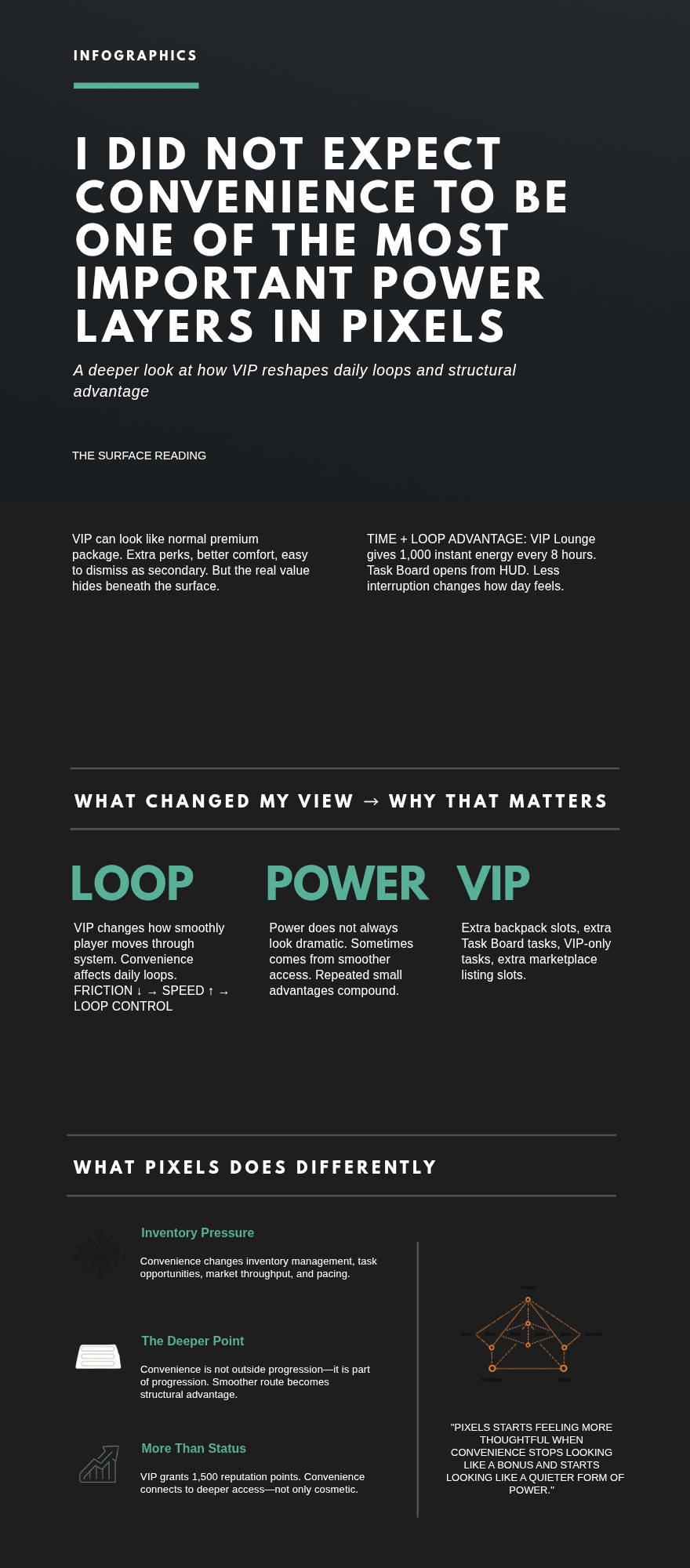
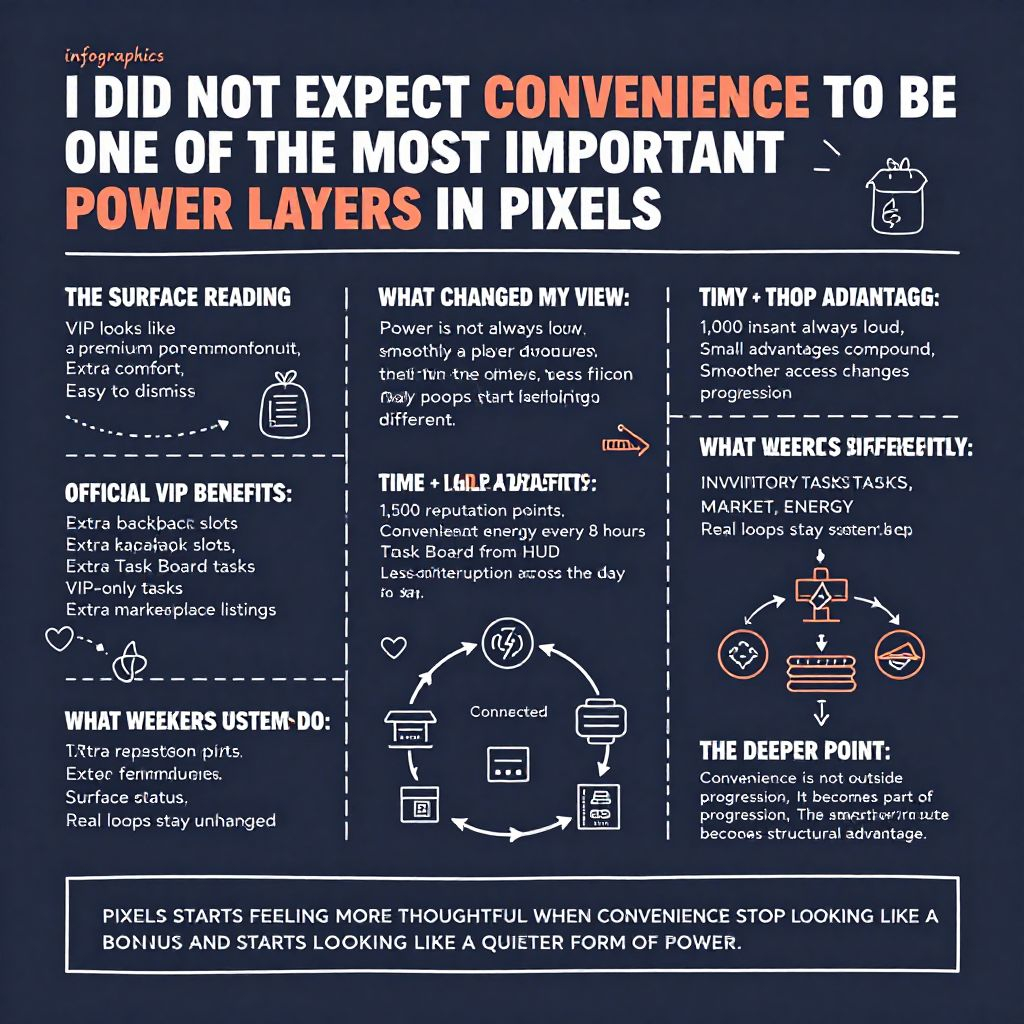
What changed my view was reading the VIP material more carefully. On paper, VIP can look like the usual premium package that many games offer: pay something, get a few extra perks, move on. But the official Pixels Help Desk does not describe it like a cosmetic add-on. VIP gives extra backpack slots, extra Task Board tasks, access to VIP-only tasks, extra marketplace listing slots, access to the VIP Lounge for 1,000 instant energy every 8 hours, the ability to open the Task Board from the HUD, and 1,500 reputation points. That is not just comfort. That is a real change in how the player experiences time, movement, inventory pressure, task flow, and market access inside the game.
That difference matters to me.
Because a lot of people still read convenience as something secondary. They assume real power lives somewhere else, and convenience is just a quality-of-life bonus wrapped around it. I do not think that reading holds up very well here. If you can carry more, list more, access more tasks, recover energy faster, and move through daily loops with less drag, then convenience is no longer sitting outside progression. It starts shaping progression itself. It does not need to look dramatic to be powerful. In some systems, the strongest advantage is not a huge visible reward. It is simply getting to do more of the meaningful things with less friction around you. In Pixels, that starts to look like a serious design choice rather than a side perk.
And honestly, this is where a lot of weaker systems lose me.
Weak systems often confuse premium design with shallow status. They give users a flashy badge, a name color, maybe a decorative extra, and then pretend that is enough to make the premium layer feel worthwhile. Pixels does include visible touches like a name color change, but the more important part is that the official benefits are tied to loops that already matter: task generation, energy, inventory, marketplace throughput, and even reputation. That is why VIP in Pixels does not read to me like simple status spending. It reads more like friction management as a form of power. The system is not only giving a player more. It is giving a player a smoother route through the same world.
That is where Pixels started feeling smarter to me.
The VIP tiering system made that even clearer. Officially, players build VIP Score through $PIXEL spending, move up tiers when they cross thresholds, and then see their score degrade by a small amount each day. There is also downgrade protection for 7 days after reaching a new tier, and a 30-day grace window after expiry to reclaim status. I actually like that structure more than I expected to. It means convenience here is not treated like a one-time switch you buy and forget. It becomes something the system keeps tracking, maintaining, and recalibrating over time. That makes the premium layer feel more alive. It is not just a static upgrade. It becomes part of a moving relationship between spending, retention, and access.
And that is where the whole thing starts reading differently to me.
The more I think about it, the more I feel Pixels understands that power in a live game economy does not only come from direct rewards. It also comes from reducing the small points of resistance that shape daily behavior. More backpack space means less interruption. More task access means more chances for useful outcomes. Extra listing slots change how a player interacts with the market. Instant energy changes pace. Reputation points matter because reputation gates things like marketplace use, withdrawals, guild creation, and other forms of deeper access. Once all of that starts stacking together, convenience stops looking soft. It starts looking structural.
That difference matters to me more than people admit.
Because in a lot of crypto games, people still focus too hard on the loud forms of power and miss the quieter ones. They look for big yield, rare assets, or obvious hierarchy. But sometimes the stronger edge is simply being able to move through the world with less wasted time, less blocked space, more opportunities, and fewer interruptions. That does not always sound exciting when you say it quickly. But inside a system people use every day, that kind of edge compounds. And once it compounds, it starts affecting who plays longer, who stays efficient, and who keeps finding reasons to remain active inside the loop.
That is the part that stayed with me.
I did not expect convenience to feel this important when I first looked at Pixels. I thought it would sit somewhere below the “real” mechanics. But the more I looked, the more it felt like one of the quieter places where the system is actually deciding who gets a smoother, faster, and more flexible version of the game.
For me, that is where Pixels starts feeling more thoughtful.
Not when convenience looks like a bonus.
When it starts looking like one of the most important power layers in the system.