
Moving beyond farming, @Pixels is building the infrastructure for Web3’s gaming future.
When we talk about sustainable Web3 gaming, we must move past the simple inflationary models of 2021. The market in 2026 demands utility, engagement, and cross-platform value. This is exactly why the recent evolution of @Pixels is one of the most compelling narratives on the Ronin network right now.
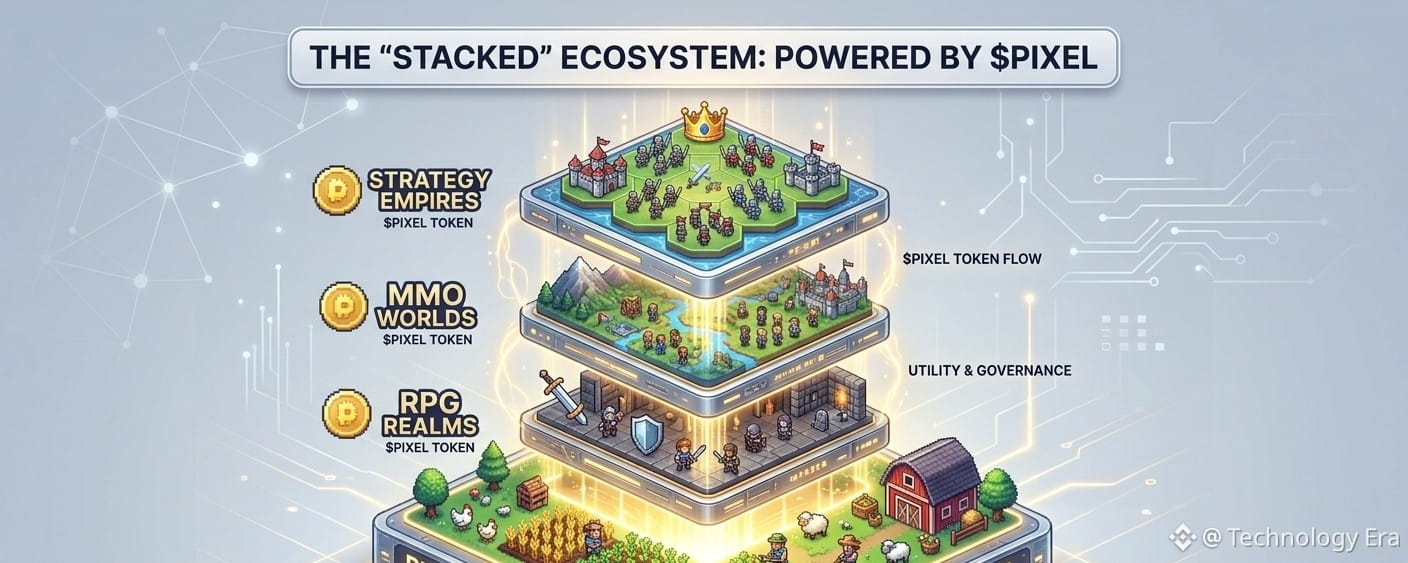
While Chapter 2 successfully refined the internal economy, the real masterstroke is the introduction of the "Stacked" ecosystem.
For those who missed the announcement, Stacked isn't just a feature update; it is a fundamental shift in how @Pixels operates. It transforms $PIXEL from a single-game currency into an ecosystem utility token. The Stacked engine allows other developers to launch titles that "stack" on top of the established Pixels infrastructure. This means $PIXEL utility is no longer confined to the farming maps; it is being integrated as the incentive layer for multiple, diverse gaming titles.
This is infrastructure play. It creates a powerful sink for the token while simultaneously onboarding new users through partner games, all of whom contribute to the core PIXEL economy. By positioning itself as the launchpad and incentive layer for the next wave of Ronin games, @Pixels is moving from being a popular title to being an essential piece of Web3 middleware.
This approach addresses the biggest challenge in GameFi: longevity. If a single game loses popularity, the token usually dies. But if the token powers a network of games, its value proposition becomes infinitely more robust. The potential for PIXEL as the backbone of the Stacked universe is immense. 🚀
What are your thoughts on the Stacked model? Are you holding PIXEL for this ecosystem expansion? Let’s discuss in the comments.