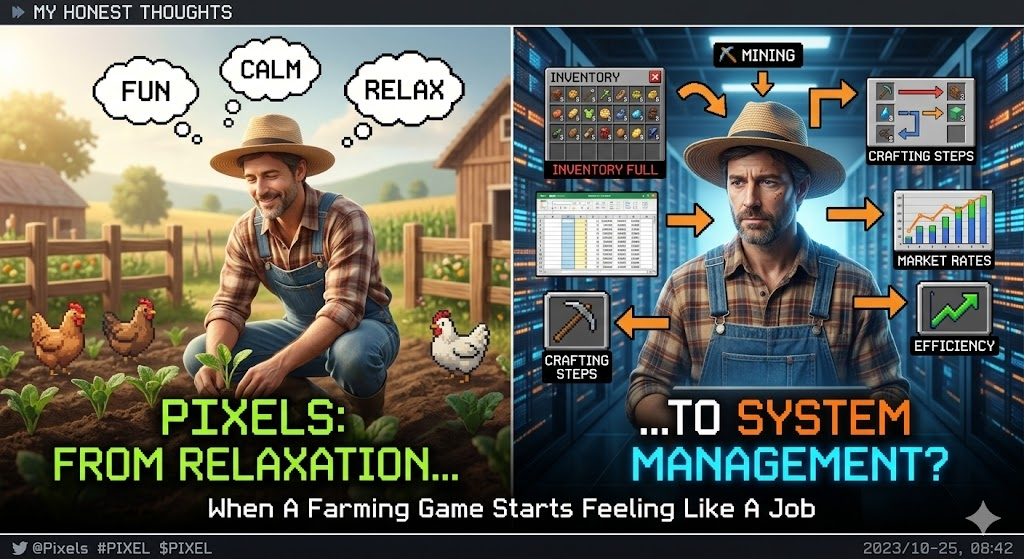
When I first started playing @Pixels , it felt light and enjoyable. You plant crops, harvest them, craft items, sell what you make, and repeat. It was simple, relaxing, and easy to enjoy without putting in too much effort.
You could log in for a short time, complete a few tasks, and leave feeling satisfied. That was the charm of it.
But after spending more time in the game, I noticed something slowly changing.
It didn’t happen all at once. There was no big moment where everything became difficult. Instead, the game gradually became more demanding. My inventory filled up faster. I collected more materials. Crafting needed more steps. I started saving items because I thought I might need them later.
Without realizing it, I stopped casually farming and started managing a system.
That’s when I understood something important: Pixels is not only about farming. It’s about managing resources.
Everything in the game connects to your inventory. Farming gives items. Mining gives items. Crafting uses those items. Trading moves them around. The more you progress, the more you need to think about what to keep, what to sell, and what to use next.
At the beginning, you play for fun.
Later, you start thinking differently.
If I grow this crop, I can craft that item.
If I craft that item, I can sell it.
If I sell it, I can buy more resources.
If I do everything efficiently, I can progress faster.
That’s where the game changes.
You stop asking, “What do I feel like doing today?”
You start asking, “What should I do right now?”
That small change matters a lot.
Because once you begin thinking this way, the game can feel less relaxing and more like responsibility. You log in because crops are ready. Items need crafting. Storage is full. Tasks are waiting.
You’re not always logging in for fun anymore.
Sometimes you’re logging in because the system needs attention.
And in my opinion, that is where the hidden pressure of Pixels begins.
The real cost is not always money. It is your time, focus, and consistency.
If you stop for a while, progress slows down. You miss farming cycles. You lose efficiency. In a game built around production, losing efficiency feels like losing value.
That creates a strong mental pull to return again and again.
To be fair, this is also one reason Pixels became successful. It attracted a huge number of players and became one of the most active Web3 games. Systems that keep people engaged usually grow fast.
But engagement and enjoyment are not always the same thing.
Many players may be active, but an important question remains:
How many are playing because they truly enjoy it, and how many are simply trying to keep up?
The deeper I went into Pixels, the more I felt the game is built around flow:
Flow of items
Flow of resources
Flow of time
Flow of progress
Everything keeps moving, and once you are inside that cycle, it becomes harder to step away.
That is how burnout can start.
Not suddenly.
Quietly.
At first, it feels like progress. You are doing more, producing more, earning more. But at the same time, you are tracking more, thinking more, and managing more.
The workload grows even if it doesn’t look like work.
That’s why Pixels feels unique.
It is not just a game.
It is not just an economy.
It is a mix of both.
And because of that, it creates a different type of pressure. No one forces you to optimize, but the system rewards players who do.
So casual play is possible.
But serious progress often comes from consistency and planning.
Once you learn the efficient path, it becomes difficult to ignore it.
That’s why many players slowly move from playing casually… to playing seriously… to managing daily routines inside the game.
So for me, the real question is not whether Pixels is good or bad.
The real question is:
Is this style of gameplay sustainable for you personally?
Because Pixels does not only ask for time.
It asks for attention.
It asks for consistency.
It asks for patience.
It asks for management.
And when that happens, the line between game and responsibility becomes very thin.
That is when you stop seeing Pixels as a place to relax.
And start seeing it as a system to run.