

I’ve been watching Pixels closely, and something about its evolution keeps bothering me. Not because the team is doing anything obviously wrong but because they might be doing everything too right from an economic standpoint. And in Web3 games, that can quietly create a different kind of problem.
At some point, sustainability stops feeling like balance… and starts feeling like restriction.
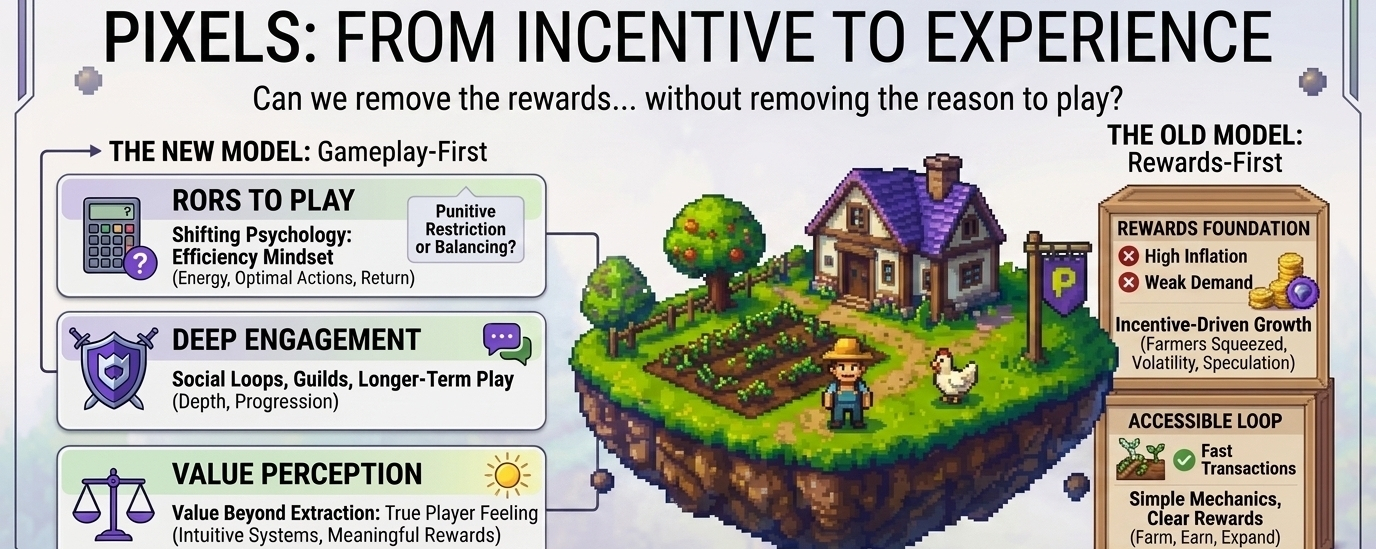
Pixels didn’t start here. It started as one of the most accessible Web3 games in the market — simple farming mechanics, fast onboarding, and a loop that anyone could understand within minutes. Farm, earn, expand, repeat. That clarity helped it scale aggressively, reaching over a million daily active users at its peak and millions more on a monthly basis.
But those numbers came with a hidden layer.
A large portion of that growth wasn’t driven by gameplay depth — it was driven by incentives. Rewards weren’t just a feature; they were the foundation. And like every GameFi cycle we’ve seen before, that foundation eventually starts to crack under its own pressure.
So the team did what most projects fail to do: they tried to fix it.
They reduced token emissions. They introduced off-chain currencies. They added sinks, friction, and more structured progression systems. They began shifting the game toward social loops, guild-like mechanics, and longer-term engagement strategies.
From a design perspective, this is exactly what “sustainable GameFi” is supposed to look like.
But here’s where things get complicated.
The moment you start optimizing for sustainability, you’re also redefining how players experience value. And in Pixels, that shift is becoming very noticeable.
I see it in how players talk about the game now. It’s less about what they enjoy doing and more about what’s worth doing. That difference might seem small, but it fundamentally changes the psychology of the player.
Everything starts to revolve around efficiency — how much energy is spent, what the return is, which actions are optimal. I think of this as a RORS-driven environment: Return on Resource Spent becomes the dominant lens through which the game is played.
And once that mindset takes over, the game stops feeling like a game.
It becomes a system to optimize.
That’s not inherently bad — in fact, it’s part of what made Pixels grow so fast. But when the rewards shrink and the optimization remains, the experience can start to feel… punishing.
I’ve noticed three clear shifts in player behavior.
First, the farmers — the users who were there primarily for rewards — are feeling squeezed. Their efficiency is down, their output is lower, and the time required to extract value has increased. For them, the game no longer “works” the way it used to.
Second, casual players are getting lost. As more systems, currencies, and mechanics are layered in, the game becomes harder to intuitively understand. Without strong rewards to compensate for that complexity, confusion starts to replace curiosity.
Third, the committed players — the ones who actually like the game — are still here. But their expectations are rising. If rewards are no longer the main hook, then gameplay depth, progression, and social interaction need to carry much more weight.
That’s a difficult balance to strike.
Because while Pixels is clearly trying to transition away from a reward-heavy model, the data suggests the ecosystem hasn’t fully stabilized yet. The token has dropped roughly 99% from its peak, even as activity metrics remain relatively strong. Trading volume is still high compared to market cap, which tells me speculation hasn’t disappeared — it’s just become more volatile.
This creates a strange dynamic.
On one side, the game is becoming more controlled, more sustainable, more “correct.” On the other side, the market is still treating it like a speculative asset with weak value capture.
That gap matters.
Because players don’t evaluate systems the way designers do. They don’t think in terms of emission curves or inflation control. They think in terms of time and return. Effort and outcome. Input and reward.
And when that equation starts to feel unbalanced, perception shifts quickly.
This is where sustainability can unintentionally become punitive.
Not because the systems are flawed — but because the experience of those systems doesn’t align with player expectations.
Energy limits, reduced payouts, and layered currencies all make sense on paper. They slow down extraction, protect the token, and extend the lifecycle of the economy. But from the player’s perspective, they can feel like friction. Like the game is taking more than it’s giving.
And perception, especially in games, is everything.
The deeper issue, in my view, is that Pixels is trying to reverse its original identity. It began as a reward-driven system that evolved into a game. Now it’s trying to become a game that happens to have rewards.
That’s a hard transition.
Because the audience you attract with incentives is not the same audience that sustains long-term engagement. Farmers don’t automatically become players. And removing rewards doesn’t automatically create fun.
So Pixels is essentially rebuilding its player base in real time — while still carrying the expectations of its old one.
That’s why the current phase feels so unstable.
For this shift to actually work, I think three things need to happen.
Gameplay has to become the primary driver of retention, not just a fallback after rewards are reduced. Systems need to feel intuitive and meaningful, not just restrictive. And most importantly, players still need to feel a sense of value — even if that value isn’t immediately extractable.
Because without that feeling, no economic model will hold.
Right now, Pixels feels like it’s being optimized for long-term survival. And that’s necessary. But if that optimization comes at the cost of player experience, it risks solving one problem while creating another.
The irony is hard to ignore.
The same mechanisms designed to save the ecosystem can slowly erode the reasons people showed up in the first place.
So when I look at Pixels today, I don’t see a failing project. I see a project in transition — one that’s trying to answer one of the hardest questions in Web3 gaming:
Can you remove the rewards… without removing the reason to play?
Because in the end, that’s what everything comes down to.
If players still feel rewarded — even in a smaller, more controlled system — Pixels has a real chance to evolve into something sustainable.
But if sustainability continues to feel like punishment, then no amount of economic design will be enough to keep the system together.