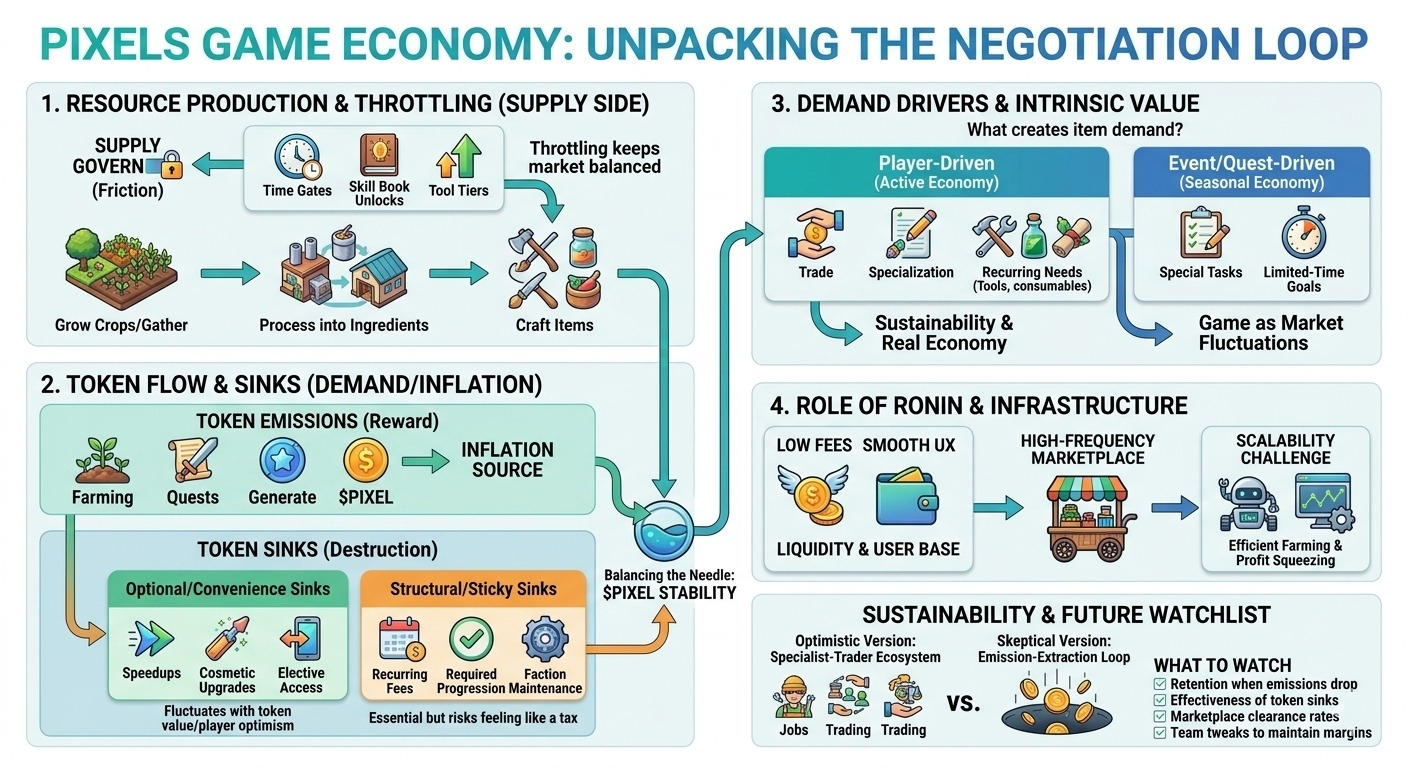
Most people talk about pixels like it’s “a farming game with a token,” and that’s the shorthand that sticks. plant stuff, harvest, craft, sell, earn $pixels, maybe trade some assets. but once you start asking where the value actually lands and where it leaks out, it stops feeling like a simple farm and starts feeling like a carefully throttled production economy with a marketplace glued on.
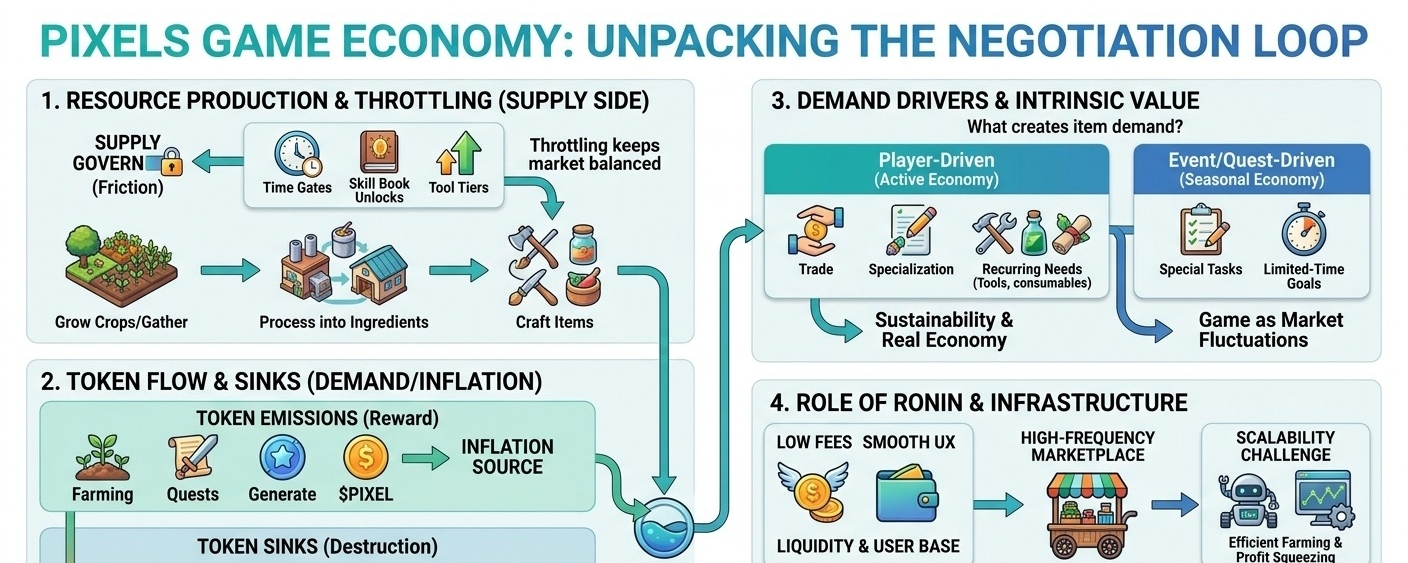
resource generation is the first place the throttling shows up. the loops are obvious: farm/gather → process → craft → either consume for progression or sell to other players. i keep using a basic chain as a test: grow a crop → turn it into an ingredient → craft a consumable → sell it because another player needs it for their own quest or crafting. that’s the “real economy” story. but what stands out is how much the game leans on friction to keep that story alive. energy caps, time gates, recipe unlocks, tool tiers, and whatever access constraints exist — those aren’t just balance knobs, they’re supply governors. without them, the market would be flooded in a week. i’m not sure if that’s a sign of thoughtful design or just a patch to keep the system from imploding.
token flow is where i’m most uncertain. emissions are the obvious driver: do activity, get $pixels, feel rewarded. but emissions are also a permanent inflation source unless sinks are doing real work. and here’s the part i’m thinking about: sinks need to be sticky even when players are skeptical. if $pixels is mostly spent on optional convenience (speedups, access, elective upgrades), that spending can vanish fast when the token feels “expensive” or when people start thinking in exit terms. if sinks are more mandatory (recurring fees, required progression costs), the token might stabilize but the game risks feeling like it’s charging rent. pixels has to thread that needle: make spending feel like gameplay, not a tax, while still keeping the token from bleeding out.
the other thing i keep circling is demand source. if item demand is truly player-driven (people repeatedly need consumables, inputs, tools), then players are generating value for each other. if demand is mostly event/quest-driven, then the game itself is the hidden buyer, just wearing a mask. that can still work, but it means the economy is more seasonal than it looks. when the event ends, demand drops, and the market has to wait for the next injection.
infrastructure-wise, ronin is doing a lot of quiet heavy lifting. low fees and smoother wallet UX make it feasible to have a high-frequency marketplace without players constantly feeling the cost. that matters because pixels’ economy seems to rely on lots of small trades (materials, crafted goods, asset transfers). ronin also brings existing liquidity and a user base that’s already comfortable with game assets, which helps markets form quickly. but ronin users also tend to optimize fast. if there’s a profitable craft chain or a mismatch between item prices and token rewards, it gets found and squeezed. scalability here isn’t just chain throughput, it’s whether the economy can survive being efficiently farmed.
so sustainability: i’m still not sure if pixels is building a durable economy or just running a well-paced extraction loop. the optimistic version is: players specialize, trade useful goods, consume items, and $pixels is just the settlement layer. the skeptical version is: players are mostly harvesting emissions, and the item economy is an intermediate step to justify token distribution. what depends on continuous user growth is liquidity and absorption. new players buy starter stuff, keep markets clearing, and keep veterans feeling like their production has an audience. if growth slows, you find out whether demand is intrinsic or just propped up by fresh bodies.
no clean conclusion. pixels feels competently constrained, but competence can still mean “this works as long as momentum holds.”
watching:
- retention when emissions or event intensity drops
- how much $pixels gets spent in recurring sinks vs just circulated or sold
- marketplace clearance rates for everyday crafted goods in quiet weeks
- how often the team needs to tweak emissions/gates to keep margins from collapsing
if $pixels went flat and new users slowed down, would pixels still feel like a functioning little economy… or would it turn into a game where everyone’s just waiting for the next reward cycle?