
I’ve watched enough cycles now to recognize the familiar shape of excitement. It usually starts with a simple promise—something about fixing trust, or redistributing value more fairly—and then it grows into something louder, faster, more certain than it has any right to be. Eventually, reality catches up. It always does.
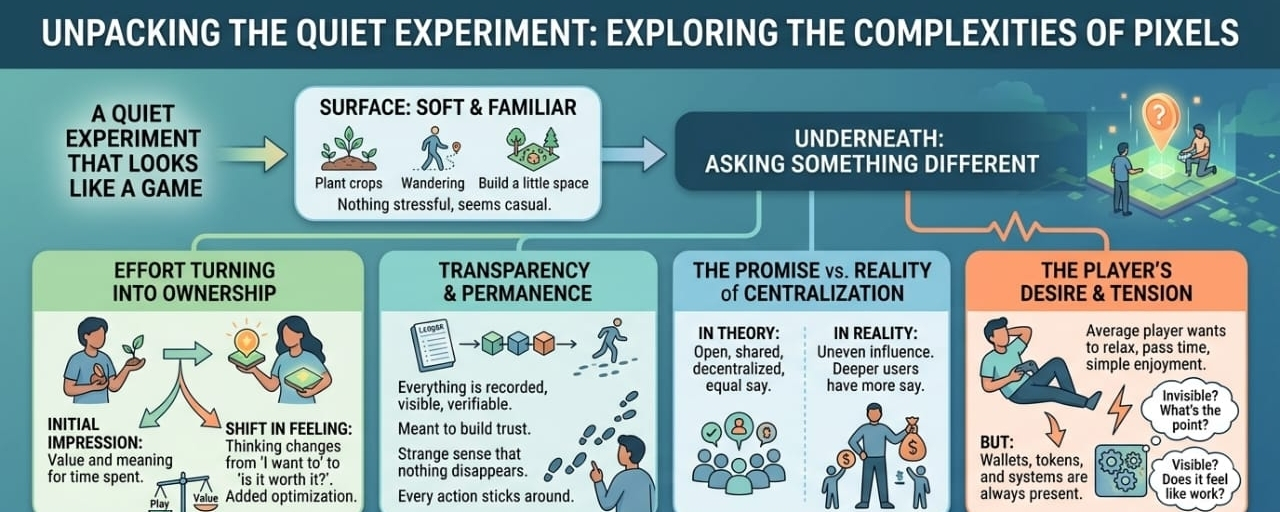
Projects like PIXELS sit in an interesting place. On the surface, it’s a game—farming, exploration, light social interaction. But underneath that, there’s a more ambitious layer forming. Not just about gameplay, but about how identity, participation, and rewards get tracked and validated over time. That’s where things start to get complicated.
Because once you move into credential verification and token distribution, you’re no longer just building a game. You’re building a system that tries to answer a harder question: who deserves what, and why?
At first, these systems feel clean. A player does something—plants crops, completes tasks, participates in events—and earns recognition. That recognition becomes a credential. Credentials become signals. Signals become eligibility. And eventually, eligibility turns into tokens.
It sounds orderly. Fair, even.
But systems like this don’t exist in a vacuum. They exist in markets, and markets have memory. People learn quickly where value accumulates, and once tokens are involved, behavior shifts almost immediately.
I’ve seen it happen before. Early participants engage naturally, almost innocently. They play because the game is enjoyable, or because the system feels novel. But once rewards become predictable, participation starts to look different. It becomes optimized.
Credentials stop being reflections of genuine activity and start becoming targets.
And that’s where trust begins to bend.
A credential, in theory, is just a record of something that happened. But over time, people stop asking what happened and start asking how it can be replicated. If planting crops leads to rewards, then planting crops becomes less about farming and more about yield extraction. If social participation earns recognition, then “social participation” gets scripted, automated, scaled.
The system doesn’t break immediately. It rarely does. It absorbs this behavior at first. It even grows because of it. Metrics look good. Activity rises. Distribution expands.
But something quieter starts to erode—the meaning behind the credentials themselves.
And once that meaning is questioned, everything built on top of it becomes less certain.
Another layer to this is the issuer. Credentials don’t exist on their own. Someone—or something—decides what counts. In centralized systems, that authority is obvious. In decentralized ones, it’s often disguised as rules, smart contracts, or community governance.
But over time, issuers face pressure.
They’re pushed to expand access, to reward more users, to keep engagement high. Sometimes they adjust criteria. Sometimes they loosen standards. Sometimes they introduce new ways to qualify.
Each change makes sense in isolation. But collectively, they blur the boundaries of what a credential represents.
And people notice.
Not immediately, but eventually. Especially those who’ve been around long enough to remember how things used to work. They start comparing. Questioning. Re-evaluating.
Was this always the threshold? Did this always count? Why does the same action now yield a different outcome?
Trust doesn’t collapse in a single moment. It stretches. It gets tested.
Then there’s the problem of distribution itself.
Token distribution tied to credentials sounds fair in theory—reward those who contribute. But contribution is hard to define, and even harder to measure consistently over time.
Some participants will always find ways to extract more than they put in. Not necessarily by breaking the system, but by understanding it better than others. They’ll optimize around rules, not intentions.
Others will participate honestly and still feel left behind.
This imbalance isn’t unique to PIXELS. It’s something I’ve seen across multiple protocols trying to align incentives with behavior. The gap between designed fairness and experienced fairness tends to widen over time.
And once people start feeling that gap, they adjust. Some lean further into optimization. Others disengage. A few stay, watching quietly, trying to understand whether the system can correct itself.
What makes PIXELS interesting is that it’s not pretending to solve trust instantly. At least not entirely. The structure it’s building—where credentials accumulate, evolve, and influence rewards—creates a kind of ongoing record.
Not a fixed identity. More like a trail.
And trails can be reinterpreted.
That’s the part I find worth paying attention to. Not whether the system gets it right from the start, but whether it allows for revision. Whether past actions can be reassessed. Whether credentials can lose weight as well as gain it.
Because real trust doesn’t come from a single verified moment. It comes from consistency over time—and from the ability to question that consistency when something feels off.
Still, I wouldn’t call this solved. Not even close.
There are too many variables. Too many incentives pulling in different directions. Too many ways for systems like this to drift without realizing it.
And then there’s the broader market context. When conditions tighten, when liquidity dries up, when attention shifts elsewhere—these systems get tested in ways that early growth phases don’t reveal.
Do people keep participating when rewards shrink? Do credentials still hold meaning when fewer people care about them? Does the system adapt, or does it quietly decay?
I don’t have clear answers to those questions. I’ve learned not to expect them.
What I see in PIXELS is an attempt to build something layered—something that doesn’t just assign trust, but records it, exposes it, and, maybe, allows it to be questioned later.
That’s more honest than most.
But honesty doesn’t guarantee resilience.
So I watch. Not with excitement, not with cynicism either. Just attention.
Because in the end, these systems don’t reveal themselves in their design documents or early metrics. They reveal themselves over time—through pressure, through behavior, through the slow, uneven process of people interacting with incentives.
And right now, it still feels early.