
There’s a small roadside fruit market near my area where I used to stop occasionally. The farmers would arrive early, unload their crates, and wait all day. But here’s the strange part: no matter how fresh or high-quality their fruit was, the final price wasn’t really in their control. A middleman would come late in the day and decide the rate. Some farmers sold at a loss, some barely broke even, and a few lucky ones made profit — not because they worked harder, but because the system decided so.
That’s when it clicked for me: effort doesn’t always translate into reward when the system itself controls distribution.
Now take that mental model and look at Pixels.
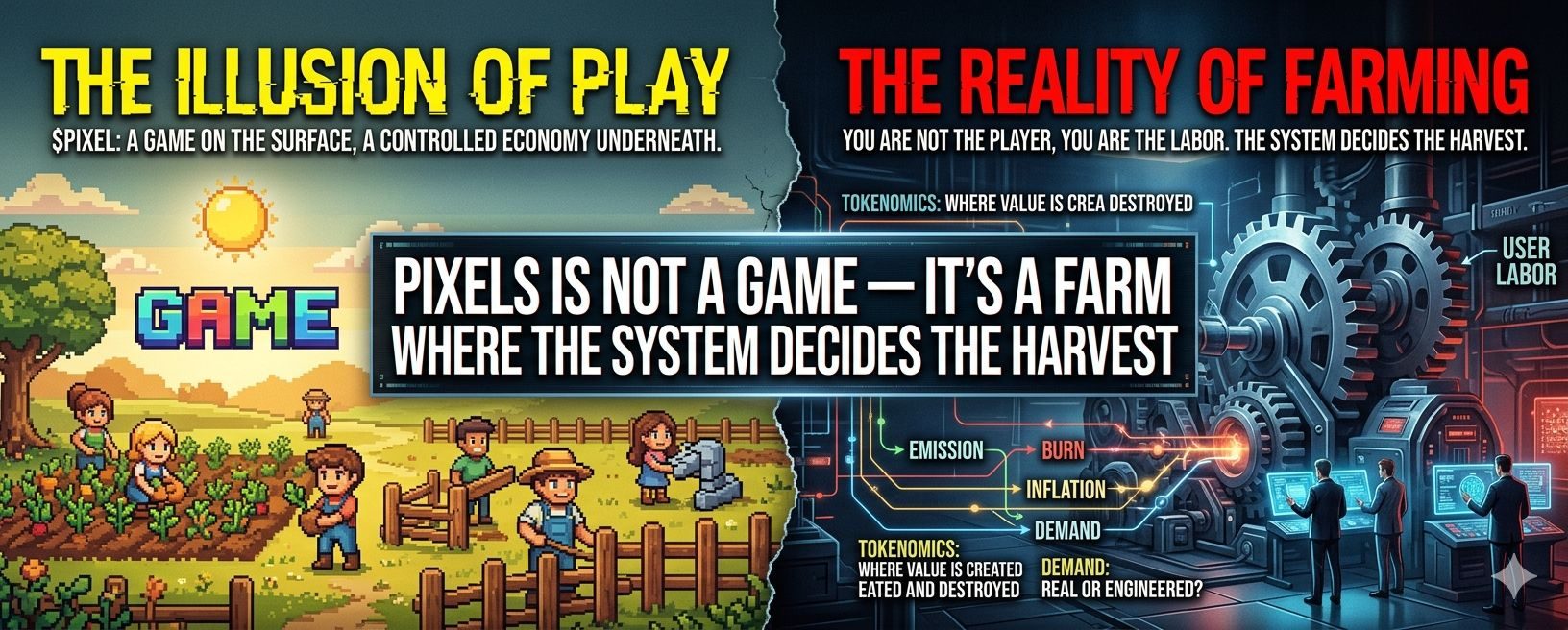
A Game on the Surface, A Controlled Economy Underneath
On the outside, Pixels looks harmless — farming crops, crafting items, socializing, building land. It feels slow, nostalgic, almost peaceful.
But once you zoom out, it stops being a “game” and starts behaving like an economic machine.
Players are not just players. They are labor.
$PIXEL is not just a token. It’s the medium through which value is distributed and extracted.
And developers? They are not just creators — they are central planners controlling emission, sinks, and behavioral incentives.
This isn’t a free economy. It’s a semi-controlled system where rules are adjustable, outcomes are guided, and “fairness” is often an illusion shaped by design.
Tokenomics: Where Value Is Created and Destroyed
Every economic system lives or dies by how supply flows.
In Pixels, token emission is tied to gameplay. Players earn $PIXEL through activities like farming, quests, and participation loops. At first glance, this feels rewarding — play more, earn more.
But that’s only one side.
Because every token emitted is inflation.
To counter this, the system introduces burn mechanisms: upgrades, crafting costs, land interactions, and in-game utilities that require spending $PIXEL. These sinks are not accidental — they are carefully designed pressure valves.
The real question isn’t “how much you earn.”
It’s “how much the system lets you keep.”
If emission > burn → inflation dominates → price weakens.
If burn > emission → scarcity builds → price stabilizes or rises.
Pixels constantly tries to balance this equation, but the balance is artificial — it depends entirely on developer adjustments and player behavior.
Demand: Real or Engineered?
Demand for PIXEL doesn’t come from outside speculation alone — it’s built inside the system.
Players need PIXEL for upgrades, progression, efficiency gains, and competitive positioning. Land ownership amplifies this by creating utility layers where holding assets gives you leverage over others.
But here’s the nuance most people miss:
This demand is not purely organic.
It is designed demand.
The game creates problems (slow progression, inefficiency, limitations), then sells you solutions (spend PIXEL to optimize). This is classic game economy design — but in Web3, it directly ties into financial value.
So the demand exists, yes. But it exists because the system requires it to.
And that makes it fragile.
The Rules You See — and The Ones You Don’t
Every system rewards something. The question is what.
Pixels rewards:
Time spent (grinding)
Asset ownership (land, tools)
Early positioning
But it quietly ignores:
Late entry efficiency
Equal opportunity for new players
Sustainable earning for everyone
Late players always face a steeper curve. By the time they arrive, asset prices are higher, competition is tighter, and earning efficiency is diluted.
Meanwhile, early adopters and landowners benefit from structural advantages — better yield, better positioning, and often indirect income from newer players entering the system.
This creates a familiar pattern:
New players inject value.
Old players extract value.
And the system sits in the middle, orchestrating both.
From a Trader’s Lens: What Actually Matters
If you strip away the game layer, Pixels becomes easier to analyze.
Bullish signals:
Rising daily active users (DAU)
Increasing token burn relative to emission
Strong retention (players staying, not just joining)
New utility layers that create fresh demand
Bearish signals:
Declining player activity
Token emission outpacing sinks
Short-lived hype spikes without retention
Over-reliance on new users for price support
The key metrics aren’t just price charts — they’re behavioral indicators.
Because in systems like this, users are liquidity.
The Cycle Everyone Repeats
Pixels, like most Web3 games, follows a predictable cycle:
Hype → players rush in, price rises
Extraction → early users take profit
Stabilization → system tries to rebalance
Decline or Reset → activity drops, adjustments begin
Then the loop restarts with new updates, new incentives, or new narratives.
The mistake traders make is assuming growth is linear.
It’s not.
It’s cyclical — and often engineered.
Reflexivity: The Dangerous Feedback Loop
Here’s where things get interesting.
When $PIXEL price rises, more players join because earnings look attractive.
More players → more demand → price goes higher.
But the reverse is just as brutal.
Price drops → players leave → demand weakens → price drops further.
This reflexivity creates short bursts of growth, but also sharp collapses if not carefully managed.
And since player motivation is partially financial, the system is always at risk of turning into a momentum-driven loop rather than a stable economy.
The Uncomfortable Truth
Pixels is not broken.
It’s doing exactly what it was designed to do.
It creates a controlled environment where:
Rewards are distributed selectively
Demand is engineered
Supply is adjustable
And player behavior is guided, not free
The illusion is that everyone is playing the same game.
The reality is that some are farming… and others are being farmed.
Final Thought
Pixels isn’t about how well you play — it’s about how well you understand the system that’s playing you.
