


When you look at Binance Futures, what stands out immediately is not just the number of coins available, but how volume concentrates around a few key assets. Despite hundreds of listed pairs, liquidity is heavily clustered, and that’s where the real trading activity and opportunity exists.
At the core of the market sits $BTC BTC/USDT. Bitcoin isn’t just leading it dominates. In fact, Bitcoin futures alone account for over 40% of total contract volume, making it the primary liquidity engine on Binance Futures.
This level of dominance creates a unique structure: tight spreads, deep order books, and constant participation from both retail and institutional traders. It’s less about explosive moves and more about controlled volatility, which is why it’s the preferred instrument for large players and high-leverage strategies.
Right behind it is $ETH ETH/USDT, which consistently ranks as the second most traded pair. Ethereum behaves differently from Bitcoin—it tends to show stronger directional moves during altcoin cycles, while still maintaining high liquidity. On some days, ETH futures volume can even surpass Bitcoin in specific trading windows, reflecting its growing role as a beta asset for the broader market.
Moving into the next layer, you start seeing what can be described as “active majors.” These include $SOL, BNB, XRP, and DOGE. Each of these coins has a distinct driver behind its volume. Solana thrives on ecosystem hype and fast-moving narratives, BNB benefits from its integration within the Binance ecosystem, XRP maintains consistent attention due to ongoing market relevance, and DOGE attracts speculative traders due to its volatility.
What connects them is simple: they move more than BTC and ETH, and that movement attracts traders looking for higher returns in shorter timeframes.
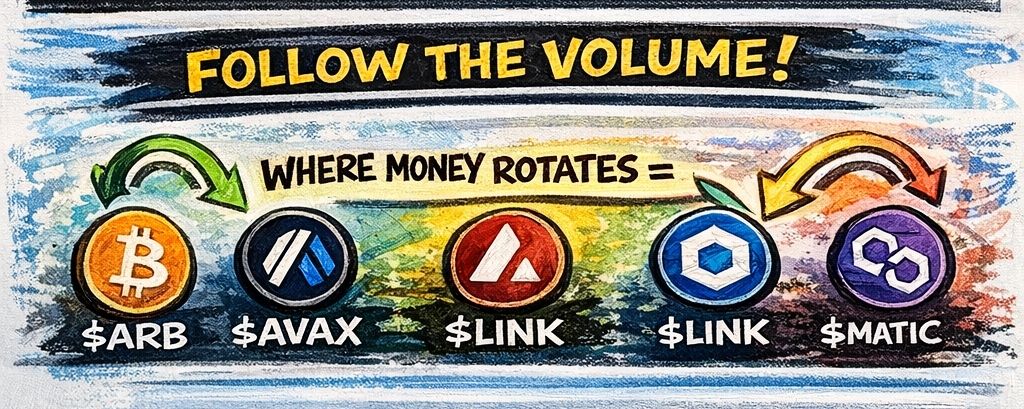
Then there’s the final layer the most misunderstood one which is rotating high-volume altcoins. These are coins like ARB, AVAX, LINK, MATIC, and even newer or trending tokens that temporarily surge in futures volume. Their behavior is driven almost entirely by narratives and catalysts listings, partnerships, hype cycles, or social momentum.
They don’t hold volume consistently, but when they spike, they often outperform everything else in terms of short-term volatility.
From a structural standpoint, Binance Futures itself amplifies this behavior. With over $30B+ in daily volume and deep liquidity across hundreds of pairs, it creates an environment where capital constantly rotates between these tiers.
That rotation is the real story. Money doesn’t stay still—it flows from Bitcoin dominance into Ethereum expansion, then into high-beta altcoins, and finally into speculative plays before resetting.
The key insight here is that volume equals attention, and attention equals opportunity—but only temporarily.
BTC and ETH offer stability and consistency. Major alts offer movement. Rotating tokens offer bursts of opportunity but also the highest risk.
In practical terms, most professional traders don’t chase everything. They track where liquidity is concentrating right now and position accordingly. Because on Binance Futures, it’s not about which coin exists it’s about which coin is being traded the most at that moment.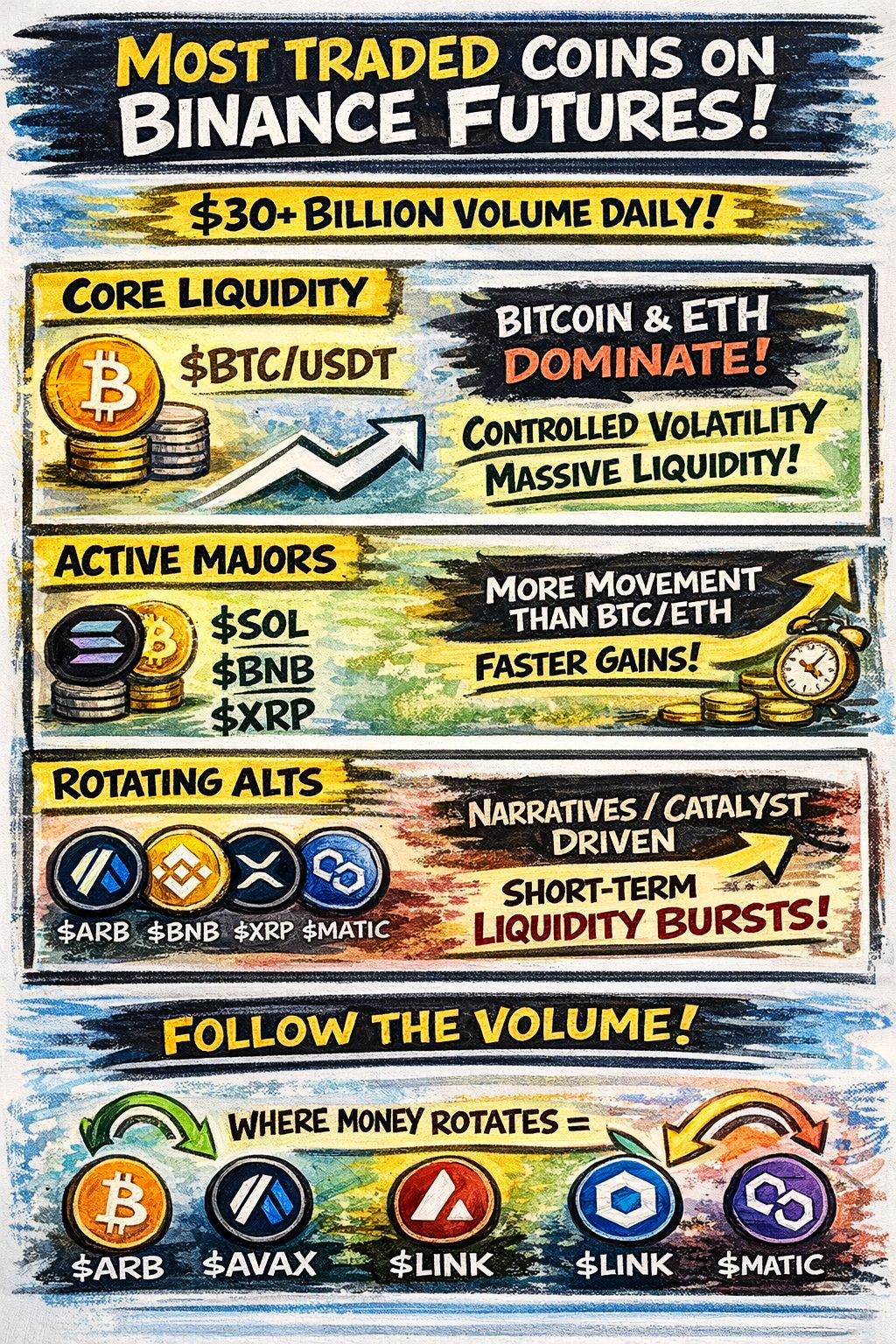
#AltcoinRecoverySignals? #KelpDAOFacesAttack #Kalshi’sDisputewithNevada