

In web3 gaming, one stubborn problem keeps surfacing: the gap between owning digital assets and actually putting them to work. Players hold land NFTs, farm tokens, and wallet balances that prove “ownership” on-chain. But too often those assets sit idle or get flipped for quick profit, with little real connection to the day-to-day transactions that make a game feel alive. Pixels’ new Stake-to-Vote-and Earn model tries to close that gap in a practical, if imperfect, way. By letting PIXEL holders stake directly into specific games across the ecosystem, it turns passive ownership into active decision-making and real earnings tied to actual player activity.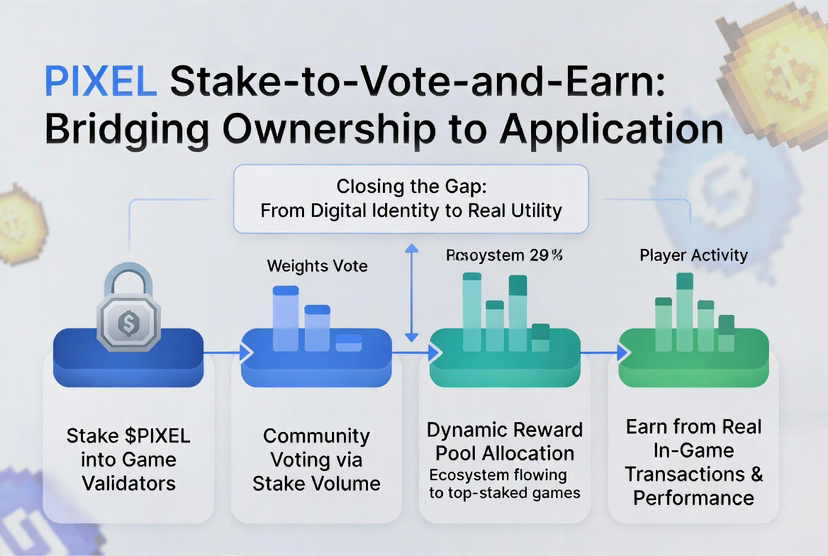
The mechanics are straightforward yet clever. You stake PIXEL into individual game projects Core Pixels, partner titles, or upcoming releases. The volume staked to each game determines its share of monthly ecosystem incentives. Games that attract and keep stakers get bigger reward pools to distribute back to their communities. Stakers earn based on how well those games perform in retention, spending, and engagement. It’s not abstract governance; it’s a market signal. Strong games pull in more stake, earn more resources, and deliver better returns. Weak ones fade. In effect, the community becomes the publisher, and games function like validators in a decentralized network except the “consensus” is measured by real player dollars and hours, not just hash rate.
 This matters because it flips the usual script. Traditional web3 titles often hand publishing power to a core team or VC backers. Here, creators whether indie studios or community devs must earn support by building experiences people actually want to play and pay into. Players stop being just liquidity providers; they become stakeholders with skin in the game. The phased rollout shows restraint: Phase 1 starts curated, Phase 2 ties rewards dynamically to stake volume, later phases open further as data proves the model works. It’s an honest attempt at sustainability rather than another yield farm.
Still, a critical look at market signals is necessary. Liquidity remains thin daily volumes hover in the $9–11 million range against a roughly $25 million market cap, leaving the token vulnerable to sharp swings from modest order flow. Holder distribution is even more telling: on-chain analysis consistently flags a centralized base where top addresses wield outsized influence. That concentration raises legitimate questions about whether “community voting” could quietly become whale-dominated, especially early on. Organic demand, not speculative staking, will decide if this lasts. If players stake because they love the games and want to see them grow spending real time and money inside them then the model has teeth. If it’s mostly yield-chasing with quick unstakes once rewards shift, the gap between ownership and application stays wide open.
What’s genuinely positive here is the focus on alignment. Rewards flow from genuine in-game economic activity, not just token inflation. Creators get clear data on what the community values. Players see their stake influence the future of the games they care about. In an industry littered with broken play-to-earn promises, this feels like a step toward treating digital identity as more than a wallet balance as a tool for real participation.
Of course, success isn’t guaranteed. Execution, sustained player retention, and a genuine shift away from speculation will determine whether this becomes a lasting innovation or just another interesting experiment. But by directly linking stake to vote and earn, Pixels is at least asking the right question: if you own part of the ecosystem, shouldn’t you help decide where it goes next?
 That question, and the attempt to answer it through real transactions rather than rhetoric, is worth watching closely.