
There’s a version of the Stacked story that’s easy to tell and probably undersells what’s actually happening.
The easy version: Pixels built good internal tools, the tools worked, now they’re selling access to other studios. Interesting, maybe valuable, probably good for PIXEL demand. End of analysis.
I don’t think that’s the right frame. Let me try to explain why.
Start with what Stacked actually is at the infrastructure level.
Stacked is a rewarded LiveOps engine — an AI-driven system that sits on top of real-time player event data and deploys targeted incentives at moments calibrated to maximize retention, revenue, and LTV. It includes an AI game economist layer that studios can query in plain language: why are high-value players churning between Day 3 and Day 7, which reward experiments are worth running next, where is reward budget leaking without producing measurable lift.
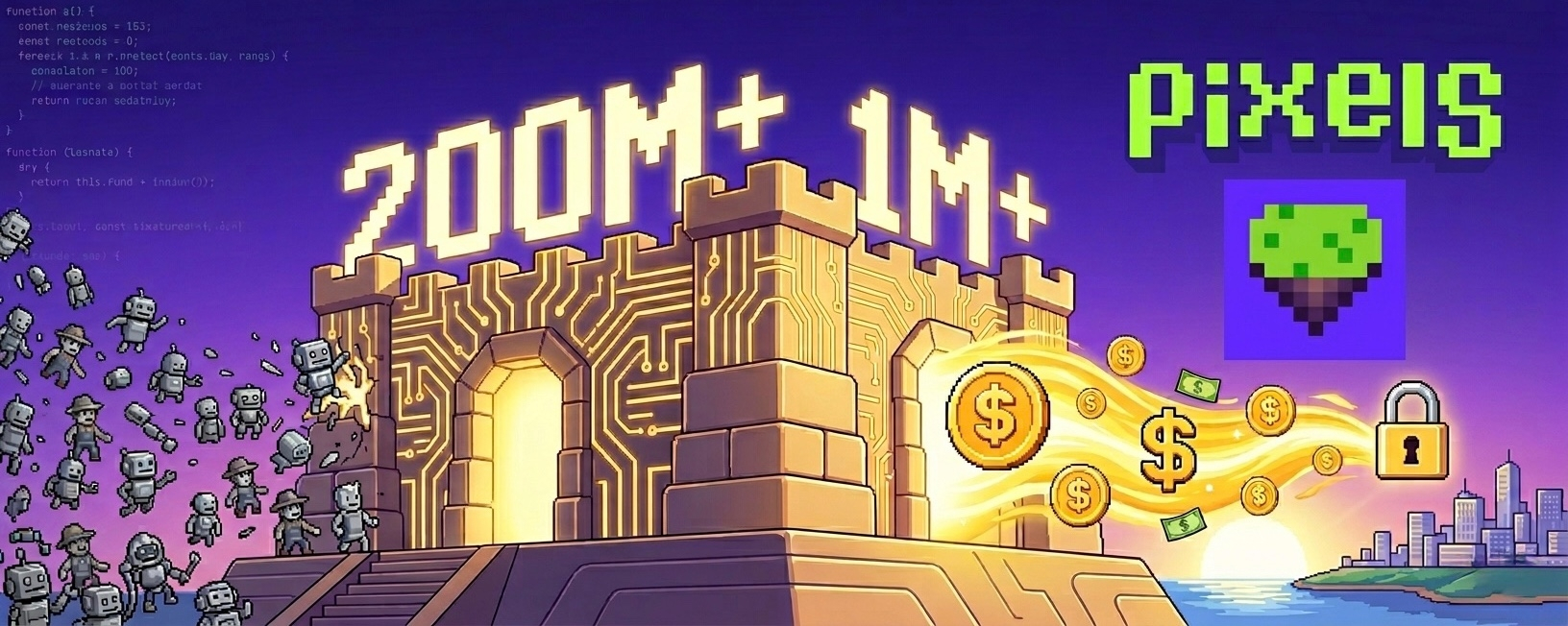
The critical fact about Stacked isn’t the feature set. It’s that the feature set was stress-tested in production — across over 200 million rewards processed, across an ecosystem that hit 1 million daily active users, across four years of adversarial usage involving real bots, real farmers, and real extraction players who were actively trying to break the economy.
That’s the moat. Not the AI layer — any team can build an AI layer. Not the targeting logic — the algorithms are known. The moat is the operational knowledge embedded in four years of live experimentation inside one of the most active Web3 gaming ecosystems ever built.
When Pixels CEO Luke Barwikowski describes Stacked, he says: “We’ve essentially built an AI game economist that any studio can access without needing an entire data science team behind it. This isn’t theoretical tech. It’s in production inside Pixels, and it’s what made us profitable on return-on-reward spend.”
That last phrase is the one I keep returning to. Profitable on return-on-reward spend. That means the revenue generated by players who received targeted rewards exceeded the cost of those rewards. For a Web3 game — where reward emissions have historically been a pure cost center disguised as growth — that’s a genuinely different economic outcome.
Now extend that logic to the B2B context.
Gaming studios globally spend billions on user acquisition every year. The majority of that spend goes to ad platforms — Facebook, Google, Apple, TikTok — that capture the data, keep the targeting intelligence, and deliver installs of varying quality with limited measurement of downstream LTV. The ROI on that spend is increasingly difficult to track as privacy changes erode attribution capabilities.
Stacked offers a structurally different proposition: instead of paying ad platforms to acquire players you can’t measure, redirect that budget directly to the players inside your game, target it with precision against behaviors that actually correlate with long-term retention, and measure the lift in real time across the same system you used to deploy the reward. The data stays in the ecosystem. The value stays with players. The ROI is auditable.
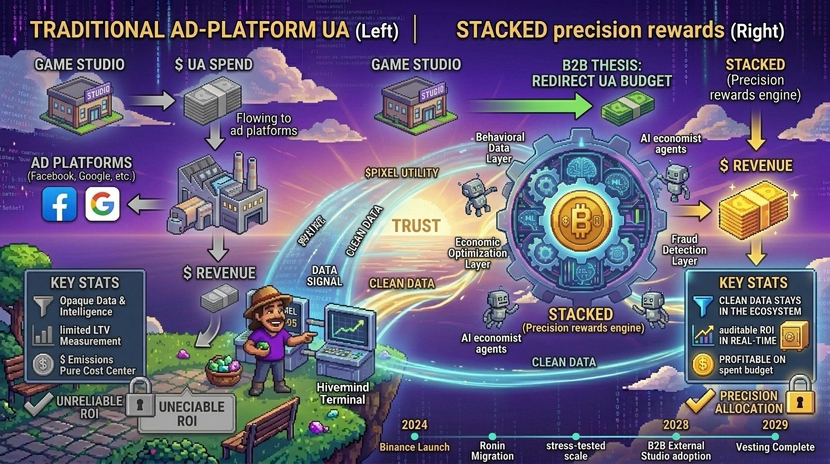
For any studio evaluating this seriously, the pitch is not “here is a cool AI tool.” The pitch is “here is a fundamentally different approach to the economics of player acquisition and retention, built by a team that has already made it work at scale.”
That’s a harder pitch to dismiss than a feature comparison.
The PIXEL implications of this are worth thinking through carefully.
As Stacked opens to external studios, the demand surface for PIXEL expands in a way that’s structurally different from single-game token utility. Each new studio running rewards campaigns through Stacked becomes a potential source of PIXEL demand — either because PIXEL is used as a reward currency directly, or because the cross-ecosystem loyalty layer makes PIXEL useful to players across multiple games simultaneously.
The Binance listing from February 2024 is relevant here. PIXEL is accessible to one of the largest retail trading communities in crypto. As Stacked’s studio count grows, each new integration is a new demand source attached to a token that’s already distributed through Binance’s infrastructure. That’s a different growth vector than most GameFi tokens have access to.
What could slow this down?
B2B infrastructure sales are genuinely slow. Studio decision cycles are long. Technical integration takes time. The first external studios to adopt Stacked will need to show results before a broader wave follows — and that validation process takes months, not weeks. There’s also the question of whether external studios are willing to share the granular player behavioral data that makes Stacked’s targeting actually work. Data privacy considerations vary by jurisdiction and studio culture.
And the broader Web3 gaming market is still in a difficult period. Many studios that might be ideal Stacked customers are fighting for survival, not evaluating new infrastructure investments. The timing of the B2B push matters.
But zoom out from the short-term friction and the structural thesis is clear: a proven, production-grade rewards infrastructure, built by a team with demonstrated operational results, opening to a market that has historically had no good solution to the problem it solves.
The gap between that thesis and the current PIXEL price is the most interesting thing I’ve found in this analysis.
