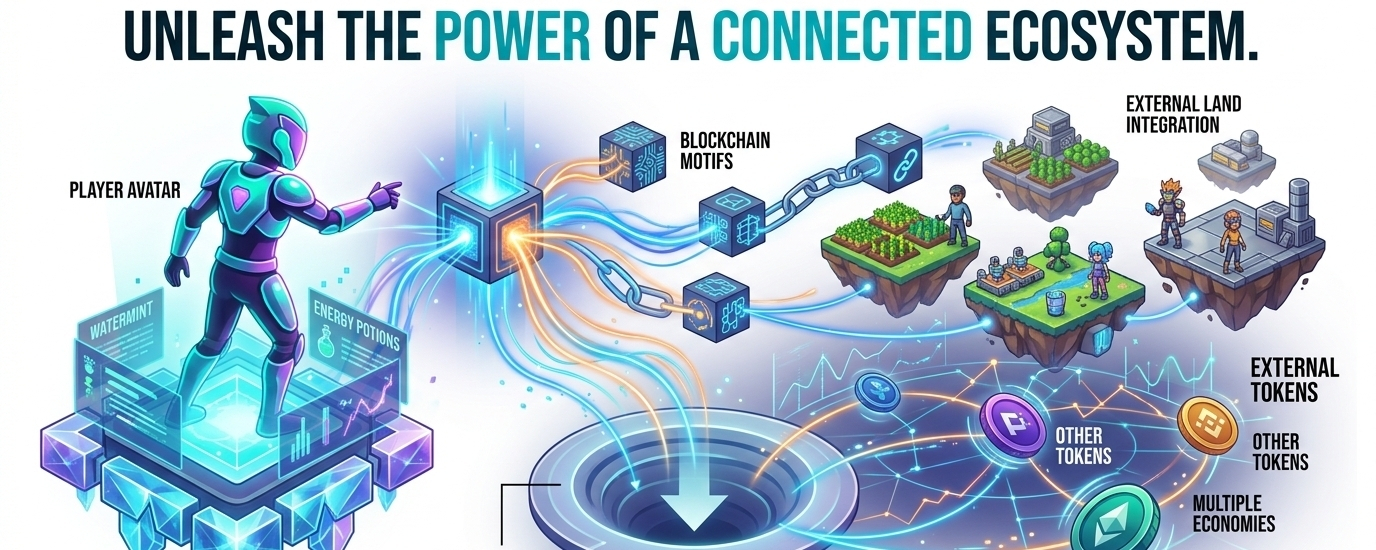
I’ve been around Pixels long enough to remember when everything felt contained. You’d log in, take care of your crops, stack some Watermint, convert it into Energy potions, and repeat. It was simple, predictable even if a bit grindy, you always knew the limits of the system.
Now those limits don’t really exist anymore.
On the surface, it sounds like progress terms like “interoperability” and “open systems” get thrown around. But in reality, it feels more like the game is loosening its own structure and letting external systems plug in freely. Sometimes it works smoothly. Sometimes it doesn’t.
But one thing is clear it’s no longer boring.
External Land Integration: Your Farm Isn’t the Whole Game Anymore
Owning land in Pixels used to be straightforward. You optimized your loop, refined your process, and slowly built efficiency until your farm ran like a machine.
That changes completely when you step into external lands.
Suddenly, your farm isn’t the game it’s just one part of a much larger system. Moving between different lands, especially ones tied to other ecosystems, feels like switching between entirely different playstyles. The pacing shifts, rewards change, and even player behavior feels different.
You’re no longer just optimizing a farm.
You’re choosing where to operate.
And that choice has real consequences. Stay in the wrong loop, and you’re wasting time while better opportunities exist elsewhere.
External Tokens: One World, Multiple Economies
This is where things get complicated.
When everything revolved around one token, at least the risks were clear. Now, with multiple tokens across different systems, the economy feels fragmented.
Each area has its own logic different rewards, different sinks, different outcomes. Some tokens hold value because they’re tied to meaningful use cases. Others inflate quickly, losing value before you can even react.
It creates a strange situation where two players in the same game can have completely different results just based on where they choose to play.
Burn Mechanics. The Line Between Stability and Collapse
The difference between a healthy system and a failing one is simple utility.
If a token has no reason to be spent, it eventually loses value. But when players are forced to reinvest through upgrades, items, or progression the system holds together longer.
You can feel the difference immediately. Some loops stay balanced because they constantly recycle value. Others collapse as soon as supply overwhelms demand.
And the market makes that obvious without needing any explanation.
Identity Now Matters More Than Appearance
Avatars used to be just cosmetic.
Now they signal something deeper.
Choosing a specific identity often means aligning with a particular group or ecosystem. Players cluster, share strategies, and move more efficiently together. Entire areas can feel dominated by coordinated communities rather than random individuals.
It subtly transforms the game from solo play into something closer to faction-based interaction.
The Bigger Shift: This Feels Like More Than Just a Game
At some point, Pixels stopped feeling like a self-contained experience.
It now feels more like a platform where different systems, economies, and communities interact and evolve.
The core gameplay is still there, but it’s no longer the main focus. It’s just the foundation.
On top of that, everything else builds lands, tokens, and player networks, all shaping the experience in real time.
That comes with issues, of course. Bugs, lag, and unstable token loops are still part of the reality.
But it also creates something rare:
Real unpredictability.
Not scripted. Not controlled. Just a constantly shifting environment driven by players and systems.
Most people still play Pixels the old way farming, managing energy, following routines.
And that still works… to a degree.
But that’s not where the real advantage is anymore.
Now it comes down to:
Where you position yourself
Which systems you trust or avoid
And who you align with
Because success here isn’t about doing more work.
It’s about making better decisions.
And that’s a much harder game to play than just farming crops.