
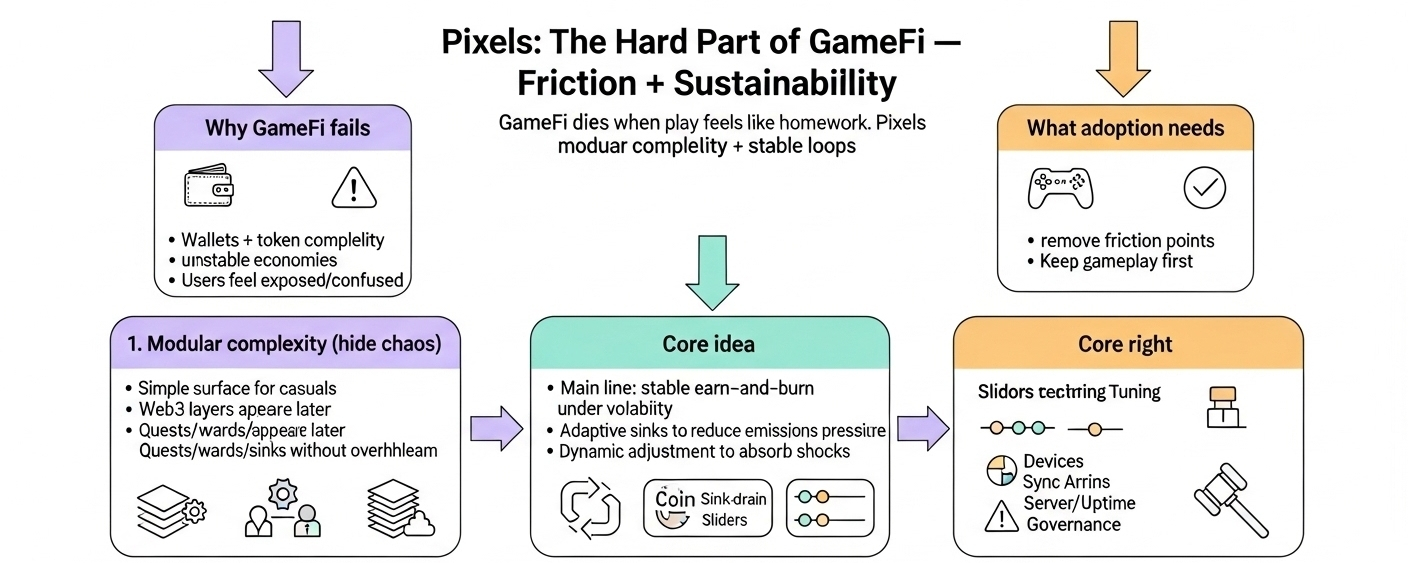


Mainstream GameFi doesn’t really fail because people “don’t like crypto games.” it fails because the experience is full of friction that normal players won’t tolerate. wallets, token complexity, unstable economies, and even device fragmentation turn what should be play into homework. that’s why the hardest part of adoption isn’t just building fun gameplay. it’s removing the points where users feel confused, delayed, or financially exposed.
Pixels seems to be designed with that reality in mind. instead of throwing the full web3 stack at the player upfront, it tries to keep the surface simple and hide the chaos underneath. the idea is modular complexity: quests, rewards, and token sinks exist, but they’re layered so the user doesn’t get overwhelmed. you can interact with the game without constantly feeling like you’re managing a wallet and a market position at the same time.
that design choice connects directly to sustainability. earlier GameFi projects often collapsed under emissions pressure. rewards flowed out, inflation grew, selling pressure piled up, and the ecosystem couldn’t sustain itself. Pixels leans toward controlled reward loops and adaptive sinks, trying to balance earn-and-burn dynamics so the economy doesn’t get eaten alive by its own output. it’s a shift from “pay players and hope” to “pay players, but keep the loop stable.”
but stability isn’t only about tokenomics on paper. any token-based economy gets hit by shocks. market sentiment changes, speculation spikes, then fades. Pixels doesn’t appear to assume volatility will disappear. it relies on dynamic reward adjustment and liquidity balancing to absorb pressure instead of pretending the system can run untouched. that’s more realistic, but it also introduces tension: constant adjustment means the economy is being tuned, and tuning can feel like control.
scale makes the challenge harder. can the game grow across devices and still feel consistent? cross-device compatibility and a hybrid Web2-Web3 architecture can help adoption, but they also introduce synchronization and latency problems that aren’t trivial. if the system feels inconsistent from one device or session to another, users notice quickly. and when thousands of users are online at the same time, you need more than “good servers.” you need coordination across the whole stack.
that’s where infrastructure redundancy becomes critical. uptime systems, fallback nodes, caching layers—boring stuff, but it decides whether a large live game feels reliable or feels broken. scaling isn’t only compute; it’s the ability to keep a consistent experience under load without failures cascading.
the deeper question is governance and bottlenecks. can Pixels evolve into a fully player-driven economy without central choke points quietly creeping back in? that’s the real tradeoff between decentralization and convenience. too much control reduces permissionless freedom. too much openness invites exploitation and collapse. engineering can contain human behavior for a while, but it doesn’t erase it. players optimize loopholes. speculation can overtake gameplay interest. incentives drift toward extraction when the system gets big enough.
so the real test for Pixels isn’t whether it looks engineered today. it’s whether its reward loops stay stable under stress, whether the system can scale across devices without sync pain, and whether it can remain meaningfully player-driven when incentives get pushed to the edge. sustainability in GameFi isn’t a one-time feature. it’s continuous economic psychology tuning, under real market pressure, with real users trying to optimize everything they can.
