
What first caught me about Pixels wasn’t the token or the Web3 angle. It was how normal it felt.
You load in, walk around, plant crops, gather resources, craft a few things, see other players moving through the same world, and for a while it just feels like a light, cozy online game. Not a pitch. Not a finance experiment dressed up as a game. Just a game. And in crypto, that alone is unusual.
That is probably the smartest thing Pixels ever did. It didn’t try to overwhelm people with jargon first. It gave them a loop they already understood. Farm a little, collect a little, upgrade a little, explore a little, come back later. There is nothing revolutionary about that, but there doesn’t need to be. A lot of people don’t want some massive, complicated digital universe. They want something easy to drop into, something that feels familiar, something that gives them a reason to come back without asking too much from them. Pixels understood that better than most blockchain games ever have.
That’s a big part of why it took off.
A lot of Web3 games talk about community, but what they really mean is speculation with avatars. Pixels felt different because the social side was actually part of the experience. The world had a soft rhythm to it. It wasn’t only about earning. It was about hanging around, doing small tasks, following daily routines, and feeling like you were part of a shared space. That sounds simple, maybe even small, but those small things are usually what make online games stick. People don’t always come back for excitement. A lot of the time they come back for comfort.
And for a while, Pixels had real momentum. The numbers around it were huge for blockchain gaming. It wasn’t just another niche project with a noisy community and a token chart. It had actual scale, actual attention, actual traffic. That gave people a reason to treat it as something bigger than the usual crypto game cycle. Suddenly Pixels wasn’t just a decent browser game on Ronin. It was being talked about like evidence that Web3 gaming had finally found its breakout success.
That is where the story starts to get messy.
Because big numbers can hide a lot.
Pixels absolutely proved that crypto incentives can drive attention. It proved that a simple, friendly, low-friction game can attract a huge crowd if the timing is right and the rewards are strong enough. But that is not the same as proving that the model is healthy. It is not the same as proving that people are deeply attached to the game itself. And it definitely is not the same as proving that tokens make the experience better.
That distinction matters.
A lot of the early excitement around Pixels felt like people rushing to declare victory before the hard part had even started. It is easy to celebrate user spikes. It is much harder to build something people still care about once the easy money disappears, once the novelty wears off, and once players start asking whether they actually enjoy the game when the rewards are less exciting.
That is the question every Web3 game eventually runs into. Pixels ran into it too.
To its credit, the team seems to have understood that the old play-to-earn model was not enough. You can see it in the way the game kept adjusting its economy, changing reward flows, rethinking how value moved through the system, and trying to make things more sustainable. That is not flashy work. It is repair work. It is the kind of thing teams do when they realize that if everyone can easily pull value out, the whole structure starts to wobble.
And honestly, I respect that more than the hype.
A lot of crypto projects keep pretending everything is fine until it clearly isn’t. Pixels at least looked like a team trying to fix problems in public. Not always elegantly, not always cleanly, but still trying. There is something more believable about a game that shows its bruises than one that keeps talking like a polished deck for investors.
Still, there is a tension inside Pixels that never really goes away.
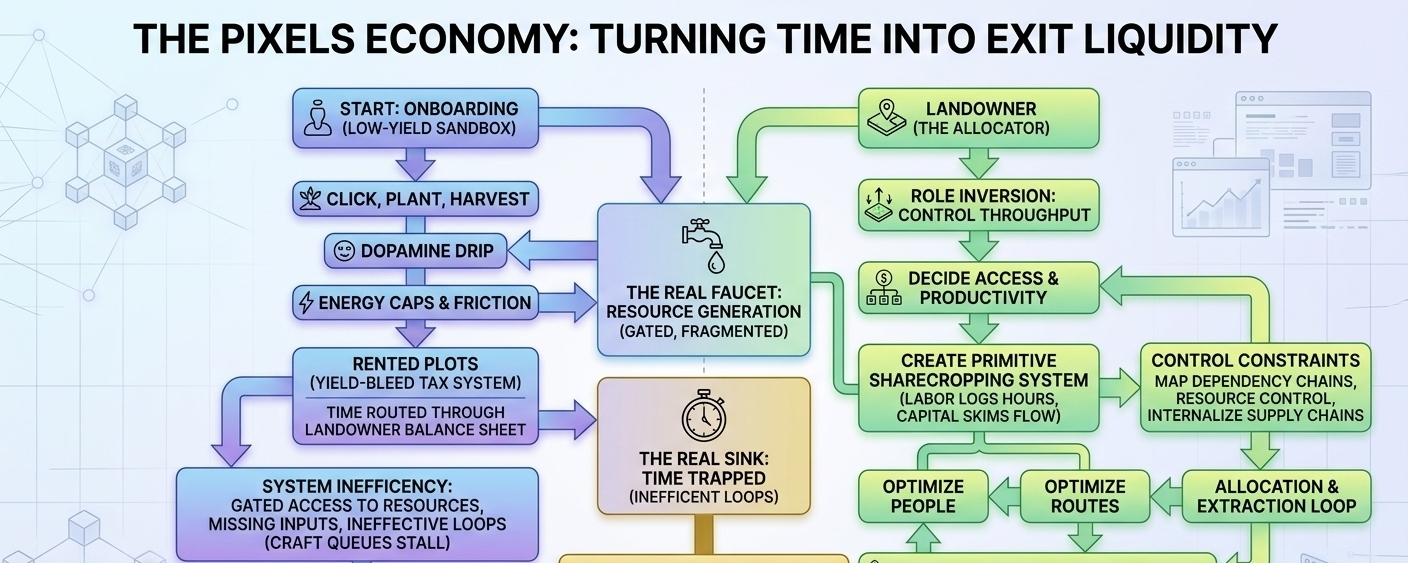
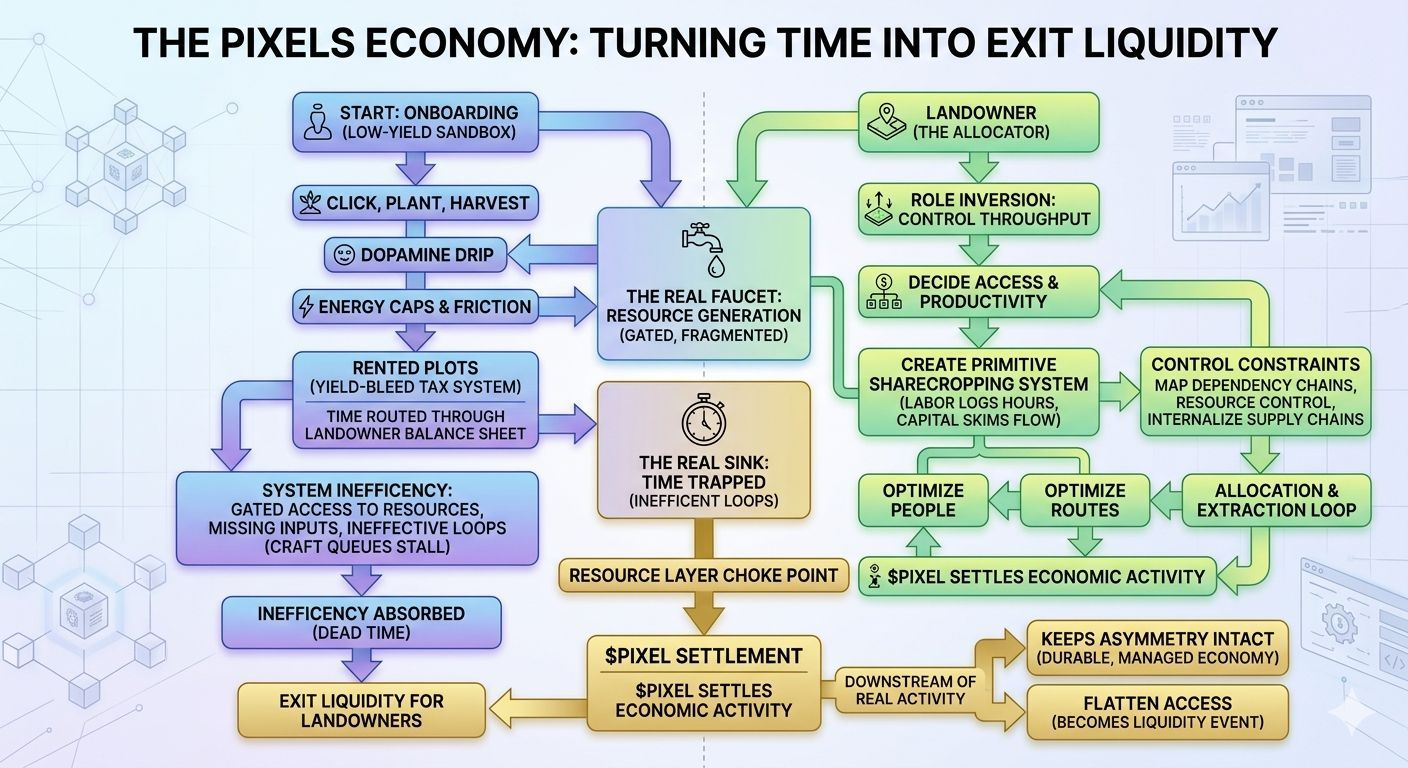
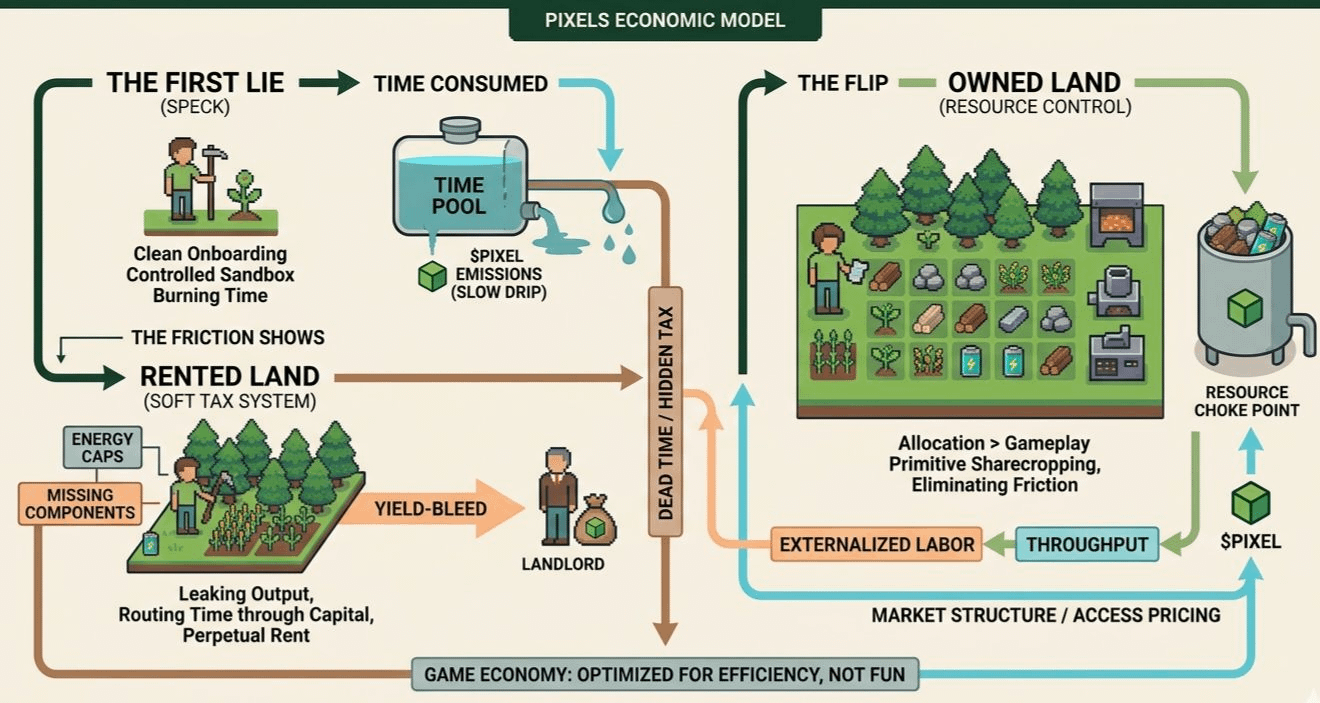
It wants to be a cozy social game. You can feel that in the art, in the farming loop, in the browser-friendly design, in the low-pressure world it tries to create. But at the same time, it also has to act like an economy. It has to think about sinks, rewards, supply, staking, retention quality, token utility, and all the invisible systems that sit underneath the experience. That creates a weird split identity. One side of the game wants you to relax. The other side wants to manage behavior.
That’s where Pixels starts to feel less magical and more engineered.
The problem is not that economics exist. Every online game has economics. The problem is that in Web3, the economics are never really allowed to stay in the background. They shape how players think. They shape how updates are received. They shape expectations. Once people enter a game with earnings somewhere in their mind, even quietly, every change starts to feel different. A balance patch isn’t just a design choice anymore. It can feel like a financial decision. A reward cut doesn’t just annoy people. It makes them feel like something was taken from them. That changes the emotional texture of the whole game.
And once that happens, it is hard to go backward.
That is why I think a lot of the praise around Pixels was too generous. Not because the game did nothing right. It clearly did a lot right. But because people were too quick to treat it as proof that Web3 gaming had solved its biggest problems. It hadn’t. It had simply built a better version of the same struggle.
Even the token tells that story. At one point, PIXEL looked like part of a winning narrative. Now the chart looks more like a reminder of how brutal these cycles are. And that is the danger of tying a game too closely to market emotion. When price is rising, everything looks smarter than it really is. When price falls, people suddenly notice all the weaknesses that were there the whole time.
That doesn’t mean Pixels failed. I don’t think that is fair. If anything, what is interesting about Pixels is that it kept going after the easy narrative broke. That matters. Plenty of projects look strong on the way up. Much fewer are still worth talking about once the excitement cools and the market stops doing half the storytelling for them.
Pixels is still worth talking about because it feels like a real test case. Not a fantasy, not a miracle, not some perfect model for the future. A test case. It shows what happens when a game that is actually kind of likable gets mixed with systems that are much harsher and less forgiving than the world it presents on-screen.
That contrast is what stays with me.
On one level, Pixels is soft, accessible, almost humble. On another, it sits on top of the same pressure that has warped so many blockchain games before it. The push to keep people engaged. The need to protect the economy. The constant balancing act between fun and extraction. The endless fear that if rewards become too weak, attention disappears, and if rewards become too generous, the system breaks.
That is not a small burden for a game built around farming and hanging out.
And maybe that is why Pixels feels more interesting now than it did at peak hype. Back then, it was easy to flatten it into a success story. Today it looks more human than that. More complicated. More uncertain. More honest. It looks like a game still trying to figure out what it really is, and whether it can hold onto the gentle, everyday charm that made people care in the first place while carrying the heavy machinery of a tokenized economy underneath.
I don’t think Pixels is some grand answer to the future of gaming. That always felt like too much. But I do think it accidentally reveals something important. If blockchain games are ever going to work in a lasting way, they probably won’t succeed because players fall in love with token systems. They will succeed only when the blockchain side becomes less intrusive, less loud, less desperate to be admired.
And that is where Pixels still has a chance.
Because the part people actually liked was never the lecture. It was the feeling. The soft routine. The easy return. The quiet sense that you could spend a little time there without needing to justify it.
That is the fragile thing at the center of Pixels. Not the token. Not the hype. Not the metrics.
Just the simple fact that for a moment, it felt nice to be there.
