
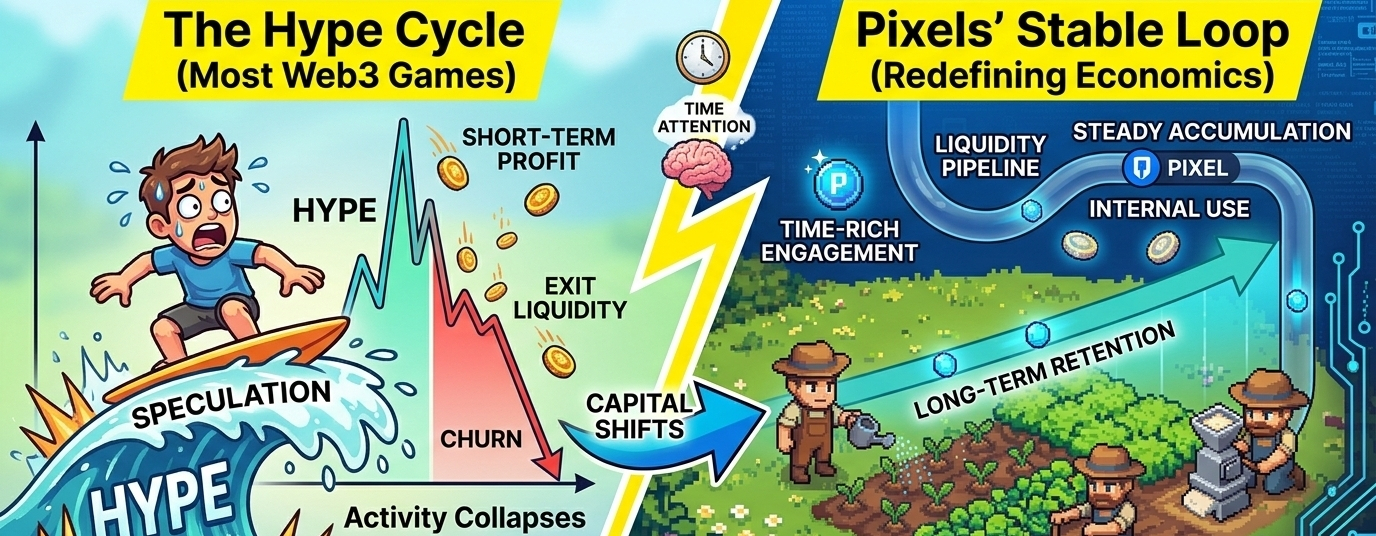
@Pixels #pixel
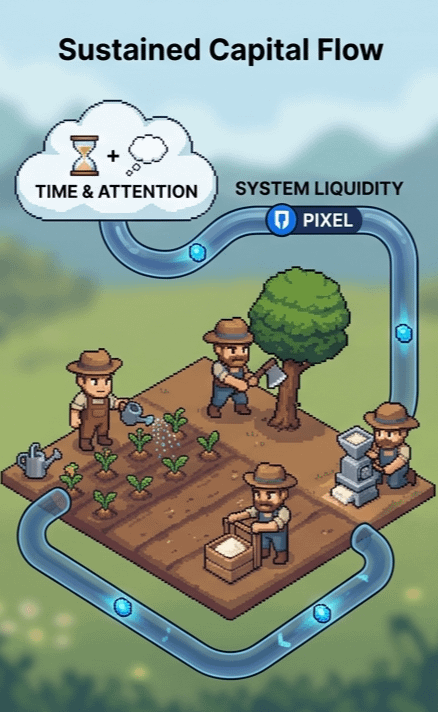
Pixels isn’t intresting because it’s a “Web3 game.” It’s intresting because it quietly solves a liquidity problem most crypto apps never acknowldge: how to keep capital circulating when spculation slows down. In most on-chain systems, activity colapses when price momentum fades. In Pixels, activity persists because the core loop isn’t dependent on token velocity—it’s tied to time, atention, and small-scale resource optmization. That changes how capital behaves inside the system. Instead of chasing upside, users manage flow.
What stands out immediately on-chain is that PIXEL doesn’t behave like a typical emission-heavy game token. You don’t see the usual pattern of aggressive farming followed by rapid dumping. The reason is structural: value extraction isn’t front-loaded. Players don’t just “earn and exit”—they accumulate incremental advantages (land, tools, efficiency boosts) that only make sense if they stay. This delays sell pressure rather than eliminating it, which is a subtle but important distinction. The system isn’t fighting human behavior—it’s redirecting it.
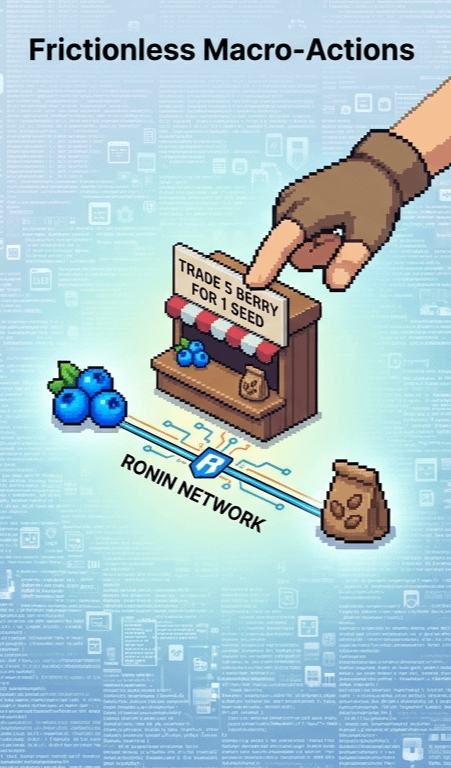
Ronin’s role here is more than just cheap transactions. Ronin Network effectively compresses friction to the point where micro-actions become economically viable. That matters because Pixels relies on high-frequency, low-value interactions. On Ethereum mainnet, this model would collapse under gas costs. On Ronin, those same interactions create a dense behavioral dataset. If you look closely, Pixels isn’t just a game—it’s a machine for generating consistent on-chain activity without requiring constant capital inflow.
The marketplace layer reveals another layer of intent. Most Web3 games treat markets as exit liquidity venues. Pixels treats it as a coordination mechanism. Prices of in-game resources aren’t purely speculative—they reflect time investment, production bottlenecks, and player distribution. When you see price dislocations, it’s often not because of hype, but because of inefficiencies in player allocation. That’s closer to a real economy than a token economy. And it means arbitrage isn’t just financial—it’s behavioral.
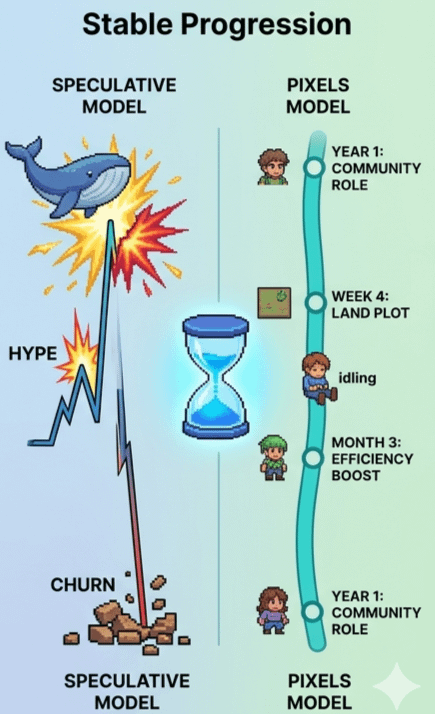
Another overlooked dynamic is how Pixels handles user fatigue. In most play-to-earn systems, fatigue shows up as declining daily active users and falling token demand. In Pixels, fatigue is absorbed into the loop. Players can downshift intensity without fully exiting the system. That creates a soft retention layer—users don’t churn, they idle. From a market perspective, this reduces volatility in both user metrics and token flows. It’s not growth, but it’s stability, and stability is rare in crypto.
From a capital rotation standpoint, Pixels sits in an unusual position. It doesn’t compete with DeFi yields or narrative-driven tokens. It captures a different type of capital—time-rich, attention-based capital that isn’t immediately sensitive to APY or price action. This is the same capital that sustains mobile games, but here it’s partially tokenized. When broader market conditions tighten and speculative flows dry up, systems like Pixels don’t necessarily grow—but they don’t collapse either. They become relative safe zones for engagement.
The real question isn’t whether PIXEL can rally—it’s whether the system can maintain internal balance as external attention increases. Most crypto games break when they succeed. New users distort resource markets, early players extract disproportionate value, and the economy destabilizes. Pixels mitigates this by tying progression to time rather than capital size. You can’t simply buy dominance—you have to operate within the system. That constraint is what keeps the economy from fragmenting under pressure.
There’s also a subtle signaling effect in how Pixels grows. It doesn’t rely heavily on narrative cycles or influencer-driven spikes. Growth is quieter, more organic, and more persistent. That makes it harder to trade, but more interesting to study. When a system grows without needing constant narrative reinforcement, it usually means the underlying loop is doing the work. In crypto, that’s rare.
From a forward-looking perspective, Pixels isn’t trying to become the next major token—it’s trying to become infrastructure for a specific type of on-chain behavior. If it succeeds, the value won’t come from speculation alone, but from the consistency of activity it generates. And in a market that’s increasingly selective about where attention goes, consistency is starting to matter more than hype.
Most traders look for volatility. Systems like this reward those who notice stability before it becomes obvious.
The edge isn’t in chasing what’s moving—it’s in recognizing what refuses to break.
