
XRP has always had a way of sitting right on the edge between strength and hesitation, and right now it feels like the market isn’t fully convinced in either direction. The price isn’t collapsing, but it’s also not showing the kind of follow-through that turns a bounce into a real trend. That in-between state is where things get interesting, because it often reveals what’s happening underneath the surface.
One of the more telling signals comes from the XRP Ledger itself. Exchange reserves holding around 2.76 billion during a period of price softness isn’t something to ignore. When reserves stay elevated while price drifts or weakens, it usually means supply is building up where it can be sold quickly. Earlier cycles often showed reserves and price moving together, which made rallies cleaner and more sustainable. That relationship now looks disconnected, and that shift matters more than the raw numbers.
A similar pattern shows up on Binance, where a significant portion of XRP supply remains on the exchange even as price action struggles. When tokens sit on exchanges instead of being moved into private wallets, it typically signals readiness rather than conviction. In simple terms, more coins are within reach of the sell button. That doesn’t guarantee immediate selling, but it does create an environment where upward moves face friction sooner than expected.
The behavior of larger holders adds another layer to this picture. Data from CryptoQuant points to repeated spikes in whale-to-exchange flows, with some bursts climbing above 40,000 and even approaching 60,000 in previous instances. These aren’t random movements. When whales move assets onto exchanges, it often reflects preparation to distribute rather than accumulate. The timing is also telling, as these inflows have frequently aligned with price pullbacks or stalled recoveries.
That combination steady reserves, elevated exchange supply, and increased whale inflows creates a kind of invisible ceiling. Even when price starts to push upward, there’s a layer of supply waiting above, ready to absorb momentum. This is why rallies can look promising at first but then lose energy quickly. It’s less about a lack of buyers and more about a constant stream of sellers stepping in at higher levels.
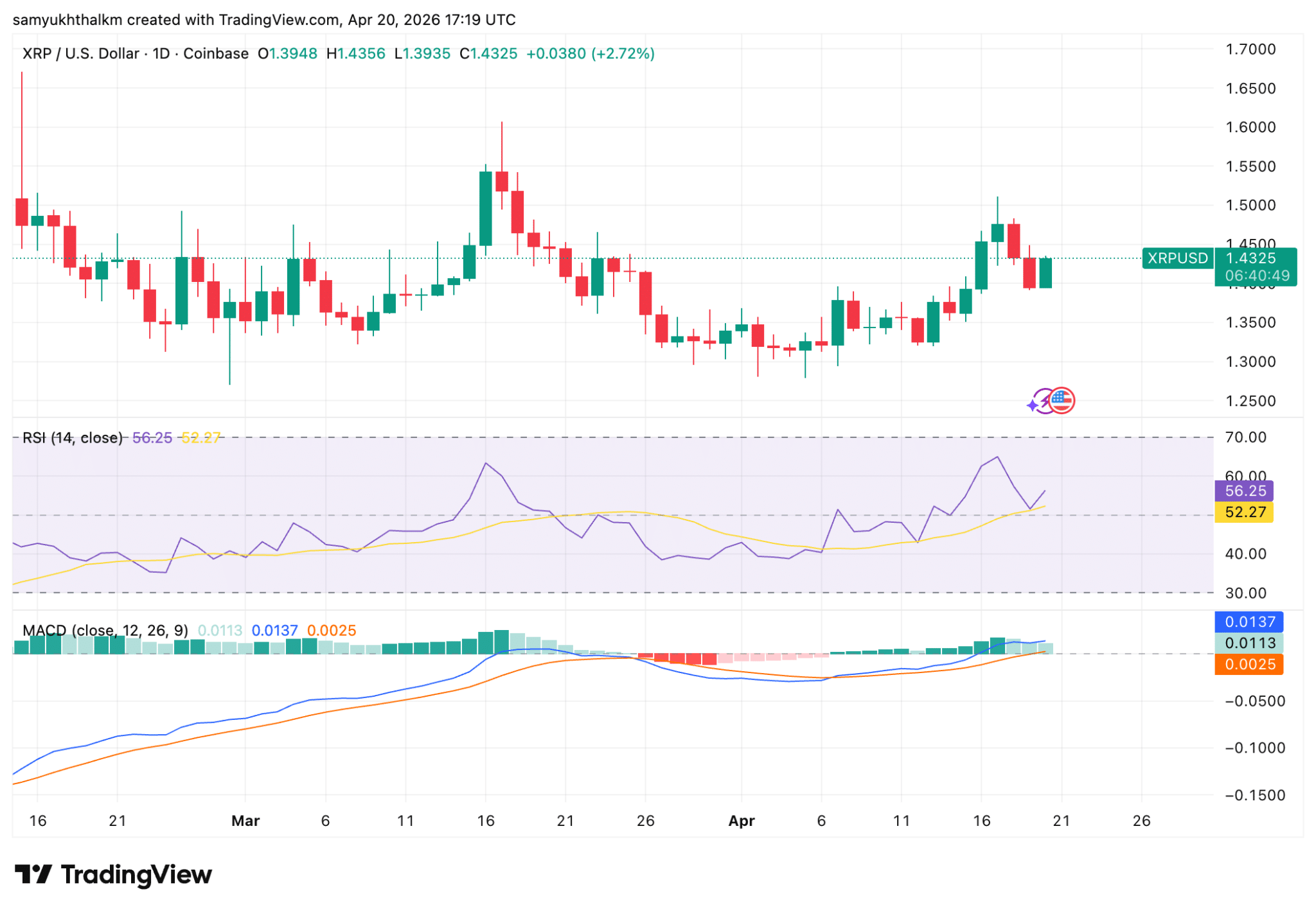
At the same time, the market isn’t entirely weak. A move back toward the mid-$1.40 range, along with improving technical indicators like RSI climbing above neutral and a bullish MACD crossover, shows that buyers are still active. The issue is that this strength feels tentative. It’s not the kind of aggressive demand that clears out overhead supply; it’s more like cautious participation, stepping in but not committing heavily.
That hesitation is what defines the current phase. XRP isn’t breaking down, but it’s also not escaping the weight above it. The structure suggests that any meaningful upside will likely require a shift in one key factor: a reduction in exchange-held supply. Without that, rallies risk becoming short-lived reactions rather than sustained moves.
What makes this situation particularly notable is how it contrasts with earlier behavior. In past cycles, when XRP started to move, it often did so with clearer alignment between on-chain data and price action. Now, those signals feel mixed. Strength in indicators is being offset by supply dynamics that lean bearish, and that tension is keeping the market stuck in a narrow range.
For now, XRP sits in a fragile balance. There’s enough support to prevent a sharp drop, but not enough conviction to drive a strong breakout. Until that balance shifts either through declining reserves or a clear surge in demand this pattern of hesitant rallies and quick resistance is likely to continue.