
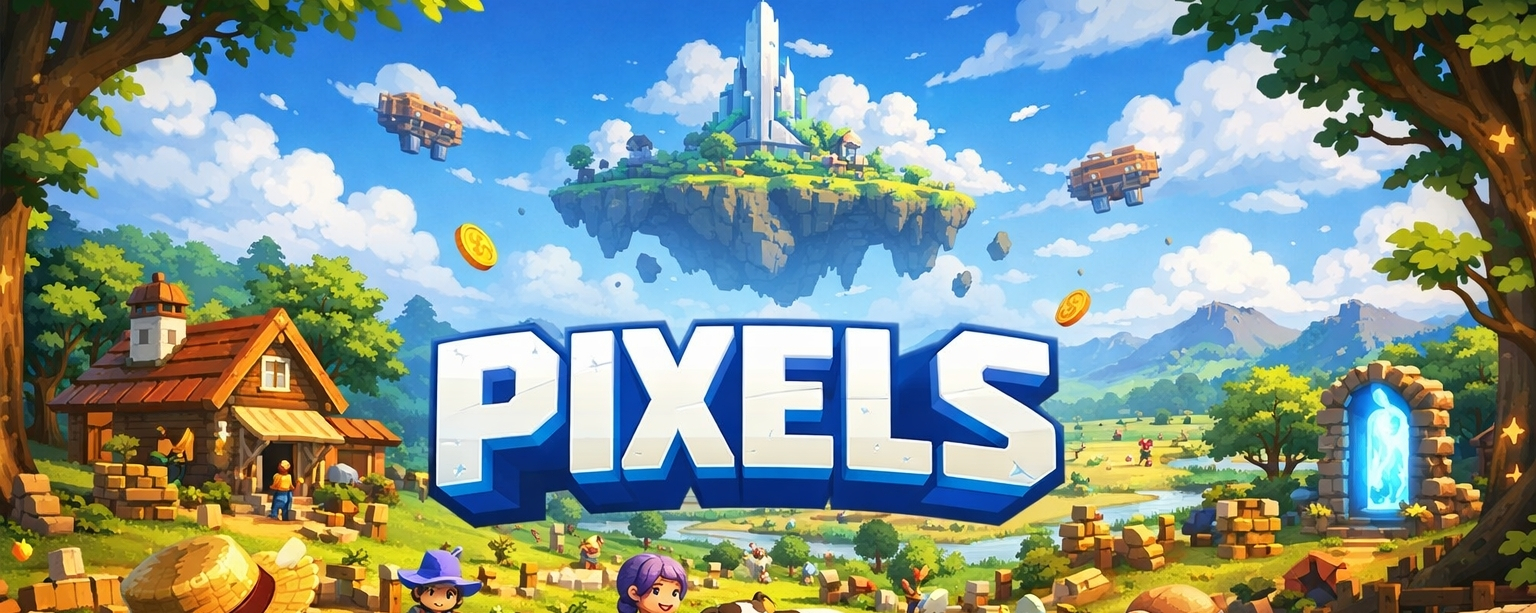

I’ve been around long enough in crypto to recognize when something feels familiar before I can fully explain why. That sense crept in the first time I opened Pixels (PIXEL), the social farming game built on the Ronin Network. At a glance, it looks approachable almost disarmingly simple. Bright visuals, low barrier to entry, a loop that revolves around planting, harvesting, crafting, and interacting. It doesn’t try to overwhelm you with complexity upfront, and that’s probably intentional.
But simplicity in crypto is rarely just simplicity. It’s usually a design decision shaped by deeper trade-offs.
So I spent some time in Pixels not just playing, but observing how it’s structured, what it’s really trying to do, and whether it actually addresses anything meaningful beyond the surface-level appeal of “a Web3 farming game.”
What struck me early on is that Pixels isn’t trying to reinvent gaming mechanics. If anything, it leans into familiarity. It feels closer to something like Stardew Valley than a typical blockchain-native experience. And maybe that’s the point. Instead of forcing players to adapt to crypto-first logic wallet friction, token obsession, speculative gameplay—it tries to invert that equation. The game comes first, and the blockchain layer sits quietly underneath.
That’s a subtle shift, but not a trivial one.
Most Web3 games I’ve seen over the years start with tokenomics and build gameplay around it. You can almost feel the economic model shaping every mechanic: rewards, scarcity, grind loops, asset ownership. Gameplay often ends up feeling like a thin wrapper around a financial system. Pixels, at least on the surface, seems to resist that instinct. It prioritizes interaction and progression in a way that feels more like traditional gaming design.
Still, I can’t help but ask: is this a genuine shift, or just a softer presentation of the same underlying structure?
Because once you spend more time in the game, you start to notice the familiar patterns creeping in. There’s still an economy. There are still incentives tied to token accumulation. There’s still an implicit expectation that time spent in the game can translate into value whether that’s through resources, assets, or the PIXEL token itself.
And that’s where things get complicated.
The core problem Pixels seems to be addressing is one that the crypto gaming space has struggled with for years: how do you create a game that people actually want to play, not just one they want to profit from? It sounds obvious, but it’s been surprisingly elusive. The industry has cycled through countless “play-to-earn” experiments, most of which collapsed under their own economic weight. Players came for the rewards, not the experience. And when the rewards dried up, so did the player base.
Pixels appears to be attempting a different angle—something closer to “play-and-earn,” though even that phrasing feels loaded. The idea is to make the game engaging enough that the economic layer becomes secondary, almost optional. If you enjoy the farming, the exploration, the social interactions, then maybe the token incentives don’t have to carry the entire system.
In theory, that’s a more sustainable approach.
But theory and reality don’t always align, especially in crypto.
What makes this problem important is that it sits at the intersection of two very different cultures. Gaming, at its core, is about immersion, creativity, and often escapism. Crypto, on the other hand, tends to revolve around ownership, speculation, and financialization. When you try to merge the two, something often breaks. Either the game becomes too transactional, or the economic layer becomes irrelevant.
Pixels is navigating that tension in a way that feels more measured than most. It doesn’t aggressively push monetization in your face. It doesn’t bombard you with token mechanics from the start. Instead, it lets you ease into the experience. That alone sets it apart from many projects that feel like they’re trying to onboard you into a financial system disguised as a game.
But I’m still not entirely convinced that the underlying dynamics are fundamentally different.
Because at some point, the question always comes back: why does this need to be on-chain?
That’s not meant as a dismissal. It’s just a question I’ve learned to ask repeatedly. In the case of Pixels, the answer seems to revolve around ownership and interoperability. Your assets exist on-chain. Your progress has a persistent identity. There’s a broader ecosystem especially given its connection to Ronin that could, in theory, allow for more composability across games.
That’s the promise, at least.
And it’s a compelling one. The idea that your in-game efforts aren’t locked into a single environment, that they have some form of permanence or portability that’s something traditional games don’t offer. But it’s also a promise that has been made many times before, often without meaningful follow-through.
What feels different here is less about the promise itself and more about the execution environment. Ronin has already gone through cycles of success and failure, particularly with Axie Infinity. That history matters. It means the team behind the ecosystem has seen what happens when a game becomes overly dependent on speculative inflows. They’ve seen how quickly things can unravel when the economic layer outpaces the gameplay.
So Pixels exists in a kind of post-Axie landscape. It’s shaped by lessons learned, whether explicitly or implicitly.
You can feel that in the design choices. The pacing is slower. The onboarding is smoother. The focus on social interaction feels more intentional. It’s not just about grinding for rewards; it’s about existing in a shared space. That might sound like a small detail, but it changes the tone of the experience. It makes the game feel less like a job and more like a place.
Still, there’s an underlying tension that doesn’t fully go away.
Crypto has a way of pulling systems toward financialization, even when they start with more balanced intentions. Players begin optimizing for returns. Communities shift toward discussions about token price rather than gameplay. Developers face pressure to maintain economic incentives, sometimes at the expense of long-term design integrity.
I’ve seen this pattern repeat enough times that it’s hard not to expect it.
Pixels hasn’t escaped that gravity entirely. There’s already a layer of speculation around the PIXEL token. There are strategies emerging around resource optimization and yield. None of this is surprising—it’s almost inevitable. The question is whether the game can maintain its identity in the face of those pressures.
That’s where my skepticism comes in, not as a critique of Pixels specifically, but as a reflection of the broader industry.
Because the industry often gets one thing wrong: it assumes that adding economic incentives will enhance engagement. In reality, it often distorts it. When players are motivated primarily by financial outcomes, the nature of the experience changes. It becomes transactional. And once that happens, it’s very difficult to go back.
Pixels seems aware of this risk, at least to some extent. Its design leans toward intrinsic motivation—progression, creativity, social interaction—rather than purely extrinsic rewards. But whether that balance can hold over time is an open question.
Another thing I find myself thinking about is accessibility. One of the barriers to Web3 gaming has always been friction—wallets, transactions, onboarding complexity. Pixels does a relatively good job of minimizing that friction. You can get into the game without feeling like you’re navigating a financial protocol. That’s important. It lowers the barrier for people who might not otherwise engage with crypto.
But accessibility cuts both ways.
If the game becomes too detached from its blockchain elements, then the value of being on-chain becomes less clear. If, on the other hand, those elements become more prominent over time, the experience risks becoming more complex and less approachable. Finding the right balance is tricky, and it’s not something that can be solved once and for all. It requires constant adjustment.
As I spend more time with Pixels, I don’t come away with a definitive conclusion. Instead, I’m left with a mix of cautious optimism and lingering doubt.
On one hand, it feels like a step in a better direction. It’s more grounded than many of the projects that came before it. It respects the idea that a game should be enjoyable on its own terms. It doesn’t rely entirely on speculative hype to attract attention.
On the other hand, it still operates within the same broader framework that has produced so many fragile systems. The presence of a token, the emphasis on ownership, the connection to a larger ecosystem—all of these introduce variables that can shift the experience in unpredictable ways.
Maybe that’s the nature of this space.
Crypto projects rarely exist in isolation. They’re part of a larger narrative, one that evolves through cycles of experimentation, failure, and iteration. Pixels feels like one of those iterations—a response to what came before, rather than a complete departure from it.
And perhaps that’s enough, at least for now.
I don’t think Pixels is trying to solve everything. It’s not positioning itself as the definitive answer to Web3 gaming. Instead, it seems to be exploring a narrower question: can you build a game that people enjoy, while still incorporating blockchain elements in a way that doesn’t dominate the experience?
That’s a more modest goal than what we’ve often seen in this space. And in some ways, it’s a more honest one.
Whether it succeeds is still uncertain. A lot will depend on how the game evolves, how the community behaves, and how the economic layer is managed over time. These are not trivial challenges. They’re the same challenges that have tripped up many projects before.
But for now, walking through Pixels feels different enough to be worth paying attention to. Not because it’s revolutionary, but because it’s trying quietly, cautiously lto do things a little differently.
And in a space that often chases extremes, that restraint might be its most interesting quality.
