
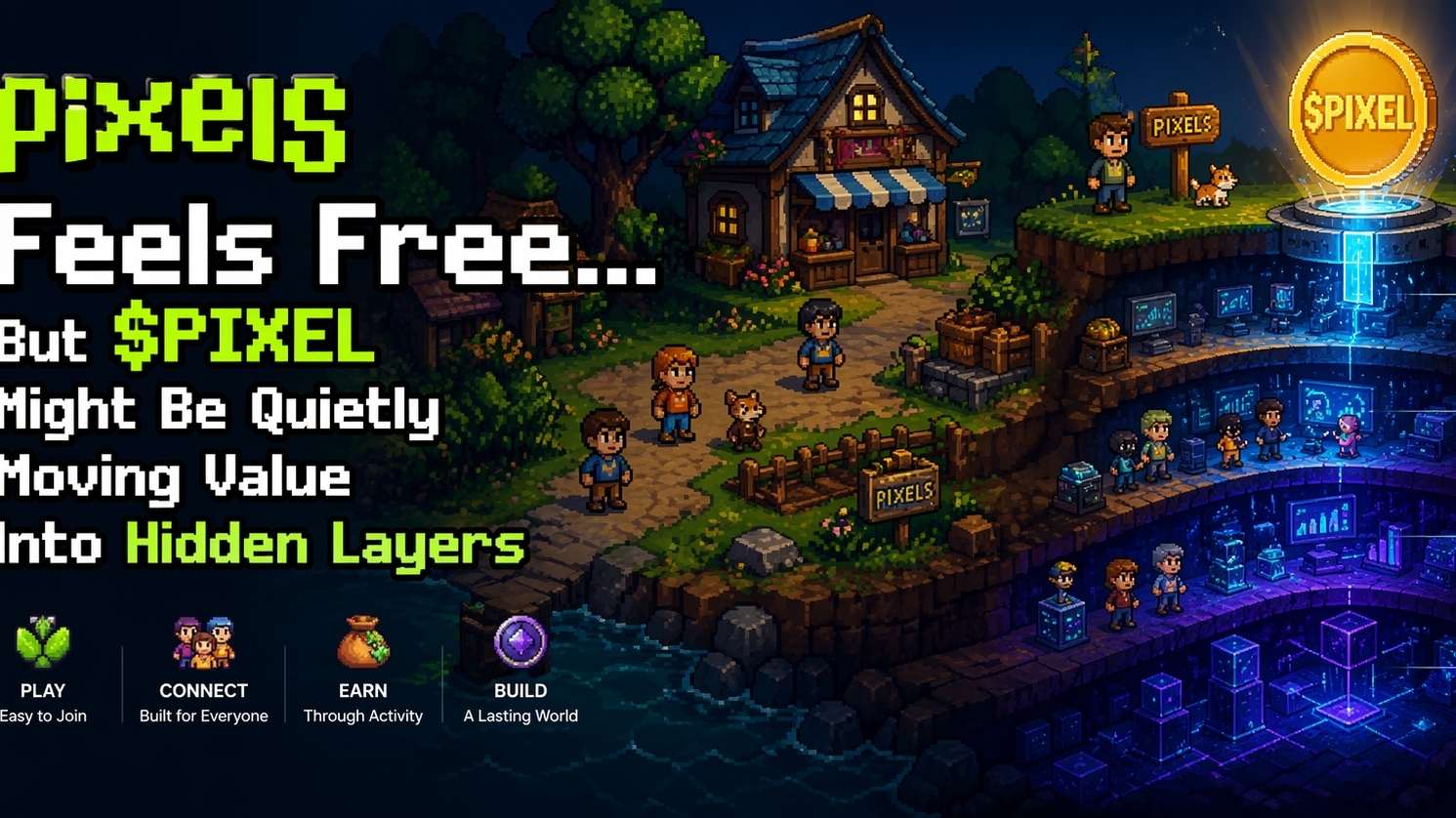

Pixels is what I keep coming back to lately. I’m watching it not because it’s loud or trying to prove something, but because it feels quiet in a space that usually isn’t. On the surface, it looks simple—just a soft, easy game where people farm, explore, and spend time. But I’ve been around long enough to know that when something feels this easy, there’s usually more going on underneath. I’m not looking at it as just a game. I’m looking at what it’s trying to do with people’s time.
What makes Pixels interesting to me is how it doesn’t immediately push the usual crypto narrative. The token is there, but it’s not screaming for attention. Instead, the focus feels like it’s on getting people to show up, interact, and stay. That sounds basic, but it’s actually one of the hardest problems in this space. I’ve seen too many projects attract users with rewards, only to lose them when those rewards slow down. So the real question isn’t how many people are playing right now—it’s whether they would still be here if the incentives felt smaller or less obvious.
I keep thinking about how value works inside something like this. In a lot of crypto projects, value is loud and visible—it’s in charts, prices, and speculation. Here, it feels quieter, almost like it’s being tucked into the background. Maybe it’s in the way people spend time, or how they build routines, or how they interact with each other. But that only matters if those actions mean something beyond the system itself. If people are just moving through tasks because there’s a reward at the end, then it’s not really value—it’s just a loop.
There’s also a bigger idea here that I can’t ignore. Across crypto and even AI, everyone is trying to figure out how to keep people engaged without forcing it. How do you create something open, where people choose to participate, but still give it enough structure to hold together? Pixels feels like it’s experimenting with that. It’s trying to make participation feel natural, almost effortless. But that balance is delicate. If it leans too much on rewards, it becomes predictable. If it removes them too much, people may stop caring.
What I’m really watching is whether Pixels can become something people return to without thinking about it too much. Not because they expect a payout, but because it feels like part of their routine. That’s when a system starts to feel real. That’s when it moves beyond being just another project and becomes something people actually live inside, even in a small way.
I’ve seen this space get distracted by numbers too often—user counts, volume, token movement. Those things matter, but they don’t tell the full story. The real signal is quieter. It’s in whether people stay when things slow down, when the excitement fades, when there’s nothing new being announced. That’s where most projects lose their shape.
Pixels might be trying to avoid that by keeping things simple on the surface while building something deeper underneath. Or it might just be another version of the same cycle, just presented in a softer way. It’s still early, and I don’t think the answer is clear yet.
But I’m paying attention. Because if Pixels does figure this out—if it finds a way to turn time and participation into something that actually lasts—it won’t be obvious at first. It will show up slowly, in how people behave, in how often they come back, and in whether the system still makes sense even when no one is talking about it anymore.