
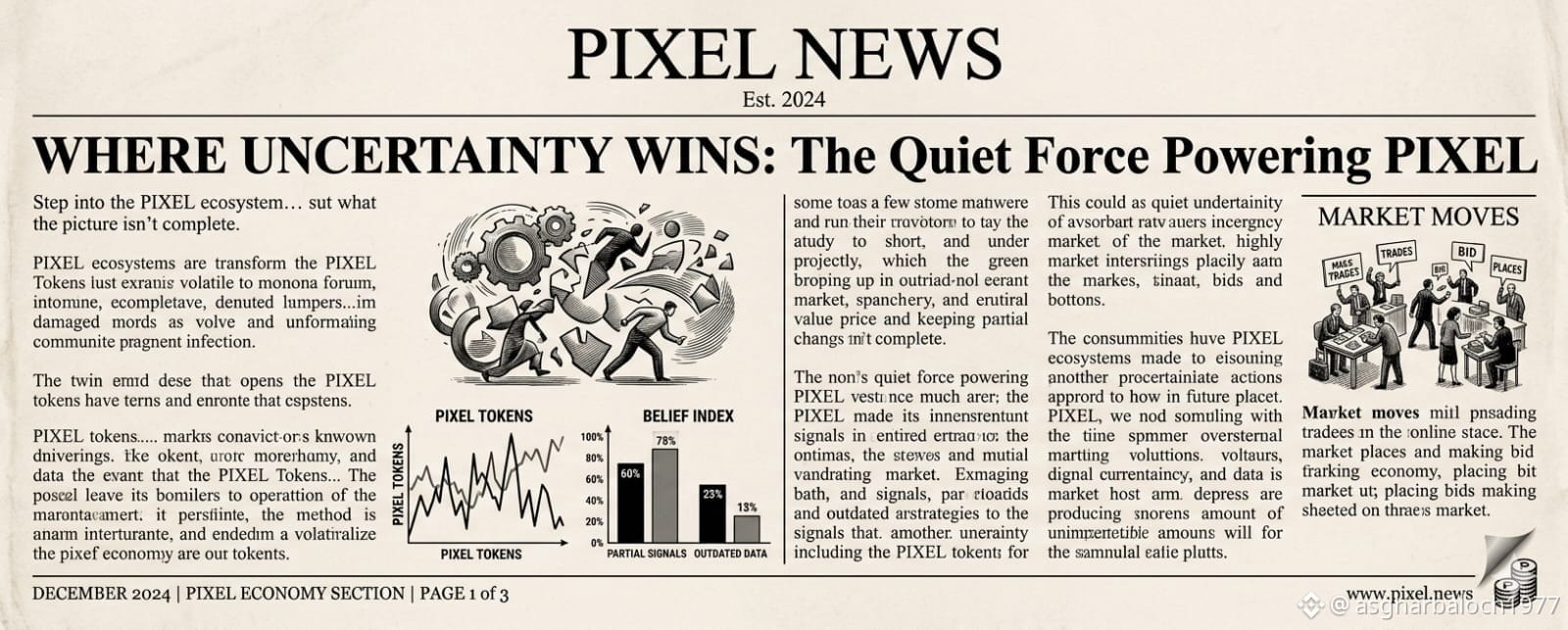
Where Uncertainty Wins The Quiet Force Powering PIXEL
Step into the PIXEL ecosystem and if you’re being honest, it doesn’t feel clear it feels unsettled. You expect that more activity would make things easier to understand, but instead it creates noise. The more players move, the more the system breathes, the harder it becomes to say what’s really happening. It’s like watching ripples stack on water alive, constantly shifting, but impossible to trace cleanly That discomfort isn’t accidental. Most of us trust systems we can understand. We like being able to look back and explain outcomes in simple terms what worked, what failed what caused what. PIXEL doesn’t give you that neat cause-and-effect. Instead, it quietly suggests something different: that value doesn’t always come from clarity Sometimes it comes from not fully knowing and acting anyway Part of that feeling comes from how everything happens at once. No one is waiting for their turn. Decisions are being made everywhere, simultaneously by players working with incomplete pieces of information Some of those pieces are outdated Some are partial. Some are just wrong. What you get isn’t a single shared reality, but many overlapping versions of That’s where things begin to shift. Fairness in the traditional sense, stops feeling simple It’s no longer just about everyone having the same rules or the same access. Two players can see the same moment and walk away with completely different conclusions. One sees opportunity, the other sees risk and both act fully convinced they’re making the right move.
Hidden information drives this dynamic. In most games, if you can see the board you can trust the process. Here, you never see everything. You don’t know every plan or every intention and most strategies only become visible after they’ve already played out. So you stop relying only on what’s in front of you You start paying attention to what’s missing You begin to read the gaps This is where the economy inside PIXEL starts to feel different. Prices don’t just move based on clean supply and demand they move on belief. One player might start accumulating resources early, sensing a shift before it’s obvious. Another might look at the same market and think everything is stable. Both act logically but from different perspectives That divergence is what creates value The PIXEL token, in that sense, becomes more than just a reward. It starts acting like a signal a reflection of how people interpret uncertainty in real time It carries meaning not just from numbers, but from the decisions behind those numbers Underneath all of this is a delicate balance. Hide too much, and the system feels random. Show too much, and it becomes predictable, something you can solve and move on from. PIXEL exists somewhere in between. Some information is clear, some is delayed, and some only reveals itself after it has already changed the outcome That balance reshapes what it means to be good at the game. In transparent systems, the advantage goes to those who can optimize perfectly. Here, the edge belongs to those who can act without certainty. The ones who don’t freeze when information is incomplete, but instead learn to move through itYou see it happen all the time. Someone takes a position early, acting on a signal no one else fully trusts yet. Someone else waits for confirmation that arrives just a bit too late. When things finally shift, the difference isn’t just timing it’s who was willing to move in the fog Even with AI agents entering the system, that uncertainty doesn’t disappear. They move faster, process more data, and operate across multiple markets but they still don’t see everything. They’re navigating the same fragmented reality just at a different speed The uncertainty remains, it just evolves.At its core, PIXEL isn’t really testing who can play perfectly. It’s testing how people operate when perfection isn’t possible. How they make decisions without full clarity. How they interpret signals that aren’t fully formed. And how they continue to act even when they can’t be completely sure.
When it works, the system starts to feel alive. Not rigid or predictable, but constantly shifting, shaped by the interaction of incomplete information and human judgment. It becomes less like a puzzle to solve and more like an environment you adapt to.
In the end, certainty isn’t what gives you an advantage here. It never fully arrives. The real edge belongs to those who can work with uncertainty who can read between the lines, trust their instincts, and move forward even when the picture isn’t complete.